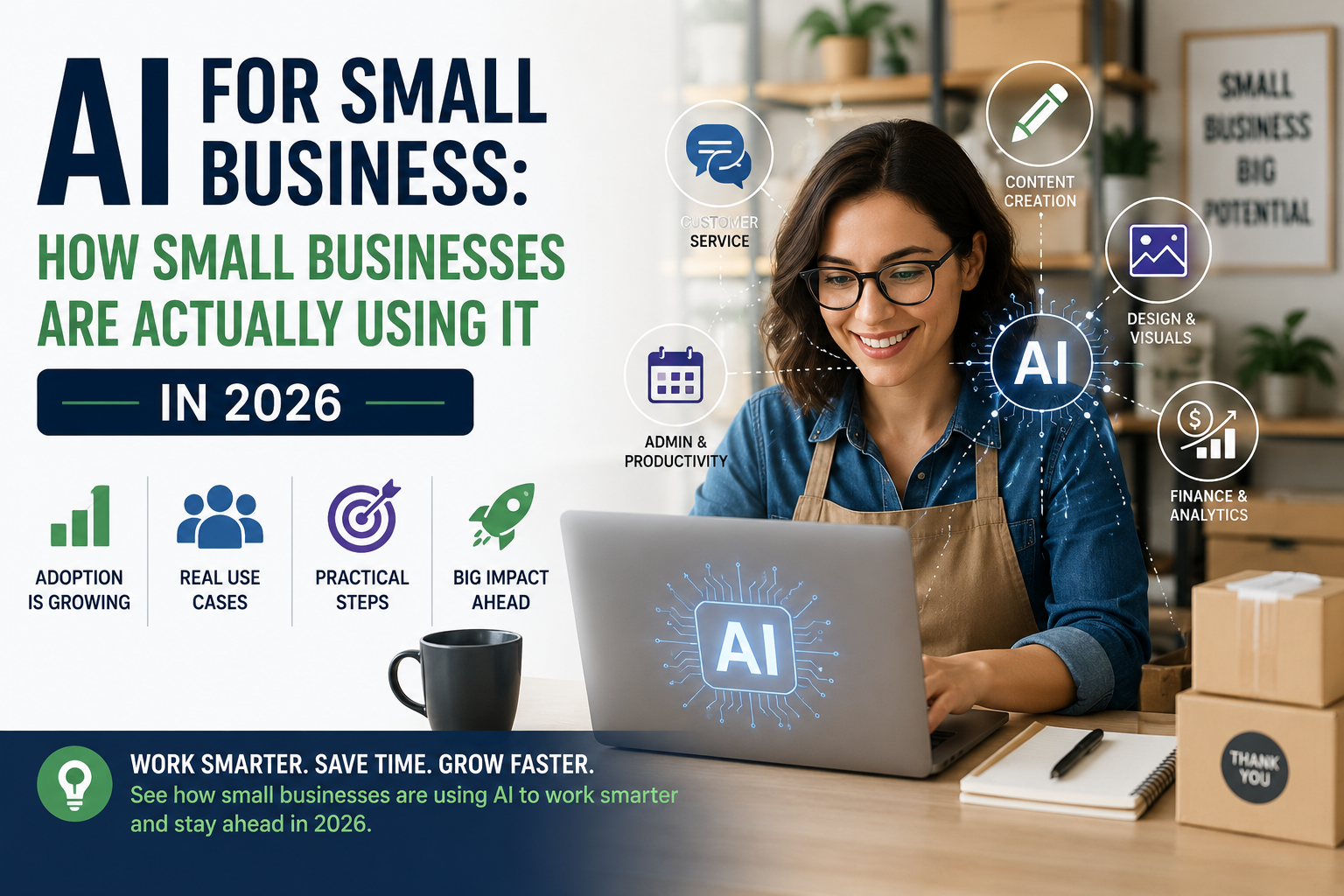
AI for small business stopped being a “someday” project a while ago. In 2026, it’s simply part of how work gets done — quietly running inside email tools, customer chats, scheduling apps, and marketing dashboards that small business owners already use every day. The question business owners are asking has changed too. It’s no longer “should I use AI?” It’s “where is it already saving me time, and where am I still behind?”
This isn’t hype. The data backs it up, and so does what’s actually happening inside small businesses right now.
Table of Contents
Why AI for Small Business Has Crossed a Tipping Point
A few years ago, AI adoption among small businesses was slow and experimental. That’s changed fast.
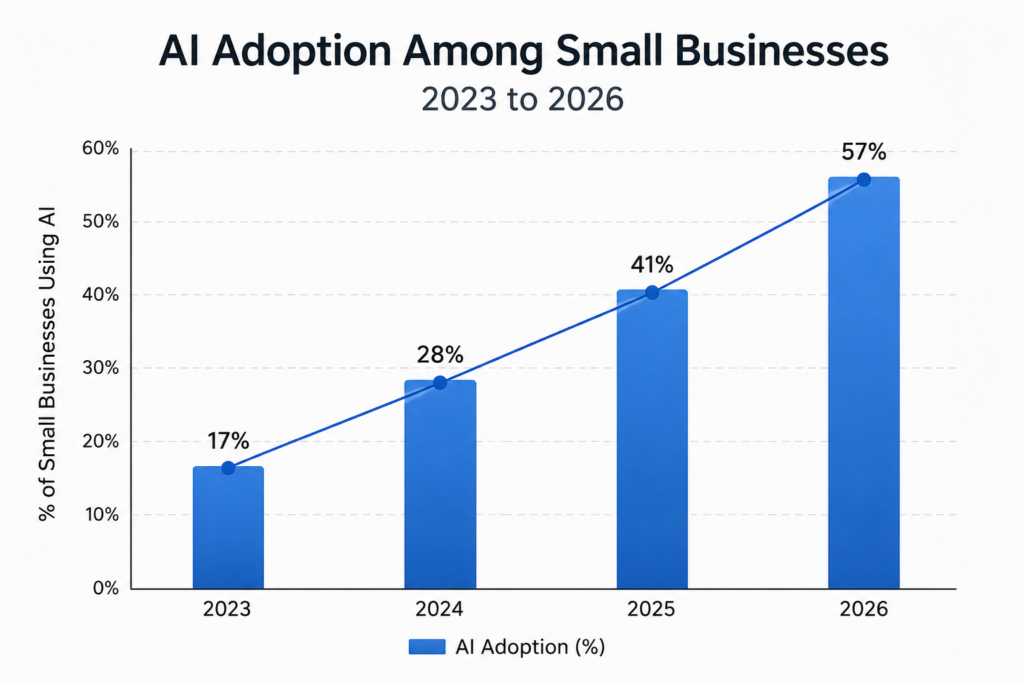
According to Intuit QuickBooks’ ongoing small business surveys, regular AI usage climbed from under half of U.S. small businesses in mid-2024 to over three-quarters by early 2026. Separately, the U.S. Chamber of Commerce’s 2026 Small Business Survey found that the vast majority of small businesses now use AI in some capacity — a sharp jump from just over a third in 2023.
The financial case is part of what’s driving this. Research cited by Salesforce found that the great majority of small businesses using AI report revenue increases. Business.com’s 2026 research puts the average time savings at around 5.6 hours a week for small business owners, with some managers saving well over 7 hours weekly.
That’s the headline. But the more useful question is how — what are small businesses actually doing with AI day to day?
How Small Businesses Are Actually Using AI in 2026
Adoption numbers only tell half the story. The more revealing data is where small business owners are actually spending their AI hours.
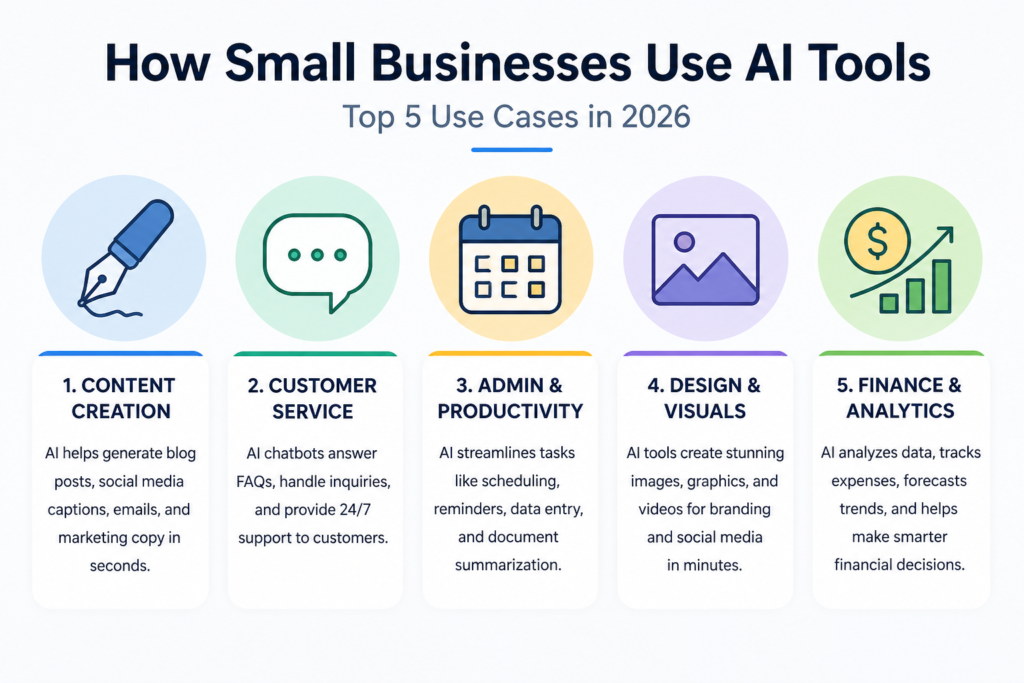
1. Content and Marketing
This is, by far, the biggest use case. Most AI-adopting small businesses now use AI writing and content tools for blog posts, product descriptions, social captions, and email campaigns. It’s the easiest entry point because the tools are cheap, fast, and don’t require technical skill — a business owner can draft a week’s worth of social content in the time it used to take to write one post.
2. Customer Service and Chatbots
AI-powered chat and support tools are now common on small business websites, handling routine questions, booking inquiries, and after-hours messages. Businesses using chatbots report meaningfully faster response times, which matters most for service businesses where a slow reply often means a lost customer.
3. Admin Work and Scheduling
Appointment booking, calendar management, invoice reminders, and basic customer follow-ups are increasingly automated. This is less visible than AI-written content, but it’s often where owners feel the biggest personal relief — it’s the “10pm admin work” that quietly disappears.
4. Visual Content and Design
AI image and design tools are being used to create social graphics, product mockups, and simple marketing visuals without hiring a designer for every asset. This is a smaller slice of adoption than writing or chat tools, but it’s growing quickly as the tools get easier to use.
5. Finance, Bookkeeping, and Fraud Protection
AI-assisted bookkeeping tools now flag unusual transactions, categorize expenses, and catch fraud patterns that a busy owner might miss. For small e-commerce businesses especially, this has translated into real dollar savings by catching fraudulent orders before they ship.
The Real Gap: Using AI vs. Winning With AI
Here’s the part most articles skip: using AI and getting real value from AI are not the same thing.
Research from the Salesforce SMB Trends Report found that only a small fraction of small businesses have reached an advanced stage of AI adoption. Most are still in what researchers call the “explorer” phase — testing a tool here and there without a clear system for how it fits into the business long term.
That gap is starting to show up in growth numbers. Businesses that are actively growing are far more likely to have adopted AI, and far more likely to say they plan on increasing their AI investment, compared to businesses that are stagnant or declining. AI adoption is quietly becoming a signal of business trajectory, not just a technology choice.
In other words: the businesses pulling ahead aren’t necessarily the ones with the fanciest tools. They’re the ones who picked a use case, stuck with it, and built it into how they actually run the business.

What’s Actually Holding Small Business Owners Back
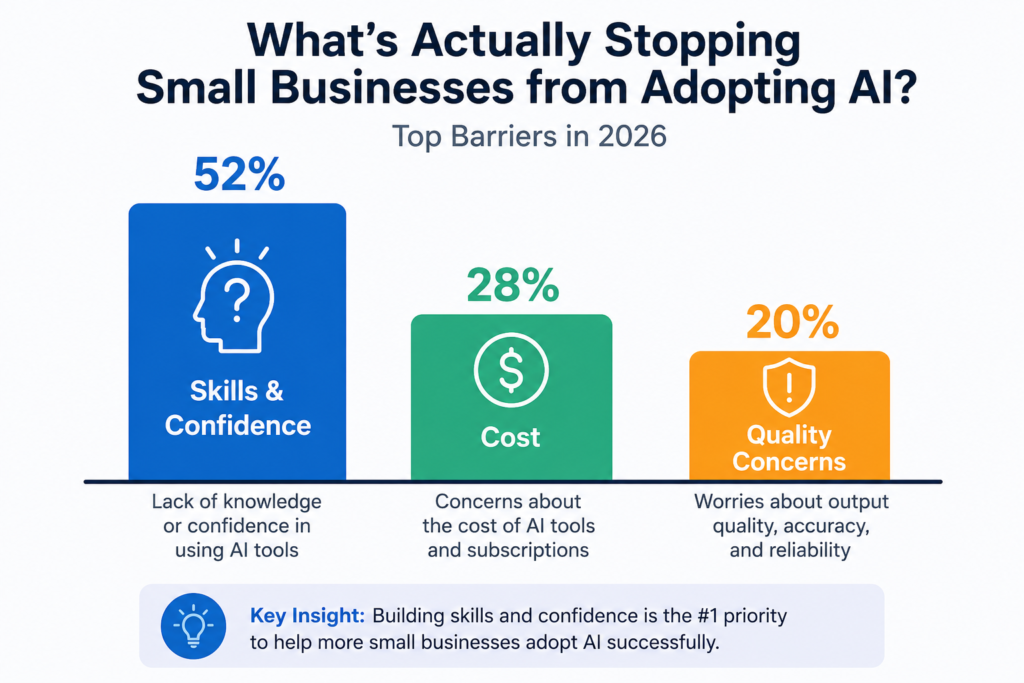
If AI adoption is this high, why isn’t everyone using it strategically? The barriers aren’t really about access anymore — the tools are cheap and widely available. The real barriers are more human.
Surveys of small business owners consistently point to the same top obstacle: not knowing how to use the tools effectively, more than cost or doubts about quality. In other words, most owners aren’t held back by price. They’re held back by not knowing where to start or how to fit AI into a workflow that already works.
That’s actually good news. A skills-and-clarity problem is a lot easier to solve than a budget problem.
How to Start Using AI in Your Small Business This Week
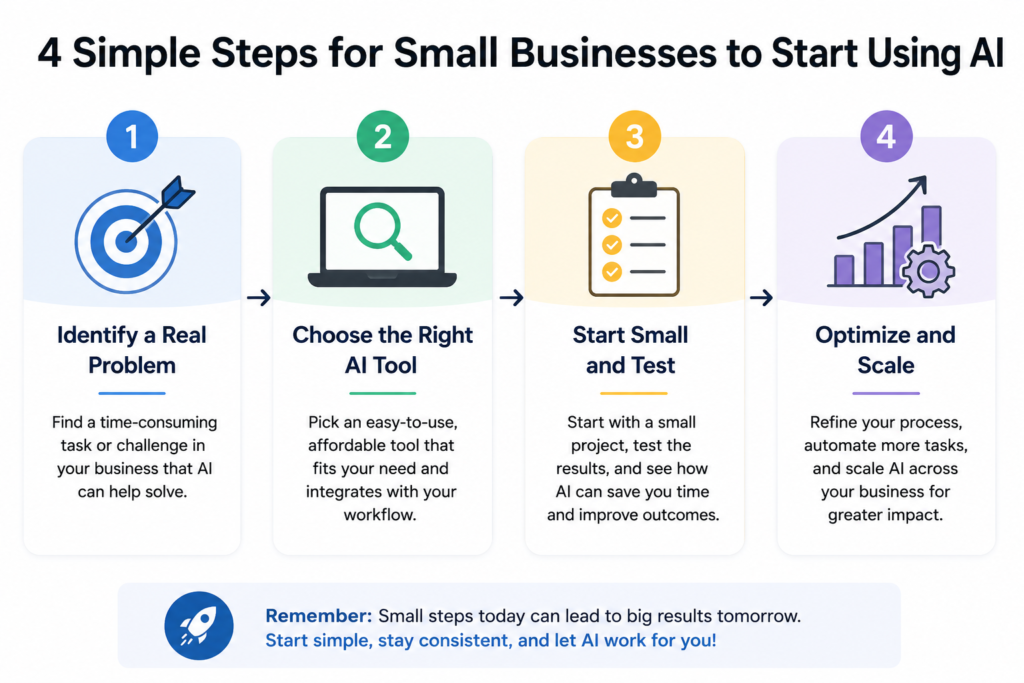
You don’t need a strategy document or a big budget to get started. Small businesses that are winning with AI tend to follow a similar pattern:
- Pick one repetitive task, not ten. Start with the task you dread most — writing social captions, answering the same customer questions, or sorting invoices.
- Use a free or low-cost tool first. Most of the highest-impact AI tools for small businesses cost less per month than a single hour of contractor time.
- Measure the time you save, not just the output. If a tool saves you 30 minutes a day, that’s worth noticing and building on.
- Add one more use case only after the first one sticks. This is how “explorers” become strategic adopters — one solid workflow at a time, not five half-finished experiments.
This slow, deliberate approach is exactly what separates businesses that are actually winning with AI from the ones still just poking at it.
The Bottom Line
AI for small business isn’t a trend to watch from the sidelines anymore — it’s already running inside the businesses you’re competing with. The good news is that getting started doesn’t require a big budget or technical skill. It requires picking one task, trying one tool, and building from there.
The businesses that treat AI as a real part of how they operate — not just something they tested once — are the ones pulling ahead in 2026. The best time to become one of them is now.
Looking for more small business growth strategies? Explore the rest of the blog for practical guides on marketing, tools, and growing your business without a big team behind you.