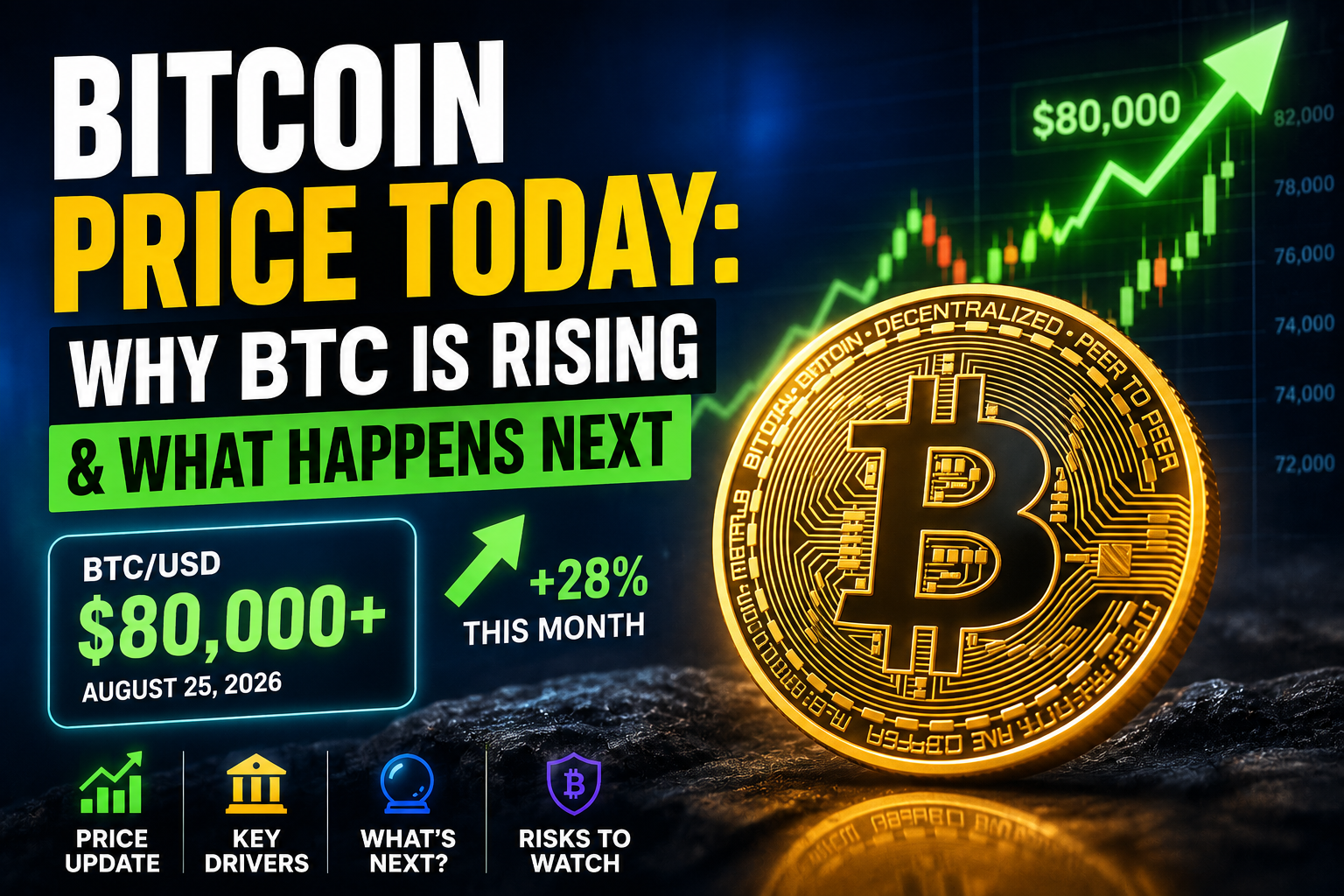
The Bitcoin price has made a powerful move higher, with BTC breaking above the $80,000 level today for the first time since May. Bitcoin’s August gain has reached roughly 28%, marking a significant change in market momentum after a much weaker period earlier in the year.
But what is behind the rally?
And perhaps more importantly: what happens next for the Bitcoin price?
The answer isn’t as simple as saying Bitcoin is going up because buyers are buying. Several forces are coming together—including a changing U.S. dollar outlook, Treasury bond-buyback plans, renewed institutional interest, improving crypto-regulation expectations and short covering.
This guide explains what is happening, why the Bitcoin price is moving, what could push BTC higher or lower, and what investors should watch next.
Table of Contents
Bitcoin Price Today: What Is BTC Worth?
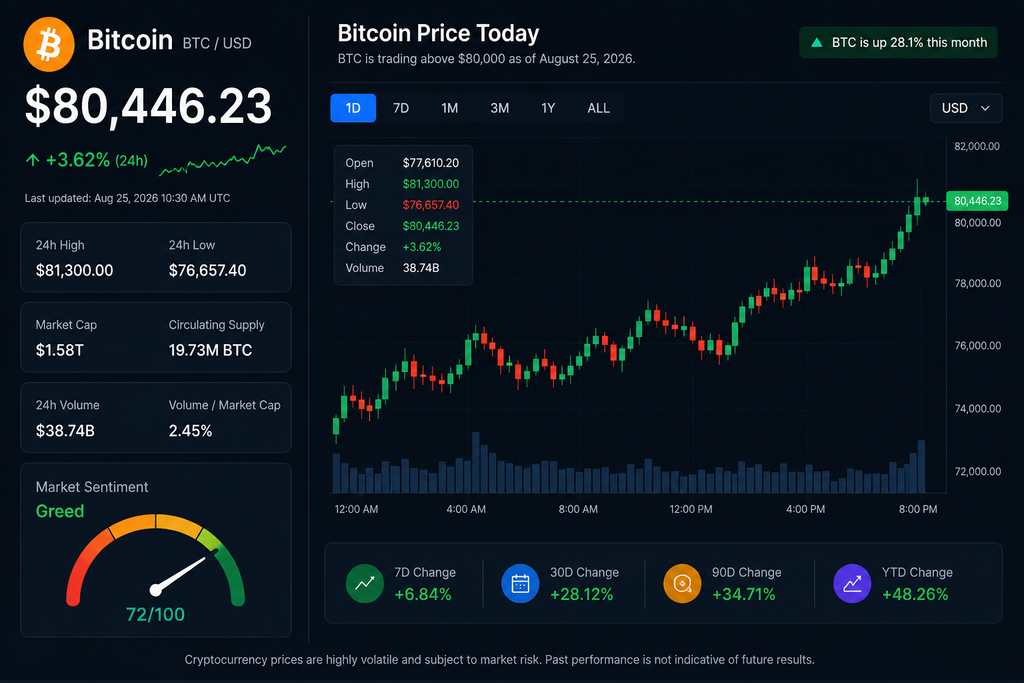
As of August 25, 2026, Bitcoin is trading around the $80,000–$81,000 area, although the exact price changes continuously because Bitcoin trades 24/7. Intraday data shows BTC/USD recently trading around $80,446, with a session range extending from roughly $76,657 to $81,300.
Important: The Bitcoin price you see can differ slightly between exchanges and data providers because each venue has different liquidity, order books and execution conditions.

What matters besides the Bitcoin price?
When checking BTC, don’t look at the headline price alone. Also consider:
- 24-hour percentage change
- 7-day performance
- Trading volume
- Market liquidity
- Recent highs and lows
- Major market catalysts
- Bitcoin ETF flows
- Broader financial-market conditions
A Bitcoin price of $80,000 tells you where the market is trading. It doesn’t tell you why it is trading there or whether the move can continue.
Why Is the Bitcoin Price Rising Today?
There isn’t one single explanation.
The current rally appears to be the result of several factors working together.
1. Bitcoin Has Broken Above $80,000
The first factor is straightforward: momentum has returned.
Bitcoin moved above $80,000 today, reaching its highest level since May. Reuters reported that the cryptocurrency’s August gain had reached approximately 28%.
Breaking through a widely watched round number such as $80,000 can also affect market psychology.
Traders who were waiting for confirmation may become buyers, while short sellers can be forced to close bearish positions if the market moves against them.
That can create additional upward pressure.
2. The U.S. Dollar Is Part of the Story
One of the most important factors currently influencing the Bitcoin price is the U.S. dollar.
Bitcoin is generally quoted in U.S. dollars, so changes in the dollar’s value can influence how investors perceive alternative assets.
Recent market reporting has highlighted concerns about currency debasement and the sustainability of government debt. Those concerns have contributed to renewed interest in assets such as Bitcoin and gold.
This doesn’t mean Bitcoin automatically rises whenever the dollar falls.
Rather, investors may become more interested in scarce or alternative assets when confidence in traditional currencies or fiscal policy weakens.
3. U.S. Treasury Bond Buybacks Are Affecting Market Sentiment
Another unusual factor is the U.S. Treasury’s expanded plan to buy back longer-dated government bonds.
Treasury Secretary Scott Bessent confirmed that the Treasury intends to double the size of its quarterly buybacks of 10- to 30-year securities beginning September 10. The stated objective includes supporting liquidity in the Treasury market.
Why does this matter for Bitcoin?
Because financial markets are interconnected.
Changes in Treasury yields, liquidity expectations and the dollar can affect investor appetite for riskier assets. Recent reporting has linked the Treasury developments with stronger demand for Bitcoin and gold.
The important point is that the Treasury isn’t directly buying Bitcoin.
Instead, the broader liquidity and currency environment may be influencing investor behavior.
4. Bitcoin ETF Demand Has Returned
Institutional access is another important part of the Bitcoin price story.
Spot Bitcoin ETFs allow investors to obtain Bitcoin exposure through a regulated investment vehicle rather than directly managing Bitcoin themselves.
Recent reports indicate that Bitcoin ETF inflows have returned after a period of weaker demand. Investopedia reported that five consecutive days of inflows in the previous week totaled nearly $2 billion, although ETFs remained in net outflows year-to-date at the time of its report.
Why is this important?
Because sustained ETF demand can represent meaningful buying pressure.
However, one should avoid assuming that ETF inflows automatically mean Bitcoin will continue rising. Flows can reverse, and market conditions can change quickly.
5. Short Covering May Be Adding Fuel
Another factor behind the speed of the rally is short covering.
A short seller profits if an asset falls. If Bitcoin instead rises sharply, short sellers may be forced—or choose—to close their positions by buying BTC.
That buying can push the Bitcoin price even higher.
This can create a feedback loop:
Bitcoin rises → short sellers close positions → buying increases → Bitcoin rises further.
Recent market analysis has specifically identified short covering as one contributor to Bitcoin’s latest rally.
However, short covering can also mean that part of a rapid rally is technical rather than purely driven by long-term investment demand.
That’s one reason investors should watch what happens after the initial surge.
6. Crypto Regulation Is Becoming a Positive Narrative
Regulation is another important part of the current market story.
On August 19, President Donald Trump called on Congress to move forward with legislation establishing clearer definitions for the cryptocurrency sector.
For institutional investors, regulatory uncertainty can be a major barrier.
Clearer rules could potentially make it easier for financial institutions and businesses to participate in the digital-asset market.
But there’s an important distinction:
Regulatory optimism is not the same thing as regulatory certainty.
Investors should watch actual legislation, regulatory decisions and implementation—not just political statements.
Bitcoin Price Chart: What Should Investors Watch?
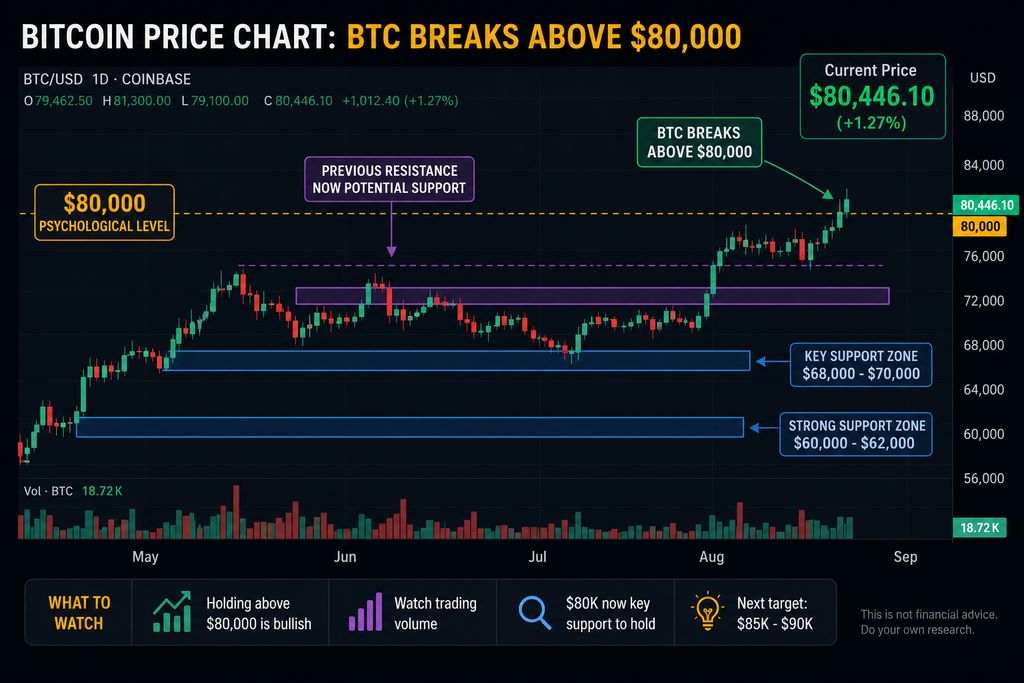
The move above $80,000 is technically significant, but the next question is whether Bitcoin can hold above that level.
There is a major difference between:
Bitcoin temporarily trading above $80,000
and
Bitcoin establishing $80,000 as meaningful support.
This is where price structure becomes important.
Watch these areas:
$80,000:
The psychological level that Bitcoin has just crossed.
Recent highs:
If BTC continues rising, traders will watch whether it can establish new short-term highs.
Previous support zones:
If Bitcoin pulls back, previous areas of buying interest can become important.
Trading volume:
A sustained move supported by healthy volume can provide stronger confirmation than a move occurring on thin activity.
What Happens If Bitcoin Holds Above $80,000?
A sustained move above $80,000 could strengthen the bullish narrative.
If buyers continue to step in during pullbacks, the market could begin looking toward higher psychological levels.
Some analysts have already discussed potential moves toward the $95,000–$100,000 range if momentum remains strong. However, those are scenarios rather than guaranteed targets.
A healthier bullish setup would generally involve:
- BTC holding above important breakout levels
- Continued institutional demand
- Healthy ETF flows
- Strong liquidity
- Continued regulatory progress
- No major deterioration in macroeconomic conditions
- Sustainable spot-market demand rather than excessive leverage
The key word is sustainable.
A rapid move higher can be impressive, but markets frequently experience pullbacks after strong rallies.
What Could Make the Bitcoin Price Fall?
A balanced Bitcoin analysis needs to consider the bearish case too.
Bitcoin remains a volatile asset, and today’s rally does not eliminate downside risk.
1. Stronger U.S. Dollar
If the dollar strengthens substantially, some of the current “currency debasement” narrative could weaken.
That could reduce demand for alternative assets.
2. ETF Outflows
If institutional ETF demand reverses, it could remove an important source of buying pressure.
3. Profit-Taking
After a roughly 28% August rally, some investors may decide to lock in profits.
Profit-taking can create short-term selling pressure even when the longer-term trend remains positive.
4. Regulatory Disappointment
If expected crypto legislation is delayed, weakened or fails to provide the clarity investors expect, sentiment could deteriorate.
5. Excessive Leverage
Leverage can amplify both directions.
If Bitcoin begins falling and leveraged traders are liquidated, forced selling can accelerate the decline.
6. Macro Shock
Unexpected changes in:
- interest rates
- inflation
- Treasury yields
- geopolitical conditions
- liquidity
- economic growth
could all affect Bitcoin’s risk appetite.

Bitcoin Price Prediction: What Happens Next?
Nobody knows exactly where Bitcoin will trade next week or next month.
Instead of relying on one Bitcoin price prediction, it is more useful to consider three possible scenarios.
Bull Case
Bitcoin maintains momentum above $80,000, ETF demand remains strong, institutional interest continues and the broader liquidity environment remains supportive.
Under that scenario, Bitcoin could continue testing progressively higher levels.
Some current analyst commentary has discussed the possibility of Bitcoin moving toward $95,000–$100,000 if the rally remains sustained.
Base Case
Bitcoin consolidates after its rapid August rally.
In this scenario, BTC could move sideways, experience several pullbacks and establish a new trading range before making its next major move.
This would not necessarily be bearish.
Consolidation can allow the market to absorb gains and determine whether new buyers are willing to support higher prices.
Bear Case
Bitcoin fails to hold its recent breakout, ETF flows weaken, the dollar strengthens and investors reduce exposure to risk assets.
In that situation, BTC could experience a deeper correction.
The important lesson is that a bullish trend can still contain significant declines.
How to Read the Bitcoin Price Without Getting Caught in FOMO
A rapidly rising Bitcoin price can create FOMO—fear of missing out.
This is one of the biggest psychological risks for new investors.
When Bitcoin rises 5%, 10% or 20% quickly, it is tempting to assume that the next move must be higher.
That’s not how markets work.
Instead, ask:
- Why is Bitcoin rising?
- Is the buying supported by genuine demand?
- What is happening with ETF flows?
- What is happening with liquidity?
- Where are the important support levels?
- How much volatility can I tolerate?
- What happens to my finances if Bitcoin falls substantially?
These questions are more useful than simply asking:
“How high can Bitcoin go?”
How to Buy Bitcoin Responsibly
If you’re considering buying Bitcoin because of the recent price move, don’t start with the question:
“How much Bitcoin can I afford?”
Start with:
“How much risk can I afford?”
Bitcoin can be purchased fractionally, so you don’t need to buy one entire BTC.
Before making a purchase, consider:
- Your investment timeframe
- Your risk tolerance
- Your existing portfolio
- Your emergency savings
- Transaction fees
- Exchange or swap spreads
- Storage arrangements
- Local tax obligations
Never invest money that you need for essential expenses.

ChangeNOW: A Resource for Crypto Swaps
If you are looking for a convenient way to explore cryptocurrency swaps, ChangeNOW is one platform worth researching.
ChangeNOW provides cryptocurrency exchange/swap services and also operates an affiliate program for partners.
Before completing any transaction, compare the actual amount you will receive, not just the headline Bitcoin price.
Check:
- Exchange rate
- Network fees
- Platform fees
- Spread
- Minimum/maximum transaction limits
- Supported assets
- Destination address
Recommended resource
How to Store Bitcoin Safely
Buying Bitcoin is only part of the process.
You also need to think about security.
There are two broad approaches:
Custodial storage
A third party holds the keys associated with your Bitcoin.
Self-custody
You control the wallet and the associated key-management process.
Neither approach eliminates risk.
With self-custody, responsibility shifts toward the user.
That means protecting your recovery phrase becomes extremely important.
Never:
- Share your recovery phrase
- Email your recovery phrase
- Store it in an unencrypted cloud document
- Enter it into an unsolicited website
- Give it to supposed customer support
- Take a screenshot of it
Ledger: A Hardware Wallet Option
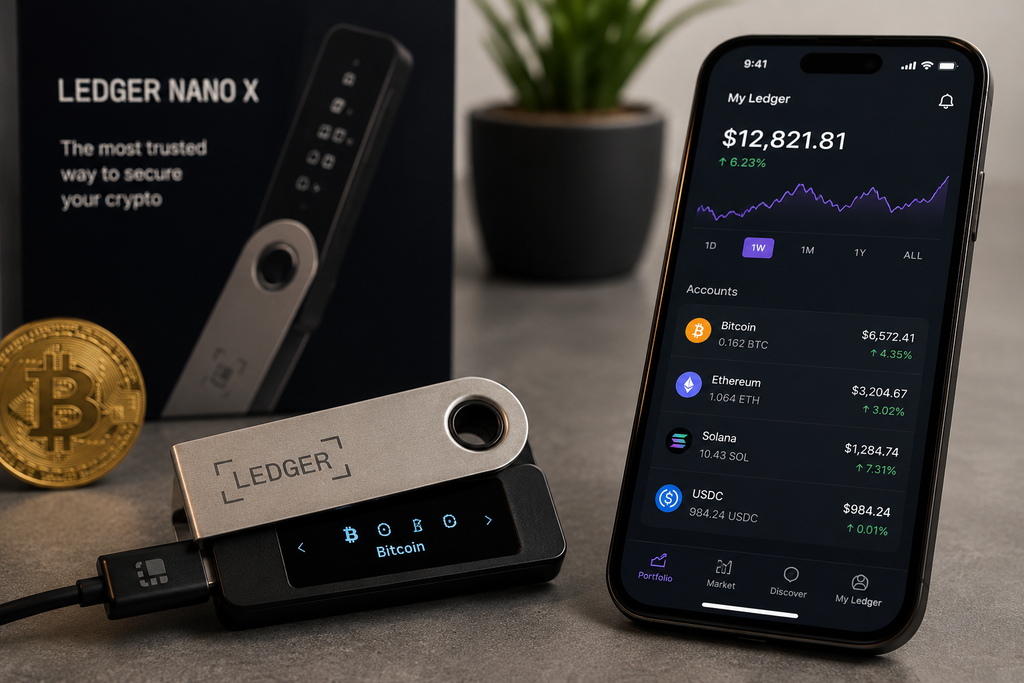
For readers considering self-custody, Ledger is one hardware-wallet provider worth researching.
Hardware wallets are designed to provide a more isolated environment for managing cryptographic keys than a general-purpose internet-connected device.
Ledger’s official affiliate program is available to publishers, bloggers, creators and other crypto educators. Its current affiliate information advertises commissions starting at 10% of qualifying net sales, excluding VAT and shipping, although affiliate terms can change.
Why consider a hardware wallet?
A hardware wallet can be useful for people who want greater control over their crypto rather than relying entirely on an exchange.
But remember:
A hardware wallet does not protect you from every scam.
You still need to protect your recovery information and verify transactions carefully.
Recommended resource
Bitcoin Price vs. Bitcoin Value
One of the most important concepts for beginners is understanding that price and value are not identical.
The Bitcoin price is the market price at a specific moment.
Bitcoin’s perceived value can be influenced by factors such as:
- Scarcity
- Network adoption
- Security
- Liquidity
- Institutional demand
- User demand
- Monetary characteristics
- Market confidence
The market can assign a very different price to the same asset six months later.
That’s why investors should avoid thinking:
“Bitcoin is $80,000, so it must be worth exactly $80,000.”
Instead:
“The market currently values Bitcoin at approximately $80,000 per BTC.”
That distinction matters.
How to Track Bitcoin Price Without Watching It Every Minute
Bitcoin trades around the clock.
That doesn’t mean you need to watch it around the clock.
Constantly checking BTC can encourage emotional decisions.
Instead, establish a routine.
The 10-minute Bitcoin research routine
Minutes 1–2: Check the Bitcoin price and recent range.
Minute 3: Check volume.
Minutes 4–5: Review major Bitcoin and crypto news.
Minute 6: Review major macroeconomic developments.
Minute 7: Check institutional/ETF developments.
Minute 8: Review your portfolio allocation.
Minute 9: Revisit your investment thesis.
Minute 10: Decide whether your plan requires action.
Sometimes the correct decision is:
Do nothing.
Bitcoin Price: 10 Questions to Ask Before Buying
Before buying because BTC is moving higher, ask yourself:
- Why am I buying?
- What is my investment timeframe?
- How much can I afford to lose?
- What percentage of my portfolio will Bitcoin represent?
- Have I considered fees?
- Do I understand where my Bitcoin will be stored?
- Do I know how to protect my recovery information?
- Am I buying because of research or FOMO?
- What would make me change my thesis?
- Would I still be comfortable with my position if Bitcoin fell 30%?
If you cannot answer these questions, slow down.
Bitcoin Price: Key Things to Watch Next
The next phase of the Bitcoin market could depend on several variables.
Watch #1: Can BTC Hold Above $80,000?
A breakout is more meaningful if the market can establish the former resistance area as support.
Watch #2: ETF Flows
Continued institutional demand could provide an important source of buying pressure.
Watch #3: The U.S. Dollar
Currency movements remain an important macro factor for the current Bitcoin narrative.
Watch #4: Treasury Yields and Liquidity
Investors will continue watching how U.S. Treasury policy affects bond yields and broader financial conditions.
Watch #5: Crypto Regulation
Progress toward clearer cryptocurrency rules could influence institutional participation.
Watch #6: Leverage
If leverage becomes excessive, sudden liquidations can increase volatility.
Watch #7: Trading Volume
A sustained move with healthy market participation is generally more interesting than a thinly traded price spike.

Frequently Asked Questions About Bitcoin Price
What is the Bitcoin price today?
As of August 25, 2026, Bitcoin is trading around the $80,000–$81,000 area, with the exact price changing continuously throughout the day. Recent BTC/USD data showed an intraday range extending from approximately $76,657 to $81,300.
Why is Bitcoin price rising today?
The current rally is being supported by several factors, including a weakening-dollar/debasement narrative, U.S. Treasury bond-buyback developments, renewed institutional interest, ETF inflows, short covering and improving expectations around crypto regulation.
Can Bitcoin reach $100,000?
It is possible, but nobody can guarantee it. Current market commentary has discussed $95,000–$100,000 as a potential upside scenario if momentum continues. These are scenarios, not guaranteed Bitcoin price targets.
Why does Bitcoin price change so much?
Bitcoin trades continuously across global markets and is influenced by supply and demand, liquidity, leverage, institutional flows, macroeconomic conditions, regulation and market sentiment.
Is Bitcoin a good investment?
That depends on your financial circumstances, risk tolerance, investment timeframe and portfolio. Bitcoin is highly volatile and can experience substantial declines.
How much Bitcoin can I buy with $100?
The amount depends on the current Bitcoin price and transaction costs. The basic calculation is:
$100 ÷ Bitcoin price = approximate BTC purchased before fees.
Where can I buy Bitcoin?
Bitcoin can be acquired through various exchanges, brokers and crypto services, depending on your country and applicable regulations. Always research the provider, fees, security practices and transaction terms.
How can I store Bitcoin safely?
Options include custodial services, software wallets and hardware wallets. If you use self-custody, protecting your private keys and recovery phrase is critical.
Should I buy Bitcoin after it rises above $80,000?
There is no universal answer. A rising Bitcoin price does not guarantee another immediate rise. Consider your risk tolerance, position size, timeframe and investment strategy rather than buying solely because of recent momentum.
Final Thoughts: What Does the Bitcoin Price Tell Us?
Today’s move above $80,000 is an important development for the cryptocurrency market.
The rally is being driven by more than one factor. Bitcoin price momentum, dollar concerns, Treasury policy, ETF demand, short covering and regulatory optimism are all contributing to the current market environment.
But investors should remember that momentum can work in both directions.
The most important question isn’t simply:
“How high will Bitcoin go?”
A better question is:
“What evidence would confirm or invalidate the current trend?”
If Bitcoin holds its breakout, demand remains strong and the macro environment stays supportive, the bullish case could strengthen.
If ETF flows reverse, the dollar strengthens, liquidity deteriorates or Bitcoin loses important support levels, a correction could follow.
Either way, the best approach is to understand the market rather than chase it.
Track the Bitcoin price. Understand the reason behind the move. Manage your risk. And protect your Bitcoin if you decide to own it.
📥 Want a More Complete Bitcoin Guide?
If you want to go beyond today’s Bitcoin price and learn how to read BTC charts, understand market cycles, evaluate Bitcoin price predictions, buy Bitcoin responsibly and protect your crypto, I’ve created a practical beginner-friendly guide:
Bitcoin Price Explained: How to Track, Understand & Buy Bitcoin With Confidence
[GET THE COMPLETE BITCOIN GUIDE]
Disclosure: This article contains affiliate links. I may receive a commission if you purchase a qualifying product or service through one of these links, at no additional cost to you. This article is for educational purposes only and is not financial advice.