
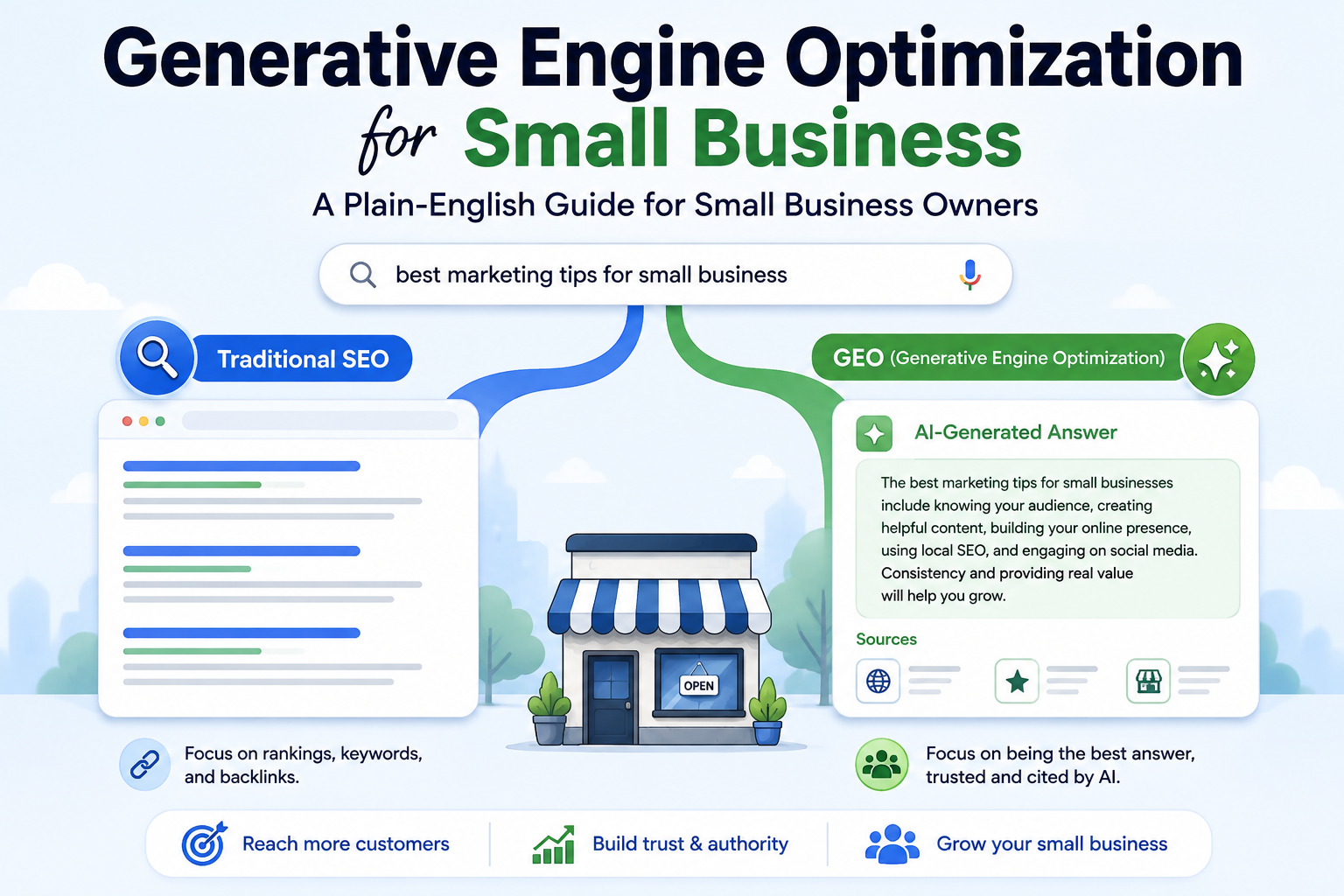
What Is Generative Engine Optimization for Small Business, Exactly?
If you’ve never heard of it, generative engine optimization for small business is quickly becoming one of those terms you can’t avoid in marketing circles — right up there with “SEO” a decade ago. And if you’re a small business owner already juggling ten other things, the last thing you need is another buzzword with no clear explanation attached to it.
So let’s fix that. This guide breaks down what GEO actually is, how it’s different from regular SEO, why it matters for a small business specifically, and what you can realistically do about it — without hiring an agency or learning to code.
Table of Contents
What Does Generative Engine Optimization (GEO) Actually Mean?
Generative engine optimization, or GEO, is the practice of structuring your website and content so that AI tools — like ChatGPT, Google’s AI Overviews, Gemini, and Perplexity — can find your information, understand it, and use it when they generate an answer for someone.
In plain terms: instead of trying to rank your blog post or service page in a list of ten blue links, GEO is about trying to get your business mentioned or quoted directly inside the AI’s answer — sometimes with a link back to you, sometimes without.
This matters because people are increasingly typing full questions into AI chat tools instead of typing three keywords into Google. Someone might type “who’s a reliable plumber near me that does emergency callouts” into ChatGPT the same way they’d ask a friend. GEO is what determines whether your business shows up in that answer.

GEO vs. SEO: What’s the Real Difference?
They sound similar, and they’re related, but they’re not the same thing:
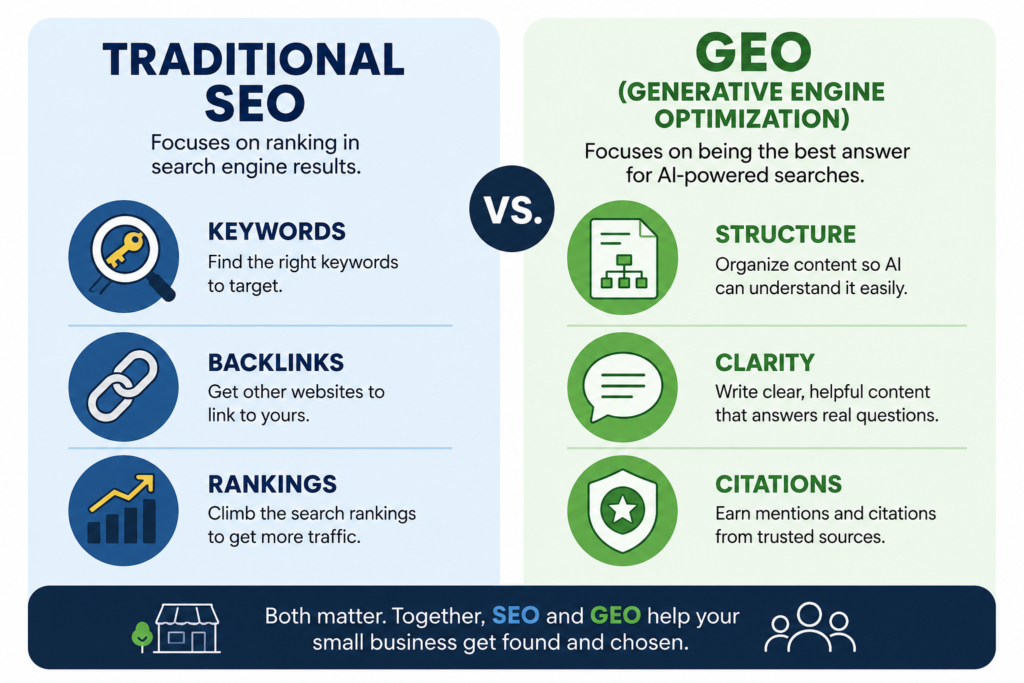
- SEO (Search Engine Optimization) focuses on getting your page to rank in a traditional list of search results, driven largely by keywords, backlinks, and technical site health.
- GEO (Generative Engine Optimization) focuses on getting your content cited or referenced inside an AI-generated answer, driven more by clarity, structure, evidence, and how directly you answer a specific question.
Here’s the important part: GEO doesn’t replace SEO — it builds on top of it. A messy website with no clear structure and thin content won’t perform well in either world. If your SEO foundation is solid, you’re already most of the way to being GEO-friendly too.
Why Should a Small Business Owner Care About GEO Right Now?
It’s fair to ask whether this is worth your limited time. A few reasons it is:
- AI referral traffic is growing fast. Traffic to small business websites coming directly from AI tools has grown sharply over the past year, and that trend shows no sign of slowing down.
- Most brands haven’t started yet. A large share of businesses currently have no GEO strategy at all — which means there’s a real first-mover advantage for small businesses willing to do the basics well.
- AI tools often favor specific, well-documented expertise over big, generic brands. For local and niche searches, a small business with clear, detailed information can actually outperform a much larger competitor in an AI-generated answer.
- It costs you nothing extra if you’re already doing good SEO. Most GEO best practices (clear writing, real expertise, updated information) are things a small business can do without buying new tools.
To be clear-eyed about it: traditional Google search still sends far more traffic than AI tools do today. GEO is an emerging opportunity to invest in early, not a replacement for the marketing you’re already doing.
How Do AI Search Tools Actually Decide What to Cite?
Generally, AI engines follow three basic steps when they answer a question:
- Retrieval — They pull relevant pages and passages from across the web related to the question.
- Summarization — They compress and combine information from multiple sources into one answer.
- Response generation — They produce a final, conversational answer, sometimes with a citation or source link.
To be pulled into that process, your content needs to be easy to find, easy to understand out of context, and clearly written to answer a specific question — not buried in vague, marketing-heavy language.
6 Practical GEO Steps a Small Business Can Actually Do
You don’t need a developer or an AI consultant to get started. Here’s where to focus first:
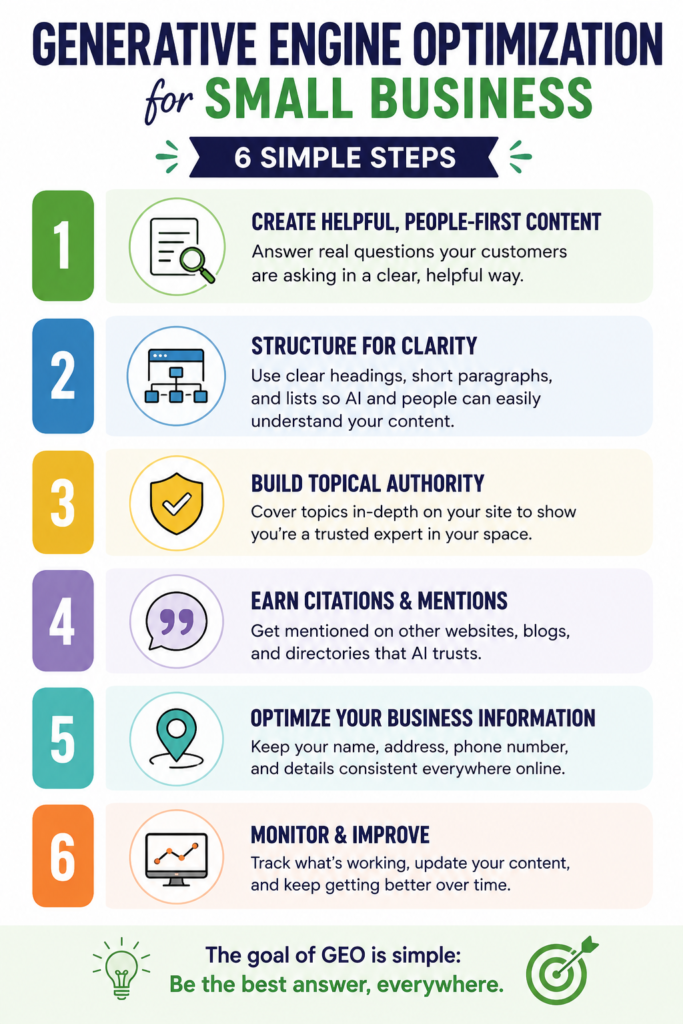
1. Answer the actual question in the first sentence or two. AI tools favor content that gives a direct, extractable answer up front, then explains further. Bury your answer in the fourth paragraph, and it’s much less likely to get picked up.
2. Write in a natural, conversational tone. People ask AI tools full questions (“what’s the best way to…” or “how much does it usually cost to…”). Structure some of your content around real questions your customers actually ask, in the language they’d actually use.
3. Add clear headers that describe exactly what’s in that section. Vague headers like “Our Approach” don’t help AI (or readers) understand what’s underneath. Descriptive headers like “How Much Does X Cost in [Your City]” perform much better.
4. Keep your business information accurate and consistent everywhere. Your business name, address, hours, and services should match exactly across your website, Google Business Profile, and directory listings. AI tools cross-check this kind of information, and inconsistencies hurt your credibility.
5. Add basic schema markup to key pages. Schema is a bit of behind-the-scenes code that tells search engines and AI tools exactly what your content means — this is a business, this is a service, this is a review. Most website builders (including WordPress plugins) can add this without you writing any code yourself.
6. Keep your content updated. AI tools tend to favor recent, current information. A blog post from three years ago with outdated pricing or advice is less likely to get cited than one that’s been refreshed recently.
Use a Simple Checklist So Nothing Falls Through the Cracks
GEO is really just one piece of a much bigger picture — most small businesses are also juggling pricing, cash flow, marketing, and day-to-day operations at the same time, and it’s easy for something like this to quietly slip down the priority list.
If you want a straightforward way to keep track of the moving parts of running and growing your business — GEO included — it’s worth working from a simple, structured checklist rather than trying to hold it all in your head. Lean Business OS is a good example of this: a lightweight system built specifically to help small business owners stay organized across marketing, operations, and growth priorities without the complexity of enterprise-level tools.
Do You Need to Choose Between SEO and GEO?
No — and you shouldn’t try to. Think of it this way:
- SEO gets you found in traditional search results, where the majority of search volume still lives today.
- GEO gets you found inside AI-generated answers, a channel that’s small today but growing quickly.
A small business that keeps doing solid, fundamental SEO — clear content, real expertise, a fast and well-organized website — is already building the foundation GEO depends on. The extra step is simply writing with AI tools in mind: direct answers, clear structure, and accurate, current information.
Frequently Asked Questions
Is GEO the same as SEO?
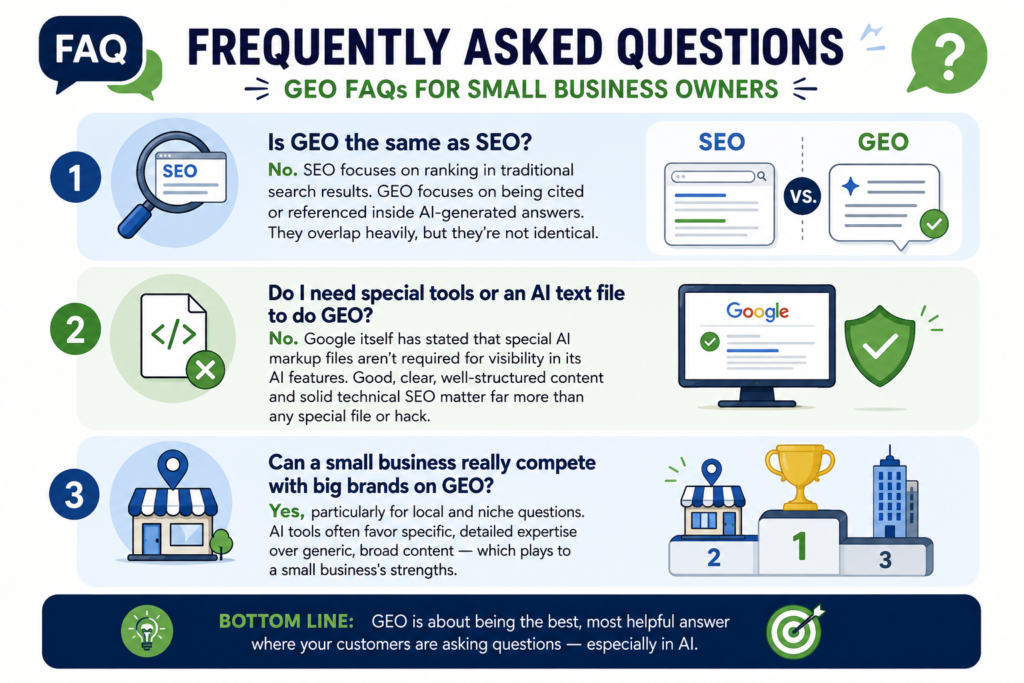
No. SEO focuses on ranking in traditional search results. GEO focuses on being cited or referenced inside AI-generated answers. They overlap heavily, but they’re not identical.
Do I need special tools or an AI text file to do GEO?
No. Google itself has stated that special AI markup files aren’t required for visibility in its AI features. Good, clear, well-structured content and solid technical SEO matter far more than any special file or hack.
Can a small business really compete with big brands on GEO?
Yes, particularly for local and niche questions. AI tools often favor specific, detailed expertise over generic, broad content — which plays to a small business’s strengths.
The Bottom Line
Generative engine optimization for small business isn’t about chasing a trend — it’s about making sure your business can still be found as more of your customers start asking AI tools questions instead of typing them into a search bar. Start with the basics: answer real questions directly, keep your information accurate and current, and build on the SEO work you’re likely already doing. The businesses that start now will have a real head start over the ones who wait.







Pingback: How to Get Your Business Mentioned in ChatGPT and AI Overviews - Your Small Business Solutions