
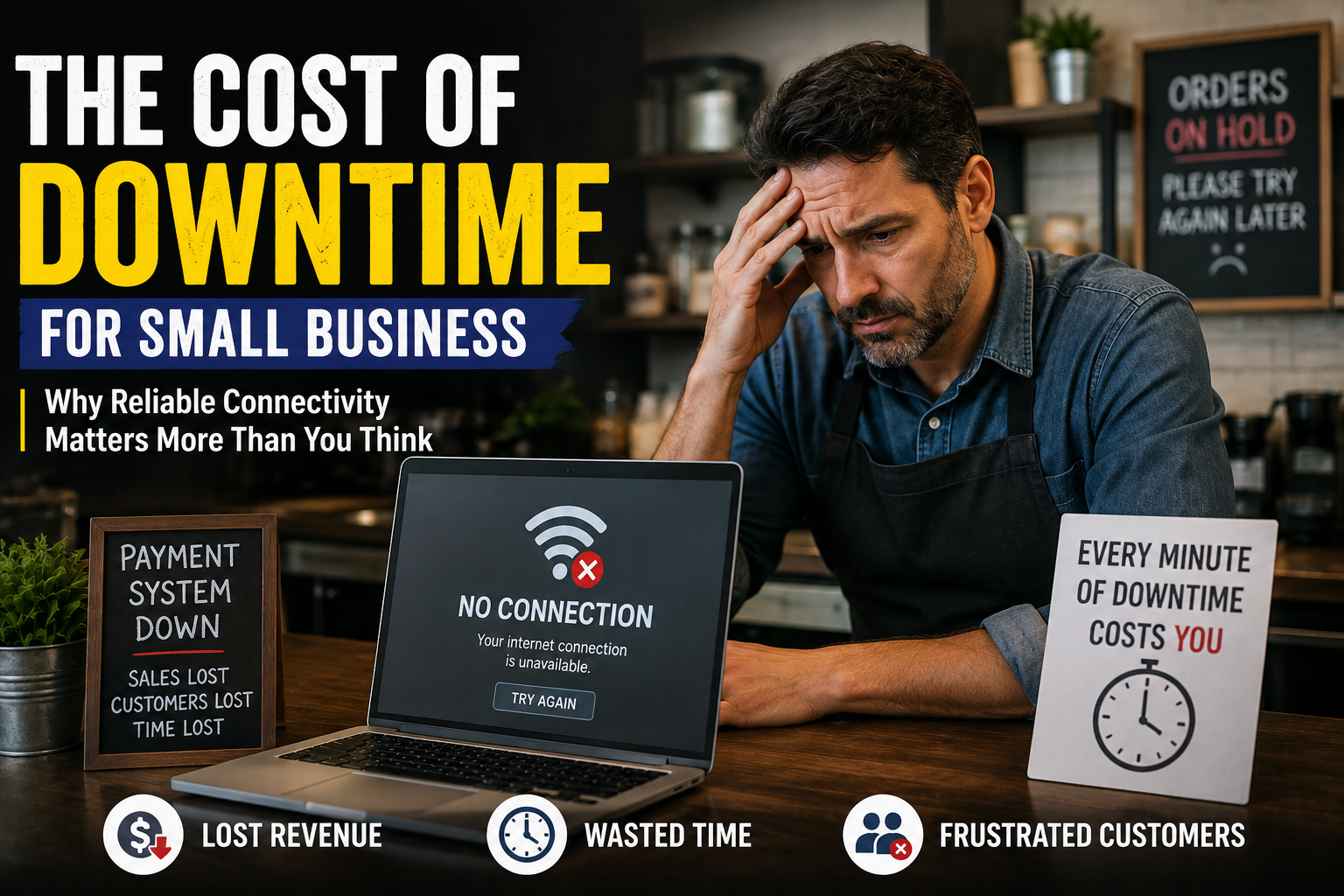
The cost of downtime for small business is one of those numbers owners rarely calculate until it’s too late. A dropped connection during a busy afternoon, a POS system that won’t process cards, a cloud tool that won’t load — these moments feel like small annoyances in the instant they happen. But add up the lost sales, the wasted payroll, and the customers who quietly walked away, and downtime turns out to be one of the most expensive problems a small business can have.
Most owners assume downtime is rare enough not to plan for. The truth is closer to the opposite: it’s common, it’s often preventable, and it almost always costs more than people expect.
Table of Contents
What “Downtime” Actually Covers
When people hear “downtime,” they usually picture a total blackout — the internet goes out, the whole store stops. In reality, downtime covers a much wider range of everyday failures:
- A Wi-Fi connection that drops mid-transaction
- A point-of-sale system that can’t reach the payment processor
- Cloud software (accounting, scheduling, inventory) that won’t sync
- VoIP or video calls that cut out during a client meeting
- Email or file storage that becomes unreachable
- A website that goes offline or loads too slowly to hold visitors
Any one of these can bring work to a stop, even if the power is on and the lights are working. That’s what makes downtime tricky — it’s rarely a single dramatic event. It’s usually a string of smaller interruptions that quietly drain time and money.

The Real Cost of Downtime for Small Business, in Numbers
Industry research consistently shows that downtime hits small businesses harder, proportionally, than it hits large ones. A few figures worth knowing:
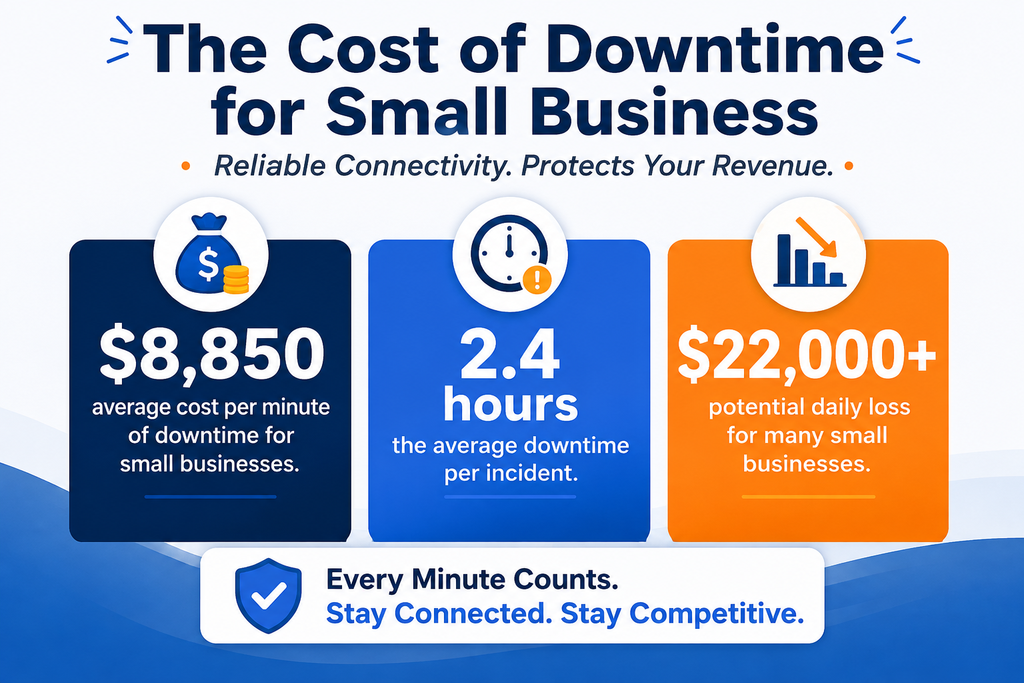
- Estimates for small business downtime commonly range from roughly $137 to $427 per minute, depending on the type of business and how revenue-dependent it is.
- Other industry surveys put small and midsize business losses at $8,000 to $25,000 per hour of downtime, with service and transaction-heavy businesses landing at the higher end.
- Research cited by the National Archives & Records Administration found that a striking share of companies that experience prolonged downtime don’t survive the following year.
These numbers vary by source and by business type, and no two small businesses will land on the exact same figure. But the pattern is consistent: even short, “minor” outages add up fast, and most owners underestimate the true bill until they sit down and calculate it.
The Hidden Costs Nobody Puts on the Invoice
Lost sales are the obvious cost, but they’re rarely the biggest one. The costs that don’t show up until later usually matter more:
Paid time with nothing to show for it. Employees still earn their wages during an outage, even if they can’t do their jobs. A team of five, each earning $20 an hour, costs $100 an hour in payroll alone — whether the internet works or not.
Recovery expenses. Emergency IT support, data recovery, hardware replacement, and rush shipping for a failed router don’t come cheap, and they’re rarely part of the normal monthly budget.
Missed opportunities. A customer who can’t reach you, book an appointment, or complete checkout usually doesn’t wait around — they go to a competitor instead, and many never come back.
Damaged trust. One outage is forgivable. A pattern of them tells customers and clients that your business isn’t dependable, and that reputation is far more expensive to repair than the outage itself.
Compounding effects. A missed shipment deadline, a bounced invoice, a client meeting that had to be rescheduled — each small disruption tends to create a few more down the line.

Why Connectivity Is Usually the Weak Link
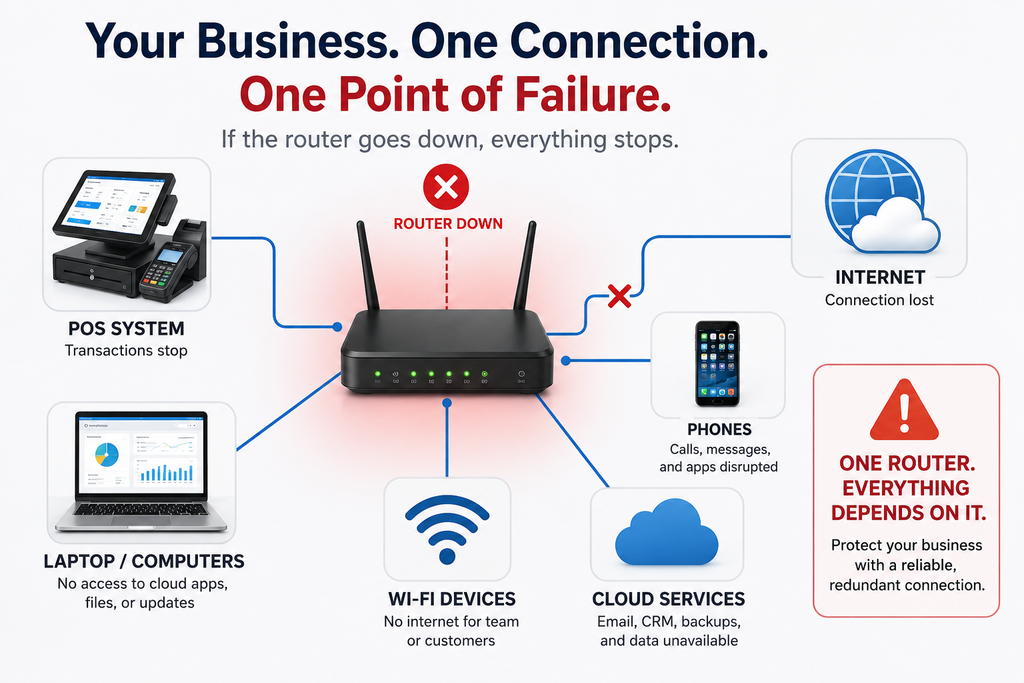
Twenty years ago, a slow internet connection meant a slow-loading webpage. Today, connectivity is the backbone almost everything else depends on. Point-of-sale systems, accounting software, scheduling tools, email, phone systems, and even the security cameras in the building often run through the same internet connection.
That’s exactly why unreliable connectivity for small business is such an outsized risk: it’s rarely just “the internet” that goes down — it’s every tool that runs through it. A single point of failure now has the power to stop an entire day’s operations, not just one task.
Two things typically drive this vulnerability:
- Relying on residential-grade internet instead of a business connection built for uptime and priority support.
- Having no backup connection — so when the primary line drops, there’s nothing to fail over to.
Neither problem is complicated to fix, which is part of why unplanned downtime is so frustrating in hindsight. Most of it is preventable.
A Simple Way to Estimate Your Own Downtime Cost
You don’t need complicated software to get a rough number. A workable formula looks like this:
- Add up your average hourly revenue and your average hourly payroll cost.
- Multiply that combined number by the number of hours a typical outage lasts for your business.
- That gives you a realistic estimate of what one hour of downtime costs you.
For example, a small business bringing in $500 an hour in revenue with $150 an hour in payroll is looking at roughly $650 for every hour it’s offline — before counting recovery costs or lost customers. Running this calculation once, using your own numbers, tends to be more convincing than any industry statistic.
Building Reliable Connectivity: Where to Start
None of this requires an enterprise-level IT budget. A few practical steps go a long way:
- Upgrade to business-grade internet if you’re still running on a residential plan — business plans typically include better uptime guarantees and priority support.
- Add a backup connection, such as a cellular failover device, so operations can continue if the primary line drops.
- Monitor your uptime so you know about a problem before a customer tells you.
- Keep networking hardware current — an aging router or modem is a common, avoidable cause of outages.
- Write down a simple continuity plan covering what staff should do the moment the connection drops, so lost minutes don’t turn into lost hours.
None of these steps eliminate risk entirely, but together they shrink both how often outages happen and how long they last — which is where most of the real cost of downtime for small business comes from in the first place.

The Bottom Line
Downtime rarely announces itself in advance, and most small businesses don’t calculate what it actually costs them until they’ve already lived through it. Once you run the numbers — lost revenue, wasted payroll, recovery costs, and the customers who quietly went elsewhere — reliable connectivity stops looking like a “nice to have” and starts looking like one of the cheapest insurance policies a small business can buy.







Pingback: Retaining Your Best Employees Without a Corporate Budget - Your Small Business Solutions