If you’re applying for financing this year, small business loan changes in 2026 touch nearly every stage of the process — how lenders score your application, how much collateral you need, and even who’s allowed to own the business that’s borrowing.
The Small Business Administration (SBA) rewrote several of its core lending rules in 2026, interest rates have settled into a new range after a year of Fed cuts, and alternative lenders have adjusted how they price risk. Here’s a plain-English breakdown of what’s actually different, and what it means for your next application.
Table of Contents
Why 2026 Is a Turning Point for Small Business Lending
For the past few years, SBA lending leaned on pandemic-era flexibility: lighter documentation, smaller collateral requirements, and credit-scoring shortcuts that let small loans move faster. That era is over. Starting in 2025 and accelerating through 2026, the SBA walked back many of those shortcuts in favor of stricter underwriting, while at the same time expanding how much capital qualified borrowers can access. Add in a new interest rate environment and a fast-growing field of AI-driven online lenders, and 2026 looks like a genuine reset for how small businesses borrow money.

The Biggest SBA Loan Rule Changes in 2026
1. The old credit-scoring shortcut is gone
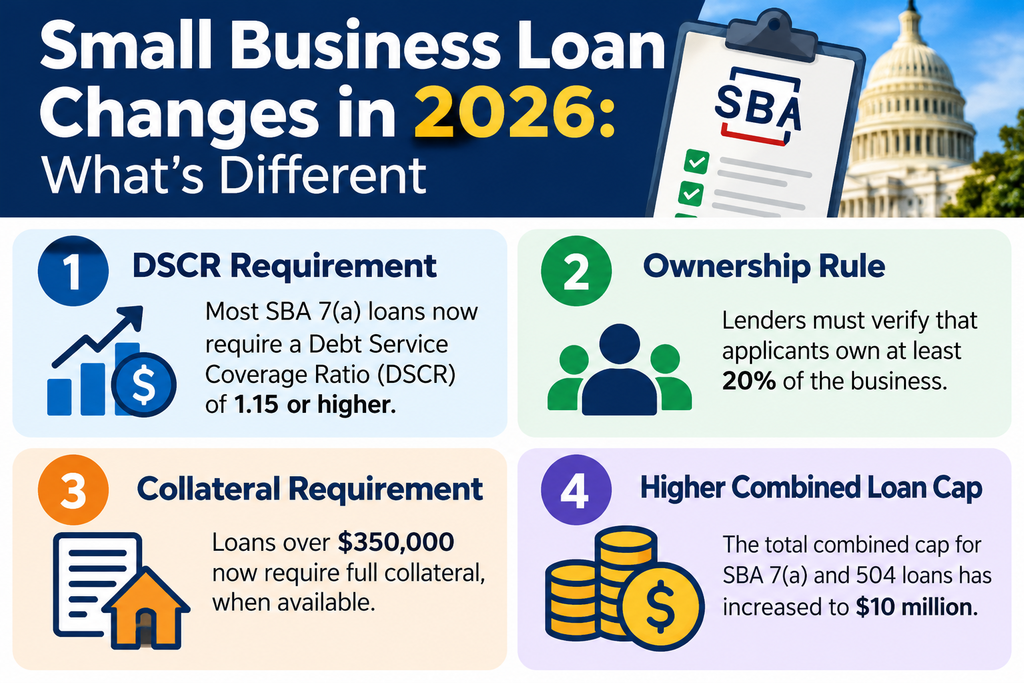
For years, smaller SBA 7(a) loans were approved using an automated credit score built specifically for small business lending. As of March 1, 2026, the SBA retired that shortcut for small 7(a) loans. In its place, lenders now have to verify a debt service coverage ratio of at least 1.1:1, meaning your business’s cash flow has to clearly support the new loan rather than relying on a credit score alone.
2. Ownership has to be 100% U.S.-based
Also, effective March 1, 2026, the SBA tightened who can own a business that receives a 7(a) or 504 loan. Every direct and indirect owner — including anyone holding a stake through a trust or holding company — now has to meet U.S. ownership requirements. Businesses with any foreign ownership in the mix will need to restructure before applying.
3. Collateral is back on the table for smaller loans
Collateral used to be a non-issue for most SBA loans under $500,000. That threshold has narrowed, so more borrowers in the small-to-mid loan range are now being asked to pledge collateral and provide documentation that wasn’t required a year ago.
4. Bigger combined loan limits for qualified borrowers
It’s not all tighter rules. Effective July 4, 2026, borrowers can combine a 7(a) loan and a 504 loan for up to $10 million in total SBA-backed financing — double the previous $5 million cap. For manufacturers, the SBA also waived upfront guaranty fees on qualifying 7(a) loans up to $950,000 for the 2026 fiscal year, which can mean real savings on a larger loan.
Where Interest Rates Stand Right Now
The small business loan changes in 2026 aren’t limited to SBA rules — interest rates have moved too.
The Federal Reserve cut rates several times through late 2025, and by early 2026 the federal funds rate had settled at 3.5%–3.75%, with the prime rate sitting at 6.75%. Since most variable-rate small business financing — including SBA 7(a) loans and business lines of credit — is priced off the prime rate, that stabilization matters more than any single Fed announcement.
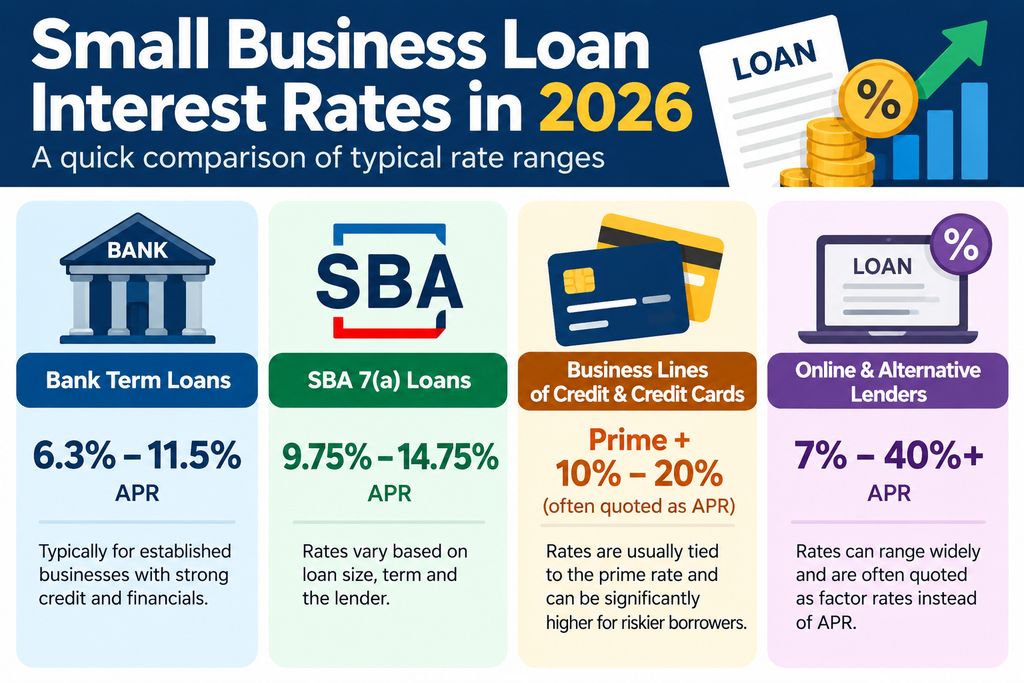
Here’s roughly where small business borrowing costs land in 2026:
- Bank term loans: around 6.3%–11.5% APR
- SBA 7(a) loans: roughly 9.75%–14.75% APR, depending on loan size and term
- Business lines of credit and credit cards: often prime plus 10–20 percentage points
- Online and alternative lenders: anywhere from 7% up into the 40%+ range, frequently quoted as factor rates instead of APR
The takeaway: rates aren’t dropping fast, and they probably won’t fall much further in 2026. If you already have a loan or you’re shopping for new financing, your actual cost depends far more on your credit profile, time in business, and loan type than on waiting for the next Fed meeting.
Beyond the SBA: How Online and Alternative Lending Has Shifted
The small business loan changes in 2026 go beyond the SBA — traditional banks and online lenders are adjusting their playbooks too. Online and fintech lenders have leaned harder into automated underwriting, often using AI models that pull real-time business data — bank transactions, payment processing history, even e-commerce sales — instead of relying solely on a credit score and tax returns. That’s made approvals faster for some borrowers, but it’s also made these loans more expensive on average, since many are priced as factor rates rather than traditional interest.
Revenue-based financing has also grown as an option for businesses with strong, predictable sales but thin collateral. Repayment is tied to a percentage of revenue rather than a fixed monthly payment, which can help seasonal businesses but gets expensive if sales stay flat.
What the Small Business Loan Changes in 2026 Mean for You
If you’re planning to borrow in 2026, a few practical shifts are worth building into your plan:
- Get your cash flow numbers in order first. With the old scoring shortcut gone, lenders want to see a debt service coverage ratio comfortably above 1.1:1 before approving a small 7(a) loan.
- Check your ownership structure early. If any part of your business is owned through a trust, holding company, or non-U.S. investor, resolve that before applying for an SBA loan.
- Expect to document collateral, even on smaller loans. Gather titles, equipment valuations, or property documentation ahead of time rather than scrambling mid-application.
- Compare total cost, not just the advertised rate. Factor-rate products from online lenders can look competitive on the surface but cost far more over the life of the loan than a traditional APR-based loan.
- If you qualify for SBA financing, ask about the higher combined cap. The new $10 million combined 7(a)/504 limit can be a real advantage for a larger expansion or acquisition.

The Bottom Line
The small business loan changes in 2026 add up to a lending environment that rewards preparation. SBA loans are harder to qualify for on paper, but more generous for the borrowers who do, with higher combined limits and fee waivers for manufacturers.
Rates have stabilized rather than dropped, and alternative lenders are leaning into AI-driven underwriting that trades speed for cost. Whatever route you take, the businesses that come out ahead in 2026 will be the ones that walk into the application with clean financials, a clear ownership structure, and a realistic read on what the loan actually costs.
Frequently Asked Questions
Do the small business loan changes in 2026 make it harder to get an SBA loan?
In some ways, yes. The SBA no longer uses its old automated credit-scoring shortcut for small 7(a) loans, and ownership and collateral requirements have tightened. But qualified borrowers also have access to higher combined loan limits and new fee waivers.
Are small business loan interest rates going down in 2026?
Rates have stabilized rather than continued to fall. The prime rate has held around 6.75% for most of 2026, and most forecasts point to at most one more modest Fed rate cut this year.
What’s the easiest type of small business loan to get approved for in 2026?
Online and alternative lenders typically have faster, more flexible approval criteria than SBA or bank loans, but they usually cost more — often quoted as factor rates rather than a standard interest rate.
Can foreign-owned businesses still get SBA loans in 2026?
Not under the current rules. As of March 1, 2026, 100% of a business’s direct and indirect ownership must be held by U.S. citizens or lawful permanent residents to qualify for a 7(a) or 504 loan.