

A cash flow buffer for small business owners isn’t optional anymore — it’s the difference between riding out a bad month and shutting your doors. Supplier prices are climbing, rent is climbing, wages are climbing, and none of that stops just because your revenue is flat. If you’ve ever stared at your bank balance wondering how you’ll cover payroll next week, this guide is for you.
Below, you’ll learn exactly how much of a buffer you need, how to build one even on tight margins, and how to keep it growing as costs keep rising.
Table of Contents
What Is a Cash Flow Buffer?
A cash flow buffer is a reserve of cash set aside specifically to cover operating expenses when income slows down or costs spike unexpectedly. It’s separate from your everyday operating account and separate from long-term savings or investments. Think of it as your business’s shock absorber — it exists so a late-paying customer, a slow month, or a sudden price hike doesn’t turn into a crisis.
This is different from profit. A business can look profitable on paper and still run out of cash, because profit is about what you’ve earned, while cash flow is about what’s actually in the bank when the bills are due.
Why Rising Costs Make a Cash Flow Buffer Urgent
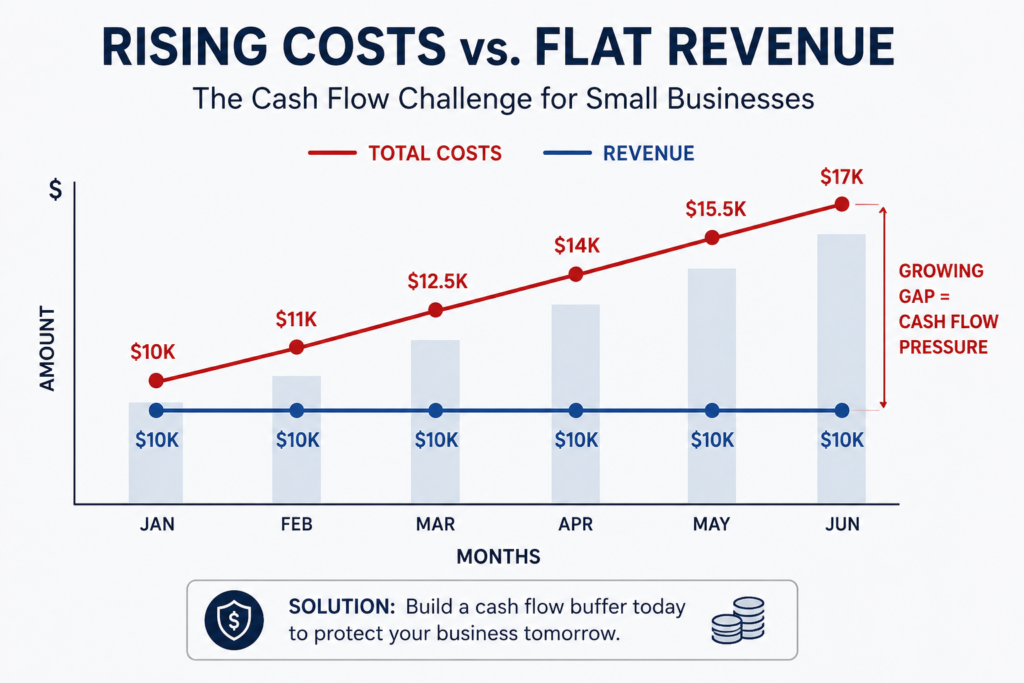
When supplier prices, rent, fuel, or wages rise, your business needs more cash just to maintain the same level of activity — even if sales stay exactly the same. A business that used to need $10,000 a month to operate might now need $12,000 simply to keep the lights on. If your reserves haven’t grown to match, you’re quietly becoming more financially fragile every month, even while everything looks “normal” on the surface.
Small businesses are especially exposed here because most operate with thin reserves to begin with. That’s exactly why a deliberate, rising-costs-aware buffer strategy matters more now than it did a few years ago.
How Big Should Your Cash Flow Buffer Be?
There’s no single number that fits every business, but here’s a practical way to think about it:
- Minimum starting point: 1 month of operating expenses. This covers the basics — payroll, rent, and essential bills — if income suddenly stops.
- Comfortable safety net: 3 months of operating expenses. This is the level most financial advisors recommend, and it gives you real breathing room to make decisions instead of panicking.
- Rising-cost adjustment: Add an extra 10–15% on top of your target to account for the fact that your “normal” expenses are likely to keep climbing over the next year.
To find your number, add up rent, payroll, supplier costs, software subscriptions, insurance, and any other recurring expense over the last three to six months, then divide by the number of months to get your average monthly burn rate. Multiply that by your target (1 month, 3 months, etc.) to get your buffer goal.

How to Build a Cash Flow Buffer for Small Business, Step by Step
1. Calculate Your True Monthly Burn Rate
Before you can build a buffer, you need to know exactly what it needs to cover. Pull your last 3–6 months of bank statements and total every recurring business expense — not just the obvious ones like rent and payroll, but also software subscriptions, insurance, loan payments, and supplier costs. Divide by the number of months to get an honest, current average. Revisit this number every quarter, since rising costs mean it rarely stays flat for long.
2. Set a Realistic Buffer Target
Using the guidance above, decide on your target: one month to start, building toward three. Write the actual dollar figure down. A vague goal like “save more” rarely gets funded; a specific number does.
3. Open a Separate Account for Your Buffer
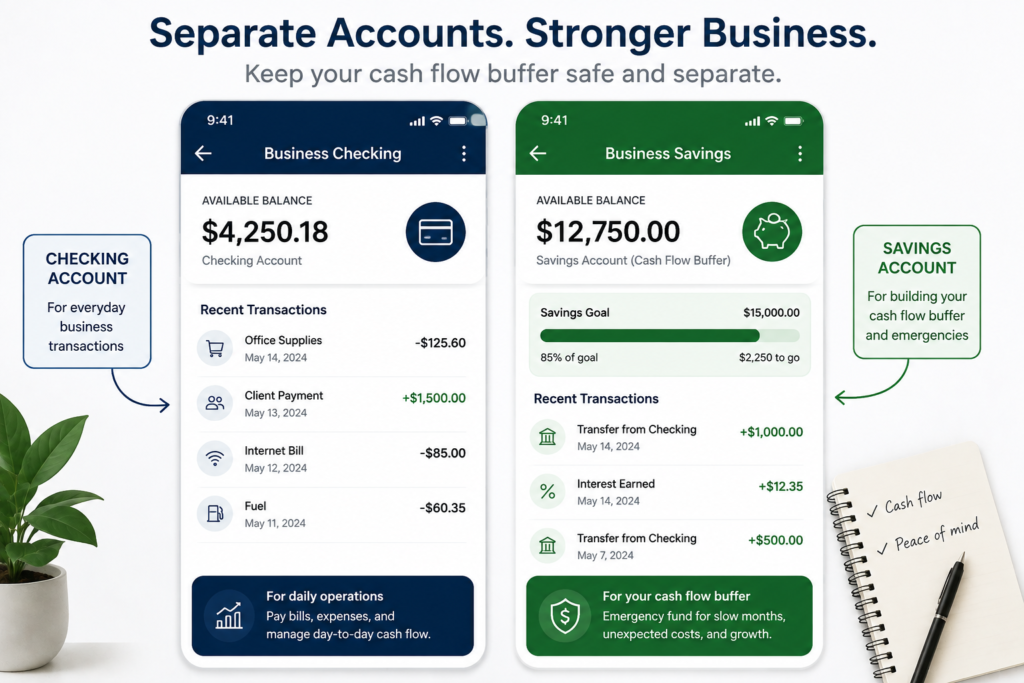
Keep your buffer in a separate business savings account, ideally one that earns a bit of interest but is still easy to access within a day or two. Mixing it with your operating account is the fastest way to accidentally spend it — if you can see it sitting next to your everyday cash, it’s tempting to treat it as available.
4. Automate Small, Consistent Contributions
Set up an automatic transfer — even 2–5% of weekly or monthly revenue — into your buffer account. Small, consistent contributions build a reserve far more reliably than “saving whatever’s left over,” because there’s rarely anything left over. Automating it removes the willpower requirement entirely.
5. Trim Costs Without Cutting What Drives Revenue
Review recurring expenses for anything you’re paying for but not fully using — unused software seats, duplicate tools, or subscriptions that quietly renewed. Redirect what you free up straight into your buffer. Be careful not to cut spending that actually generates revenue, like marketing that’s working or staff who directly serve customers; the goal is trimming waste, not starving growth.
6. Build In a Rising-Cost Cushion
Because costs are trending upward across most industries right now, add a deliberate inflation cushion on top of your baseline target — many advisors suggest around 10%. This protects you from the common trap of hitting your buffer goal, only to find it’s no longer enough six months later because your actual expenses grew in the meantime.
7. Revisit and Adjust Every Quarter
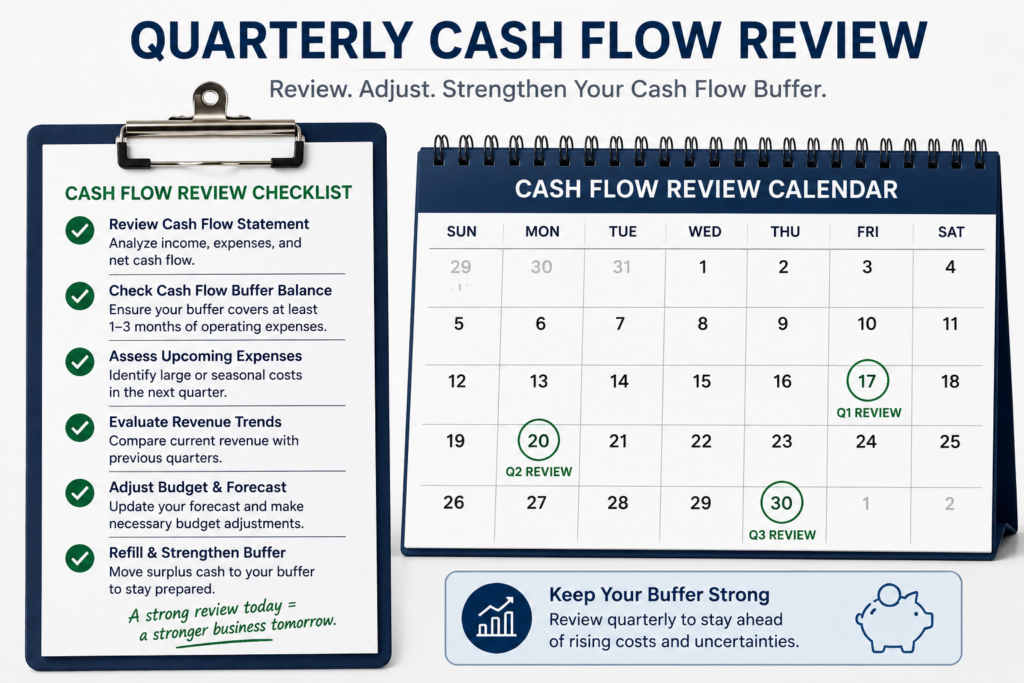
Treat your buffer as a moving target, not a one-time project. Every quarter, recalculate your average monthly expenses, check whether your buffer still covers your target number of months, and adjust your automatic contributions if costs have crept up. This quarterly check-in is what keeps a cash flow buffer for small business owners actually useful, instead of becoming outdated the moment prices shift again.
Where to Keep Your Buffer
Your buffer needs to stay liquid — accessible within a day or two — since the whole point is being able to use it fast in a real cash crunch. Good options include a high-yield business savings account, a money market account, or a short-term business CD laddered so a portion is always about to mature. Avoid tying your buffer up in anything that penalizes early withdrawal or takes weeks to access.
Common Mistakes to Avoid
- Treating the buffer as “extra” money. It’s not discretionary — it’s there for emergencies only, not for a slow-season marketing push or new equipment.
- Setting a target once and forgetting it. As costs rise, a buffer that was comfortable a year ago may now cover far less runway than you think.
- Keeping it in the same account as operating cash. Out of sight is what keeps it from being spent on everyday expenses.
- Waiting until you have “extra” cash to start. Automating even a small transfer now beats waiting for a better month that may not come.
Final Thoughts
A cash flow buffer for small business survival isn’t about hoarding cash — it’s about giving yourself room to make calm, deliberate decisions instead of reactive ones when costs rise or income dips. Start with your real monthly burn rate, set a specific target, automate small contributions, and revisit the number every quarter as prices shift. Businesses that treat their buffer as a living plan — not a one-time savings goal — are the ones that stay standing when the next round of price increases hits.







Pingback: How to Price Your Products When Costs Rise - Your Small Business Solutions
Pingback: Preparing Your Q4 Checklist for Small Business: A Practical Checklist - Your Small Business Solutions
Pingback: Small Business Loan Changes in 2026: What's Different - Your Small Business Solutions