Most small business plans are dead by February. Not because the owner stopped caring, but because the plan was a 30-page document nobody opened again after New Year’s Day. Good small business planning looks different: one afternoon, a few honest numbers, three goals and a calendar you actually check.
This guide walks you through small business planning for 2027 in seven simple steps. You’ll review 2026, pick three goals, turn your revenue target into a weekly number, trim your costs, map every key 2027 date and break the year into four 90-day sprints. Grab a coffee and a notepad. You can finish this before dinner.
Table of Contents
Why small business planning for 2027 should start in November
January is the worst month to plan. You’re tired from the holidays, invoices are piling up and the first quarter is already moving. November and early December give you three things January can’t:
- Fresh numbers. You have ten or eleven months of 2026 data, so your review is based on facts, not memory.
- Time to act before the holidays. Decisions about pricing, tools and year-end purchases still count for 2026.
- A head start on Q1. Valentine’s Day promotions need to be ready by mid-January. If you plan in November, you’re early instead of scrambling.
If you haven’t finished your year-end checks yet, pair this with our Q4 checklist for small business. It covers the operational side, while this post focuses on the year ahead.

Step 1: Review 2026 before you plan 2027
You can’t plan where you’re going without knowing where you are. Pull up your accounting software or bank statements and write down five numbers for 2026: total revenue, total expenses, profit, your best month and your worst month.
Then look for patterns. Was the slow month a one-off, or does it happen every year? Did one product or service carry the business? Most owners are surprised by at least one of these answers.
Use the start, stop, continue framework
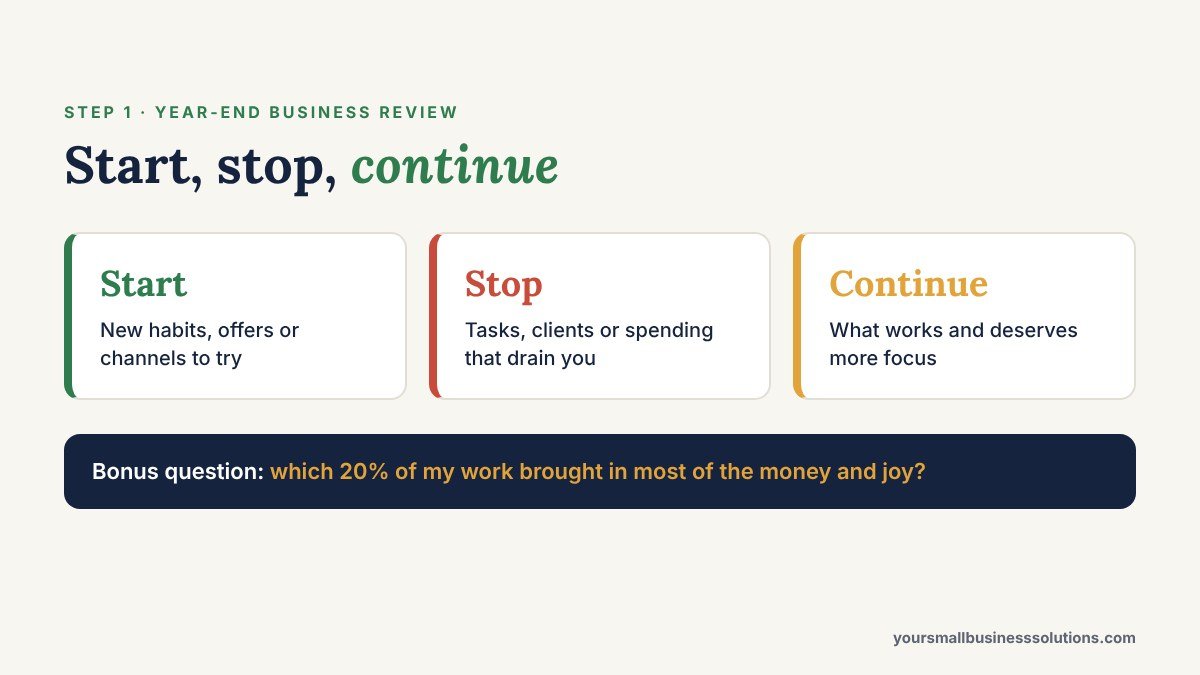
Next, answer three questions in a few lines each:
- Start: what new habit, offer or marketing channel should you try in 2027?
- Stop: which tasks, clients or expenses drain your time, money or energy?
- Continue: what’s already working and deserves more of your focus?
Finish with the 80/20 question: which 20% of my work brought in most of the money and joy? That answer usually points straight to your best 2027 goal.
Step 2: Know your best customers and offers
List your top five customers, or customer types if you serve many people. For each one, note what they buy, how often and how they found you. This tells you who to market to in 2027 and where to find more people like them.
Then rank your offers by profit, not popularity. A best-selling product with thin margins can keep you busy without growing your bank balance. A smaller offer with strong margins might deserve a bigger push. If rising costs are squeezing your margins, our guide on pricing when costs keep changing can help.
Step 3: Set three 2027 goals, no more
Write one sentence describing where you want the business to be at the end of 2027. Keep it simple: “A steady $10,000 a month, four days a week, with one part-time helper” is far more useful than a vague mission statement.
Then pick three goals that move you toward it. Each goal needs a number and a deadline. For example:
- Grow revenue from $95,000 to $120,000 by December 31, 2027.
- Add 150 people to the email list by June 30.
- Launch one new offer for existing customers by September 30.
Why three? Because every extra goal splits your attention. Small business owners already wear every hat, and a plan with ten goals usually finishes none of them.
Step 4: Turn your revenue goal into a weekly number
An annual revenue goal feels big and far away. A weekly number feels doable, and you can track it every Friday. Here’s the math using a $120,000 goal:
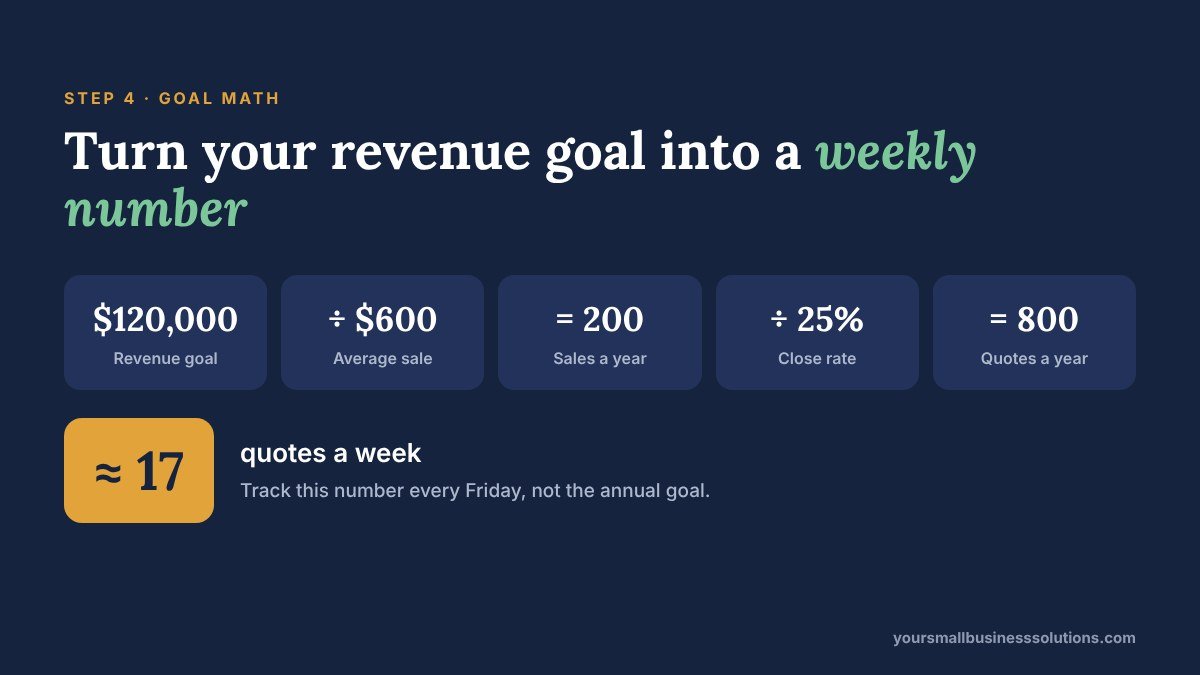
- Revenue goal: $120,000.
- Divide by your average sale ($600): 200 sales a year.
- Divide by your close rate (25%, or one in four quotes): 800 quotes a year.
- Divide by 48 working weeks: about 17 quotes a week.
Now you know the real job: get about 17 quotes, calls or proposals out every week. Swap in your own numbers, and if you sell online, use visitors and conversion rate instead of quotes.
Three ways to reach the goal faster
- Raise your average sale. Bundles, upsells and a modest price increase all shrink the number of sales you need.
- Improve your close rate. Faster follow-up and clearer proposals can turn one in four into one in three.
- Sell again to past customers. Repeat buyers cost far less to win than new ones. See our guide on turning one-time customers into repeat customers.
Step 5: Build a simple budget and audit your tools
Your 2027 budget doesn’t need to be complicated. Start with fixed costs (rent, insurance, software, loan payments), then variable costs (materials, ads, contractors), then what you’ll pay yourself. Compare the total with your revenue goal. If the gap is too thin, adjust now, not in July.
Then audit your subscriptions. Open your bank statements and list every recurring charge. For each one, ask: did I use this in the last 90 days, and would I sign up again today? Most small businesses find at least one or two tools they can cancel or downgrade. That’s money straight back into your marketing budget.
Step 6: Map your 2027 marketing calendar and key dates
Holidays and shopping events are free marketing hooks, but only if you plan them early. Here are the 2027 dates most small businesses should mark now:
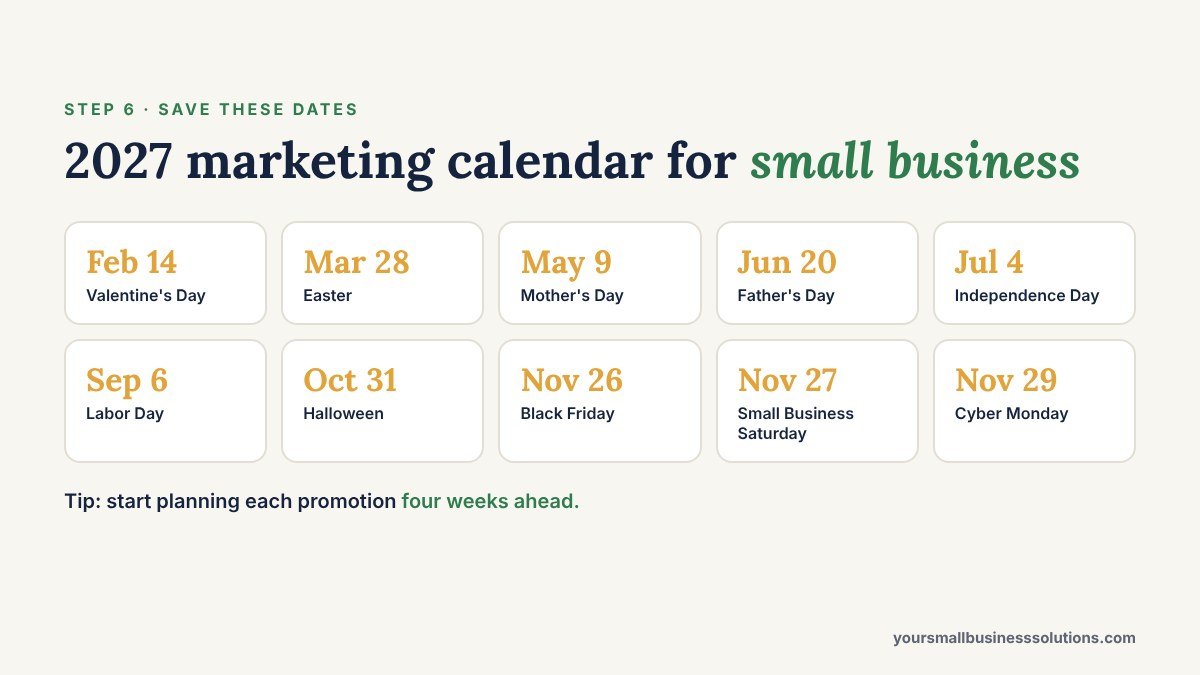
| Date | Event | Start planning by |
|---|---|---|
| Sun, Feb 14 | Valentine’s Day | Mid-January |
| Sun, Mar 28 | Easter | Late February |
| Sun, May 9 | Mother’s Day | Early April |
| Sun, Jun 20 | Father’s Day | Late May |
| Sun, Jul 4 | Independence Day | Early June |
| Mon, Sep 6 | Labor Day | Early August |
| Sun, Oct 31 | Halloween | Early October |
| Fri, Nov 26 | Black Friday | Late October |
| Sat, Nov 27 | Small Business Saturday | Late October |
| Mon, Nov 29 | Cyber Monday | Late October |
A simple rule: start planning each promotion four weeks ahead. That gives you time to create the offer, design graphics, write emails and schedule posts without a last-minute rush. Our Small Business Saturday guide shows what a well-planned holiday promotion looks like.
Key 2027 tax dates for US small businesses
Add these to the same calendar so they never sneak up on you. Always confirm the latest dates on the IRS tax calendar for businesses.
- Mon, Feb 1: W-2 and 1099-NEC forms due (January 31 falls on a Sunday).
- Mon, Mar 15: partnership and S corporation returns due.
- Thu, Apr 15: individual and C corporation returns, plus the first estimated tax payment.
- Tue, Jun 15 and Wed, Sep 15: second and third estimated tax payments.
- Mid-January 2028: fourth estimated payment. January 15 falls on a Saturday, so it moves to the next business day.
Getting ready for tax season now? Our year-end tax checklist for small business covers what to do before December 31.
Step 7: Break your 2027 plan into four 90-day sprints
A year is too long to stay focused. Ninety days is just right: long enough to finish real projects and short enough to keep the deadline in view. This is the part of small business planning that keeps the plan alive after January.
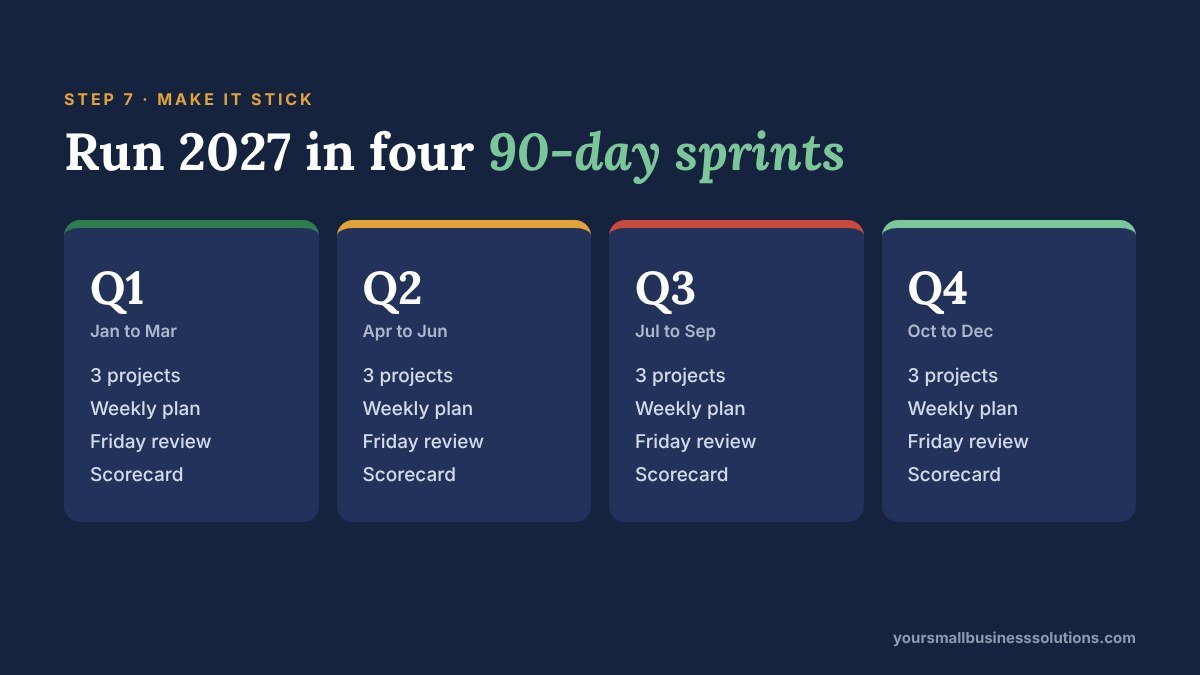
A simple theme for each quarter works for most businesses:
- Q1, fix and set up: systems, pricing and cleanup.
- Q2, grow: your biggest marketing push of the year.
- Q3, improve: offers and customer experience.
- Q4, cash in: the holiday season and planning for 2028.
For each sprint, pick three projects, then plan every week around them. On Friday, spend 15 minutes on a quick review: what got done, what’s stuck and what matters most next week. At the end of each quarter, score your progress and reset. This rhythm turns a plan on paper into results in the bank.
Get the 2027 Small Business Planning Kit
Want all of this in one printable workbook? The 2027 Small Business Planning Kit walks you through every step in this post with fill-in pages, so you can finish your plan in one afternoon.
- 2026 review pages: your year in numbers, wins and lessons, plus start, stop, continue.
- Customers and offers: your top five customers and offers ranked.
- Goals and goal math: three goals and the weekly-number worksheet.
- Budget and tools audit: a simple 2027 budget plus a subscription checklist.
- 2027 marketing calendar and key dates: all the retail and tax dates in one place.
- 90-day plans: sprint pages, weekly planning pages, a quarterly scorecard and a 2027 plan on a page.
It’s 17 printable pages for $19, written in plain English for small business owners and solopreneurs. Get the 2027 Small Business Planning Kit here.
Small business planning FAQ
When should I start planning for 2027?
November or early December is ideal. You have most of your 2026 numbers, there’s still time to act before year-end, and your Q1 promotions will be ready on time.
What should a one-page business plan include?
A one-sentence vision, three goals with numbers and deadlines, your weekly target, a simple budget, your key dates and the three projects for your first 90 days.
How many goals should a small business set for the year?
Three is the sweet spot. Fewer goals mean more focus, and you’re far more likely to finish them.
How do I stick to my business plan?
Break the year into 90-day sprints, track one weekly number and do a 15-minute review every Friday. Small, regular check-ins beat one big plan you never look at again.
Start your small business planning this week
You don’t need a perfect plan. You need an honest review, three clear goals, a weekly number and a calendar you’ll actually use. Block out one afternoon this week, work through the seven steps and walk into 2027 knowing exactly what to do on Monday morning.
For more depth on writing a formal plan, the SBA’s guide to writing a business plan is a solid free resource. And if you’d rather skip the blank page, the 2027 Small Business Planning Kit has every worksheet ready to print.