If you run a small business in the US, the next eight weeks matter more for your 2026 tax bill than anything you do in April. By the time you file, most of your options are locked in. This year-end tax checklist for small business owners walks you through the moves to make before December 31, 2026, while you can still act on them.
It’s written for sole proprietors, LLCs, S corporations and small C corporations. You’ll find what changed for 2026, 12 practical year-end tax moves, the key deadlines from now to April 2027 and the questions worth asking your accountant. The rules covered are federal, and every figure comes from IRS guidance.
Quick note: this is general education, not tax advice. The right moves depend on your entity, income and accounting method, so confirm decisions with a qualified tax professional.
Table of Contents
What changed for small business tax planning in 2026
The One Big Beautiful Bill Act, signed in July 2025, made several small business tax breaks permanent and changed some reporting rules. These are the changes most likely to affect your year-end planning.
- 100% bonus depreciation is permanent. Qualifying equipment acquired after January 19, 2025 can be fully deducted in the year it’s placed in service, instead of the phase-down the old law scheduled.
- The Section 179 limit is $2.56 million for 2026. It phases out dollar for dollar once you place more than $4.09 million of qualifying property in service in the year.
- The 20% QBI deduction is permanent. From 2026, owners with at least $1,000 of qualified business income from a business they actively run get a minimum $400 deduction.
- The 1099-NEC and 1099-MISC threshold rises to $2,000. For payments made in 2026, you generally only issue these forms once you pay someone $2,000 or more in the year, up from $600.
- The 1099-K threshold is back to $20,000 and 200 transactions. Payment apps and marketplaces only report once you pass both.
- The SALT cap is $40,400. Owners who itemize can deduct up to $40,400 of state and local taxes. The cap shrinks above $505,000 of modified AGI, but not below $10,000.
- Tips and overtime go on W-2s. Workers can deduct qualified tips and overtime premium pay for 2025 through 2028, and employers report these amounts on updated 2026 Forms W-2.
- No BOI report for US companies. FinCEN has exempted companies created in the United States from beneficial ownership information reporting.
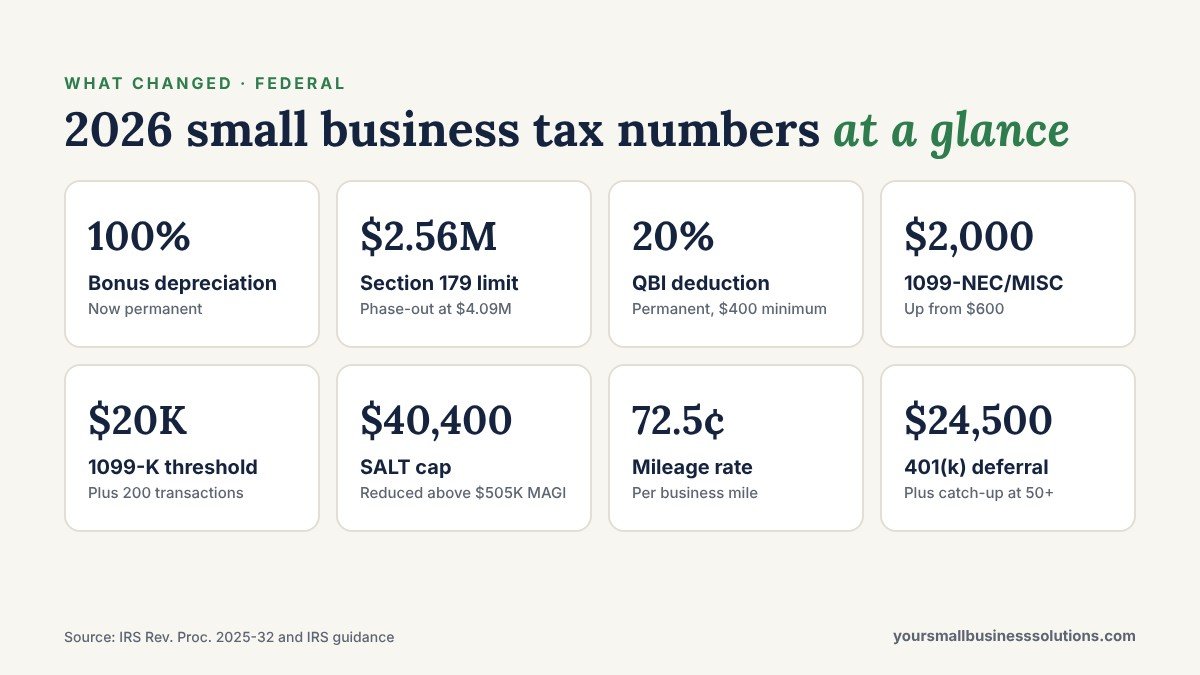
A few other 2026 numbers worth knowing: the standard business mileage rate is 72.5 cents per mile, the 401(k) employee deferral limit is $24,500 and the total defined contribution limit, including SEP IRAs, is $72,000.
Your year-end tax checklist for small business: 12 moves before December 31
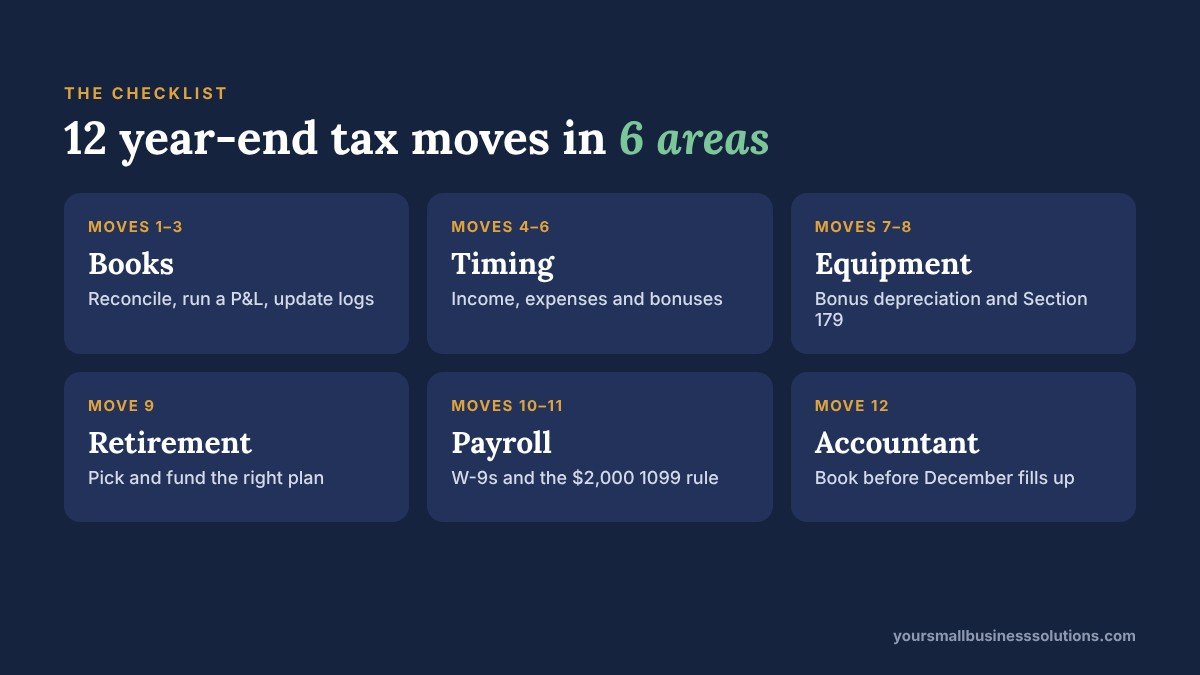
This year-end tax checklist for small business covers 12 moves in six areas. Work through them in order: clean books come first, because every other decision depends on knowing roughly what you’ll earn this year.
Get your books in order
1. Reconcile every account through November. Match each business bank and credit card account to your books, categorize anything uncategorized and separate personal expenses paid from business accounts. Clean books mean your accountant spends their time saving you money, not sorting receipts at an hourly rate.
2. Run a year-to-date profit and loss with a projection to December 31. This single number drives every timing decision that follows. Add a balance sheet and a comparison with last year, so unusual swings stand out before your accountant asks about them.
3. Update your mileage log and fixed-asset list. List anything you bought or sold this year, count inventory if you carry it and pull your mileage log together. If it’s patchy, rebuild it from your calendar now, while you still remember the trips.
Time your income and expenses
4. Decide whether to defer income or accelerate it. If you expect a similar or lower tax bracket next year, pushing some income into 2027 can help. If 2027 looks like a bigger year, collecting more in 2026 may be smarter. If you use cash accounting, timing December invoices is one lever, but only with your accountant’s agreement, and never by holding deposits you’ve actually received.
5. Pay deductible expenses you’d pay anyway. Supplies, software subscriptions, repairs, January marketing and outstanding vendor bills can often be paid before December 31. Just don’t spend to save tax: a $1,000 expense you didn’t need saves roughly $200 to $350 in tax and still leaves you hundreds of dollars poorer.
6. Settle year-end bonuses before your final payroll. Decide what you’ll pay and when and ask how timing works for your entity and accounting method.

Equipment and vehicles
7. Use bonus depreciation or Section 179 for planned purchases. With 100% bonus depreciation and a $2.56 million Section 179 limit, most small businesses can deduct the full cost of qualifying equipment in the year they start using it. The key word is using: equipment generally has to be placed in service, meaning set up and ready to use, by December 31. Something delivered on January 3 counts for 2027. The two methods work differently, especially for state taxes, so ask which suits you.
8. Check your vehicle deductions. Heavy SUVs over 6,000 pounds have a separate $32,000 Section 179 limit for 2026. Compare the actual-expense method with the 72.5-cent standard mileage rate, and keep a log with the date, purpose and miles for each trip.
If a big equipment purchase would squeeze your cash, read our guide to small business loan changes in 2026 before you sign anything. A tax deduction never makes up for running short of cash.
Retirement and benefits
9. Pick and fund the right retirement plan. Retirement contributions lower your taxes and build your own wealth at the same time. A solo 401(k) suits owners with no employees other than a spouse, with a $24,500 deferral plus an employer contribution up to $72,000 in total. A SEP IRA is simpler to set up, and a SIMPLE IRA fits small teams. Deadlines differ by plan type, and some contributions must be elected before December 31, so ask which plans you can still open for 2026 and by when.
While you’re at it, ask about the small employer credits for starting a new plan, and about a QSEHRA if you want to reimburse employees’ health costs tax-free: up to $6,450 for self-only or $13,100 for family coverage in 2026.
Payroll and contractors
10. Collect W-9s now. List everyone you paid for services in 2026 and get a Form W-9 from each before you pay them again. Forms 1099-NEC and W-2s are due February 1, 2027, barely a month after the holidays.
11. Apply the new $2,000 1099 threshold. For 2026 payments, flag anyone you paid $2,000 or more. Payments by card or payment app are usually reported on Form 1099-K by the processor instead. If you have employees, confirm your payroll is tracking qualified tips and overtime separately for the new W-2 reporting. Our guide to hiring your first employee covers the payroll basics if you’re new to this.
Book your accountant
12. Book your year-end meeting this week. Accountants’ calendars fill up fast in December. A late-November or early-December meeting leaves you time to actually act on their advice, rather than hearing in March what you could have done.
Small business tax deadline calendar: November 2026 to April 2027
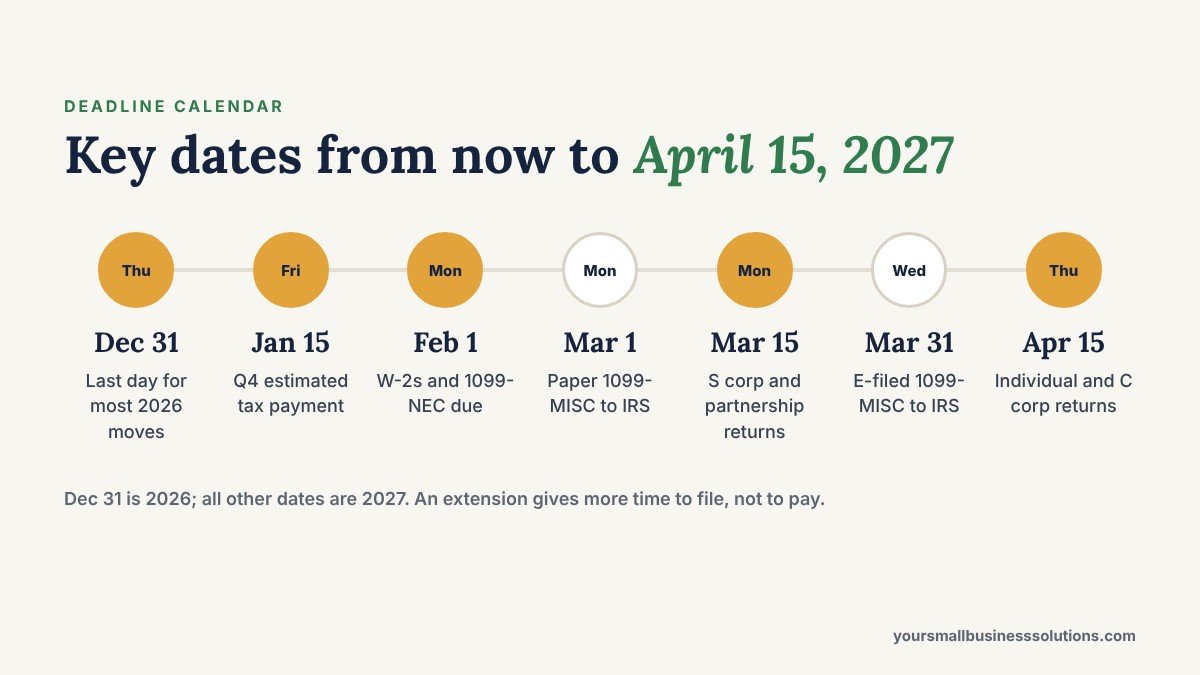
Many year-end tax moves only count if they happen by Thursday, December 31, 2026. Filing deadlines follow quickly in early 2027.
| Date | What’s due |
|---|---|
| By Nov 30, 2026 | Request W-9s from contractors and start your book cleanup |
| Thu, Dec 31, 2026 | Last day for most 2026 moves: equipment placed in service, expenses paid, charitable gifts |
| Fri, Jan 15, 2027 | Fourth-quarter 2026 estimated tax payment |
| Mon, Feb 1, 2027 | Forms W-2 to employees and the SSA; Forms 1099-NEC to recipients and the IRS; Form 1099-MISC to recipients |
| Mon, Mar 1, 2027 | Paper Forms 1099-MISC to the IRS |
| Mon, Mar 15, 2027 | S corporation (Form 1120-S) and partnership (Form 1065) returns, or an extension |
| Wed, Mar 31, 2027 | Electronically filed Forms 1099-MISC to the IRS |
| Thu, Apr 15, 2027 | Individual returns, including Schedule C, and calendar-year C corporation returns, or an extension |
Two things to remember: an extension gives you more time to file, not to pay, and if you file 10 or more information returns in total (W-2s and 1099s combined), the IRS generally requires you to file them electronically. For other filing dates through the rest of the year, see our list of compliance deadlines small business owners shouldn’t miss.
Questions to ask your accountant before year-end
Your accountant bills by the hour, so the most expensive meeting is the one where you arrive with a box of receipts and no questions. Send a short list ahead of time. Here are six to add to your year-end tax checklist for small business:
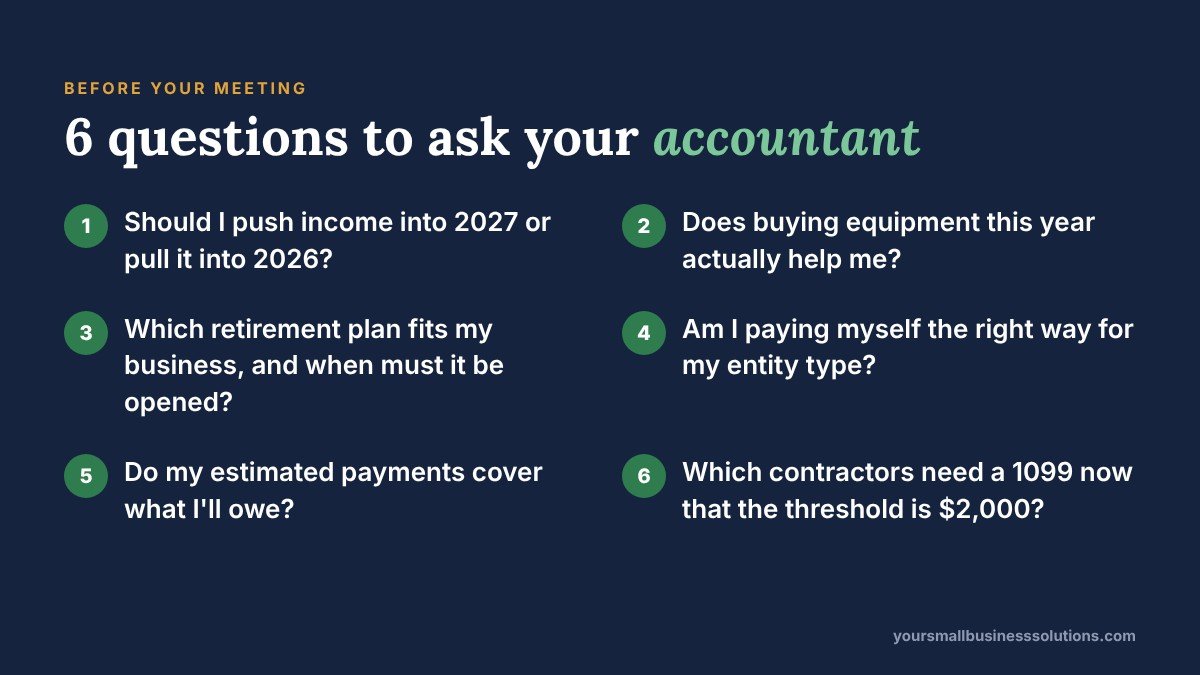
- Based on my numbers so far, should I push income into 2027 or pull expenses into 2026?
- Does buying planned equipment this year actually help me, or just reduce cash I need?
- Which retirement plan fits my business, and what’s the deadline to set it up and fund it?
- Am I paying myself the right way for my entity type, and is my S corporation salary reasonable?
- Are my estimated payments on track, and how much should my January 15 payment be?
- Which contractors need a 1099 now that the threshold is $2,000?
Bring your year-to-date P&L and balance sheet, bank and card statements, your fixed-asset list, mileage log, payroll reports, contractor list with W-9s and any 1099-K forms you expect. If something isn’t ready, say so: a good accountant can still plan with honest estimates.
Get the printable year-end tax checklist
If you want this whole year-end tax checklist for small business in one place, The Year-End Tax Prep Checklist 2026 is a 15-page printable PDF that goes deeper than this post. It includes a one-page table of the 2026 numbers, the full deadline calendar, detailed checklists for books, timing, equipment, retirement and payroll, all 30 questions to ask your accountant, the documents to hand over and a printable master checklist. It’s $19 and written in plain English.
Whether you use the printable version or not, start your year-end tax moves with two things this week: book your accountant and reconcile your books through October. Everything else gets easier once those are done. For a broader look at the quarter, our Q4 checklist for small business covers the non-tax side too.
Year-end tax checklist for small business: FAQ
What should a small business do before the end of the year for taxes?
A year-end tax checklist for small business starts with your books. Reconcile them, project your profit to December 31, decide on equipment purchases and retirement contributions, time income and expenses where it makes sense, collect W-9s from contractors and meet your accountant before December 31.
What is the 1099 threshold for 2026?
For payments made in 2026, you generally need to issue a Form 1099-NEC or 1099-MISC once you pay someone $2,000 or more in the year, up from $600. The Form 1099-K threshold for payment apps and marketplaces is more than $20,000 and more than 200 transactions.
Can I still deduct equipment if I buy it in December?
Yes, if it’s placed in service, meaning set up and ready to use, by December 31. With 100% bonus depreciation and a $2.56 million Section 179 limit for 2026, qualifying equipment can often be fully deducted that year. Equipment that arrives or is installed in January counts for 2027.
When is the Q4 estimated tax payment due?
The fourth-quarter 2026 estimated tax payment is due Friday, January 15, 2027.
Is the QBI deduction still available in 2026?
Yes. The 20% qualified business income deduction is now permanent, and from 2026 owners with at least $1,000 of QBI from a business they actively run get a minimum $400 deduction. Income limits and wage rules still apply above $201,750 for single filers and $403,500 for married couples filing jointly.
Sources
- Revenue Procedure 2025-32: 2026 inflation adjustments — IRS
- One, Big, Beautiful Bill news — IRS
- 2026 standard mileage rates — IRS
- 2026 401(k) and IRA limits — IRS
- Tax calendar for businesses and self-employed — IRS
- Beneficial ownership information reporting — FinCEN
This post is for educational purposes only and isn’t tax, legal or financial advice.