Your 2026 investment tax bill locks in on Thursday, December 31. After that, you can report what happened, but you can’t change it. That’s why tax-loss harvesting 2026 planning, along with a handful of other year-end tax moves for investors, needs to happen in the next few weeks.
This guide is for US investors and active traders with stocks, ETFs, mutual funds or crypto. It covers how tax-loss harvesting works, the wash-sale traps that quietly cancel losses, when taking gains is smarter, what the new crypto Form 1099-DA means for 2026, and the retirement and giving moves with a December 31 deadline. Every figure comes from IRS guidance for tax year 2026.
Quick note: this is general education, not tax or investment advice. The right moves depend on your income, accounts and state, so confirm decisions with a qualified tax professional.
Table of Contents
The 2026 numbers investors need to know
Long-term capital gains, on assets held more than a year, get lower tax rates than short-term gains, which are taxed like wages. The brackets use your total taxable income, including the gains.
| Filing status | 0% rate | 15% rate | 20% rate |
|---|---|---|---|
| Single | Up to $49,450 | $49,451 to $545,500 | Over $545,500 |
| Married filing jointly | Up to $98,900 | $98,901 to $613,700 | Over $613,700 |
| Head of household | Up to $66,200 | $66,201 to $579,600 | Over $579,600 |
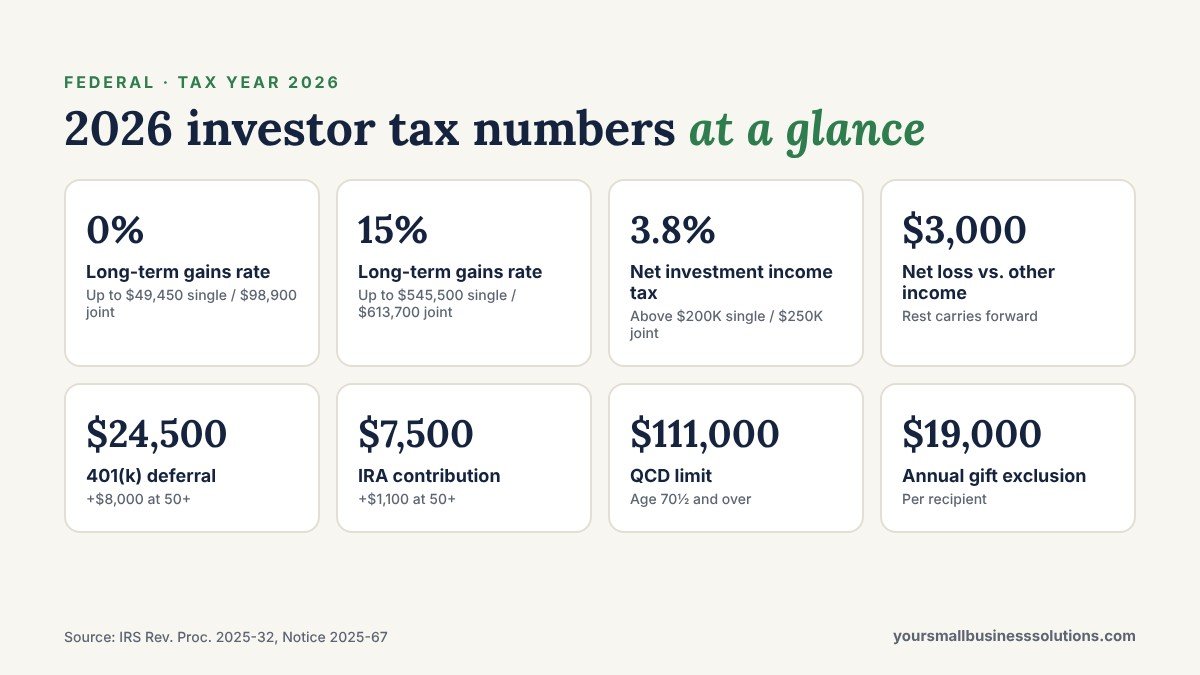
- Net investment income tax: an extra 3.8% on investment income once modified AGI passes $200,000 (single) or $250,000 (joint).
- Capital loss limit: net losses offset up to $3,000 of other income a year. The rest carries forward indefinitely.
- Retirement limits: $24,500 for 401(k) deferrals (plus $8,000 at 50+, or $11,250 at ages 60 to 63) and $7,500 for IRAs (plus $1,100 at 50+).
- Giving: a $111,000 limit on qualified charitable distributions and a $19,000 annual gift exclusion per recipient.
Tax-loss harvesting in 2026: how it works, step by step
Tax-loss harvesting means selling an investment that’s down so you can use the loss to cancel out gains, then reinvesting so you stay in the market. Done well, it lowers this year’s tax without changing your long-term plan.
How gains and losses net out
Short-term losses offset short-term gains first, and long-term losses offset long-term gains first. Any net loss in one group then offsets net gains in the other. If you still have a net loss, up to $3,000 can offset ordinary income such as wages, and anything left carries forward to 2027.
This order matters. A loss that cancels a short-term gain saves tax at your ordinary rate, which can be as high as 37%. The same loss against a long-term gain may only save 15%.
Six steps to harvest losses
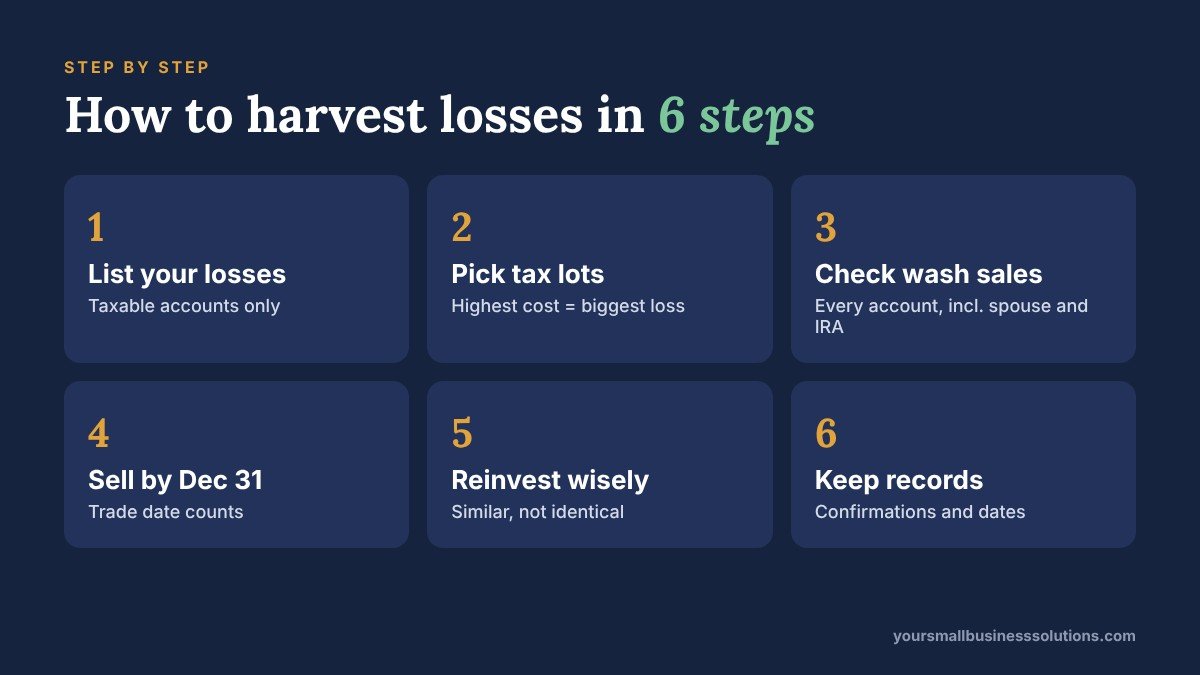
- List your losses. Only positions in taxable accounts count. Losses inside IRAs and 401(k)s can’t be harvested.
- Pick your tax lots. If you bought at different prices, selling the highest-cost shares gives the biggest loss. Set your broker to “specific identification” before you trade.
- Check for wash sales across every account you and your spouse own (see the traps below).
- Sell by Thursday, December 31, 2026. For stocks and ETFs, the trade date counts, not the settlement date.
- Reinvest wisely. Buy something similar but not substantially identical, such as a fund tracking a different index, or wait 31 days to buy back.
- Keep records of trade confirmations and replacement purchase dates.
Example: you’ve realized $12,000 of short-term gains this year, and you hold a fund showing an $8,000 loss. Selling it and buying a similar fund cancels $8,000 of gains. At a 24% tax rate, that’s about $1,920 less tax for 2026, and you’re still invested.
One trade-off: harvesting lowers the cost basis of your replacement, so you may owe more when you eventually sell. The real benefit comes from deferring tax, using losses against high-rate short-term gains, or banking losses to offset future gains.
7 wash-sale traps that cancel your losses
The wash sale rule says that if you sell a security at a loss and buy the same or a “substantially identical” one within 30 days before or after the sale, the loss is disallowed for now. That’s a 61-day window around every loss sale. Usually the loss is added to the cost of the new shares, so you get it back later. But some traps make it disappear for good.
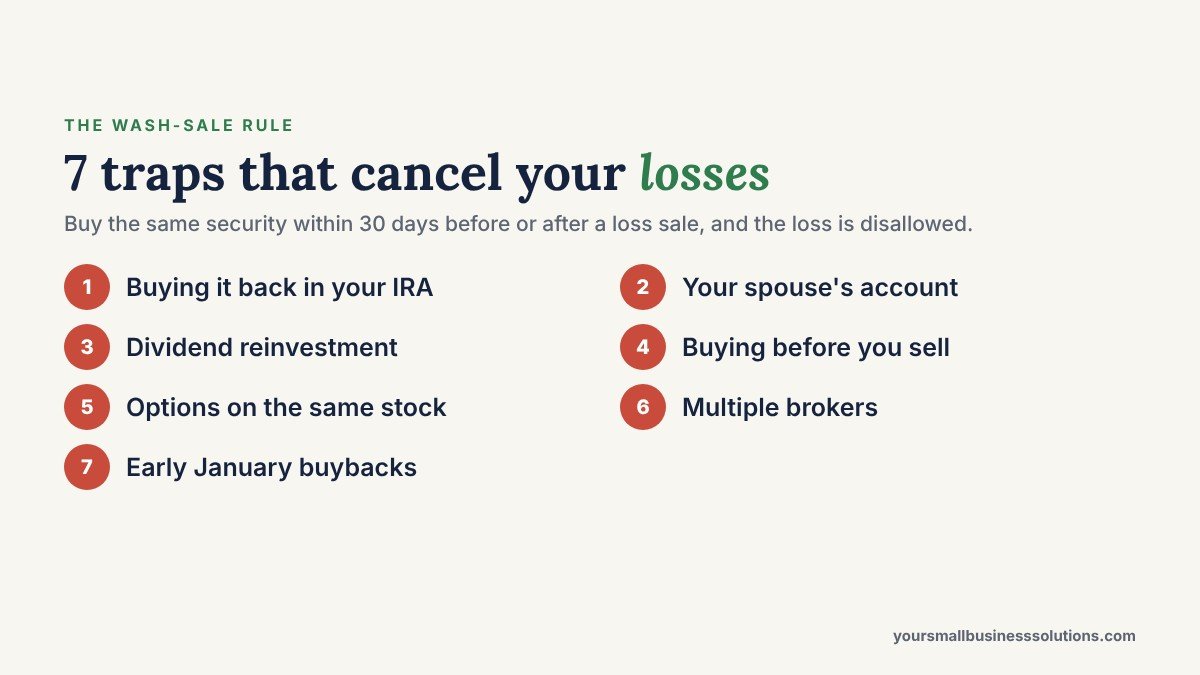
- Buying it back in your IRA. Selling at a loss in a taxable account and buying the same fund in your IRA within 30 days permanently disallows the loss.
- Your spouse’s account. A purchase by your spouse counts as yours.
- Dividend reinvestment. A small automatic reinvestment inside the window can wash part of your loss. Turn it off on positions you plan to harvest.
- Buying before you sell. The window runs 30 days before the sale too. Shares bought December 5 can wash a loss sale on December 20.
- Options. Buying a call option on the same stock can count as buying the stock.
- Multiple brokers. Each broker only tracks wash sales in its own accounts. Spotting them across brokers is up to you.
- Early January buybacks. A December 31 loss sale is washed by a repurchase up to January 30, 2027. Wait until February 1 to be safe.
Does the wash sale rule apply to crypto?
Under current law, the rule covers “stock or securities”, and the IRS hasn’t issued guidance applying it to cryptocurrency you hold directly. Many tax professionals therefore treat spot crypto as outside the rule for 2026. But crypto ETFs and other crypto-linked securities are covered, and Congress is weighing a change: the House Ways and Means Committee approved the Digital Asset Tax Certainty Act on September 16, 2026, which would extend wash-sale rules to digital assets. As of early November 2026 it isn’t law, so check its status with your tax pro before selling crypto at a loss and buying straight back.
When taking gains is the smarter move
Year-end planning isn’t only about losses. In some years, selling winners on purpose saves tax later.
- Harvest gains in the 0% bracket. If your 2026 taxable income, including the gain, stays under $49,450 (single) or $98,900 (joint), long-term gains are taxed at 0% federally. You can sell, buy straight back (wash-sale rules only apply to losses) and reset your cost basis higher.
- Mind the NIIT line. A big gain can push you over the 3.8% threshold. Splitting a sale across December and January may help.
- Wait for long-term status. If a large gain turns long-term in a few weeks, waiting can cut the rate from as high as 37% to 15% or 20%.
- Avoid the December fund trap. Many mutual funds pay out capital gains in December. Buying just before the ex-dividend date means paying tax on a distribution that simply returns your own money.

Crypto investors: what the new Form 1099-DA means for 2026
Form 1099-DA is the new form crypto brokers use to report your sales to the IRS. For 2025 sales, exchanges reported gross proceeds only. For 2026 sales, they also report cost basis and purchase dates for “covered” coins, generally those bought on or after January 1, 2026 and held at that exchange ever since.
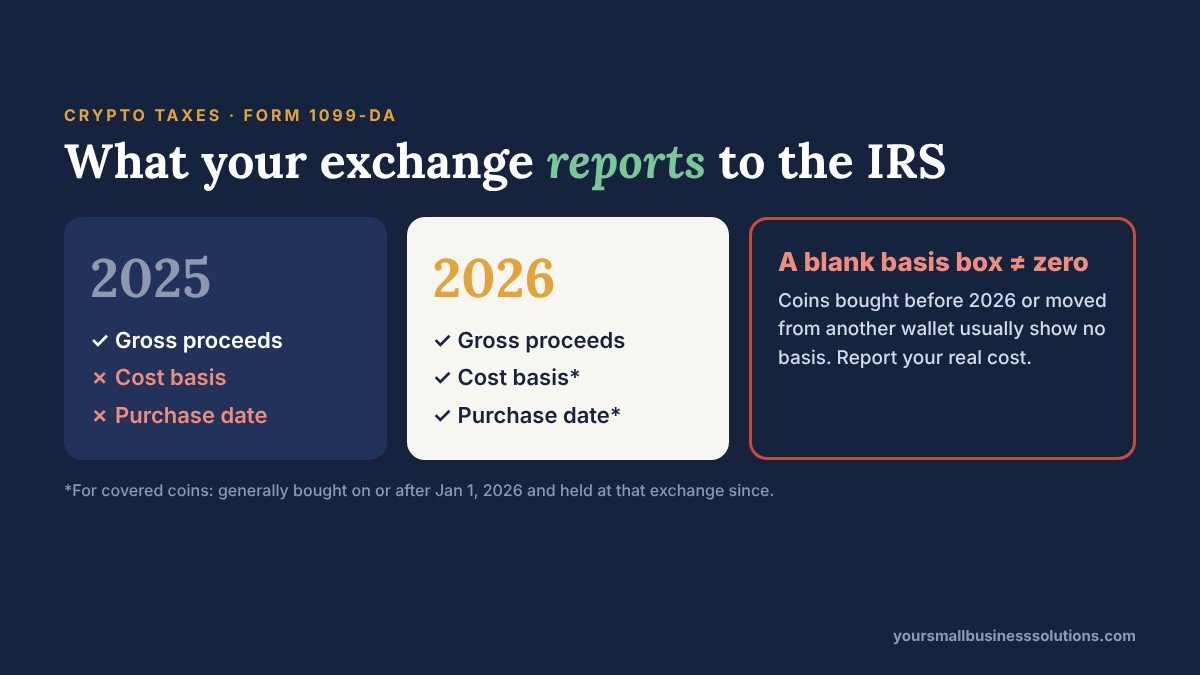
- Coins bought before 2026, or moved in from another wallet, usually show no basis. A blank box doesn’t mean zero. Report your real cost, or you’ll be taxed on the full sale amount.
- Self-custody wallets and DeFi protocols don’t issue 1099-DAs, but those trades are still taxable.
- Every crypto-to-crypto swap, and every purchase made with crypto, counts as a sale.
- Before December 31, export your full 2026 history from every exchange and wallet and record the purchase price of every pre-2026 coin.
If you hold crypto, protecting it matters as much as the tax side. Our crypto security checklist covers the scams that cost investors billions, and our look at what moves the Bitcoin price explains the bigger picture.
Retirement and giving moves with a December 31 deadline
Some moves can wait until you file in April. These can’t:
| Move | Deadline for 2026 |
|---|---|
| Roth conversion | Thu, Dec 31, 2026 |
| Required minimum distribution (age 73+) | Thu, Dec 31, 2026 |
| Qualified charitable distribution (age 70½+) | Thu, Dec 31, 2026 |
| 401(k) deferrals | Your last 2026 paycheck |
| IRA and HSA contributions for 2026 | Thu, Apr 15, 2027 |
- New Roth catch-up rule: from 2026, if you’re 50+ and earned more than $150,000 in FICA wages from your employer in 2025, your 401(k) catch-up contributions must go in as Roth.
- Roth conversions make sense in lower-income years, but they can’t be undone and they raise your income for NIIT and Medicare premiums.
- Give appreciated shares, not cash. Donating shares held more than a year usually lets itemizers deduct full market value and never pay tax on the gain. Never donate shares at a loss: sell them, harvest the loss, then give the cash.
- New for 2026: if you take the standard deduction, you can deduct up to $1,000 (single) or $2,000 (joint) of cash gifts to qualifying charities. Itemizers face a new floor: only giving above 0.5% of AGI counts.

Your tax-loss harvesting 2026 checklist
Work through these before Thursday, December 31:
- Download realized gains and losses for 2026 from every account
- Find your 2025 capital loss carryforward on last year’s Schedule D
- Check funds’ estimated year-end distributions
- List positions at a loss and set specific-ID cost basis
- Turn off dividend reinvestment on positions you’ll sell
- Check wash sales across every account, including IRAs and your spouse’s
- Look at the 0% gains bracket if your income is low
- Export and reconcile your crypto history
- Make Roth conversions, RMDs and QCDs by December 31
- Book time with your tax pro
Get the printable investor tax guide
If you want everything in one place, Year-End Tax Moves for Investors & Traders 2026 is a 15-page printable PDF that goes deeper than this post. It includes a gain and loss scorecard, the full 2026 numbers, a page on crypto and the 1099-DA, rules for active traders including the 475(f) election, a deadline calendar to April 15, 2027, 20 questions to ask your tax pro and a master checklist. It’s $15 and written in plain English.
Run a small business as well? See our year-end tax checklist for small business for the business side of December planning.
Tax-loss harvesting 2026 FAQ
What is tax-loss harvesting?
It’s selling an investment at a loss to offset capital gains, and up to $3,000 of other income, then reinvesting in something similar so you stay invested. Unused losses carry forward to future years.
What is the deadline for tax-loss harvesting in 2026?
Thursday, December 31, 2026. For stocks and ETFs, the trade date counts, so a sale placed on December 31 counts for 2026 even if it settles in January.
Does the wash sale rule apply to crypto in 2026?
Under current law, the IRS hasn’t applied it to cryptocurrency held directly, though crypto ETFs are covered. A bill extending the rule to digital assets passed the House Ways and Means Committee in September 2026 but isn’t law yet.
How much capital loss can I deduct in 2026?
Losses first offset capital gains in full. After that, up to $3,000 of net loss ($1,500 if married filing separately) offsets other income, and the rest carries forward.
What is Form 1099-DA?
It’s the form crypto brokers use to report digital asset sales to the IRS. For 2026 sales, it shows proceeds plus cost basis for coins bought on or after January 1, 2026 and held at the same exchange.
Sources
- Revenue Procedure 2025-32: 2026 inflation adjustments — IRS
- 2026 401(k) and IRA limits — IRS
- Publication 550, Investment Income and Expenses — IRS
- Instructions for Form 1099-DA — IRS
- One, Big, Beautiful Bill news — IRS
- Ways and Means approves digital assets tax bill — EY Tax News
This post is for educational purposes only and isn’t tax, legal, investment or financial advice.