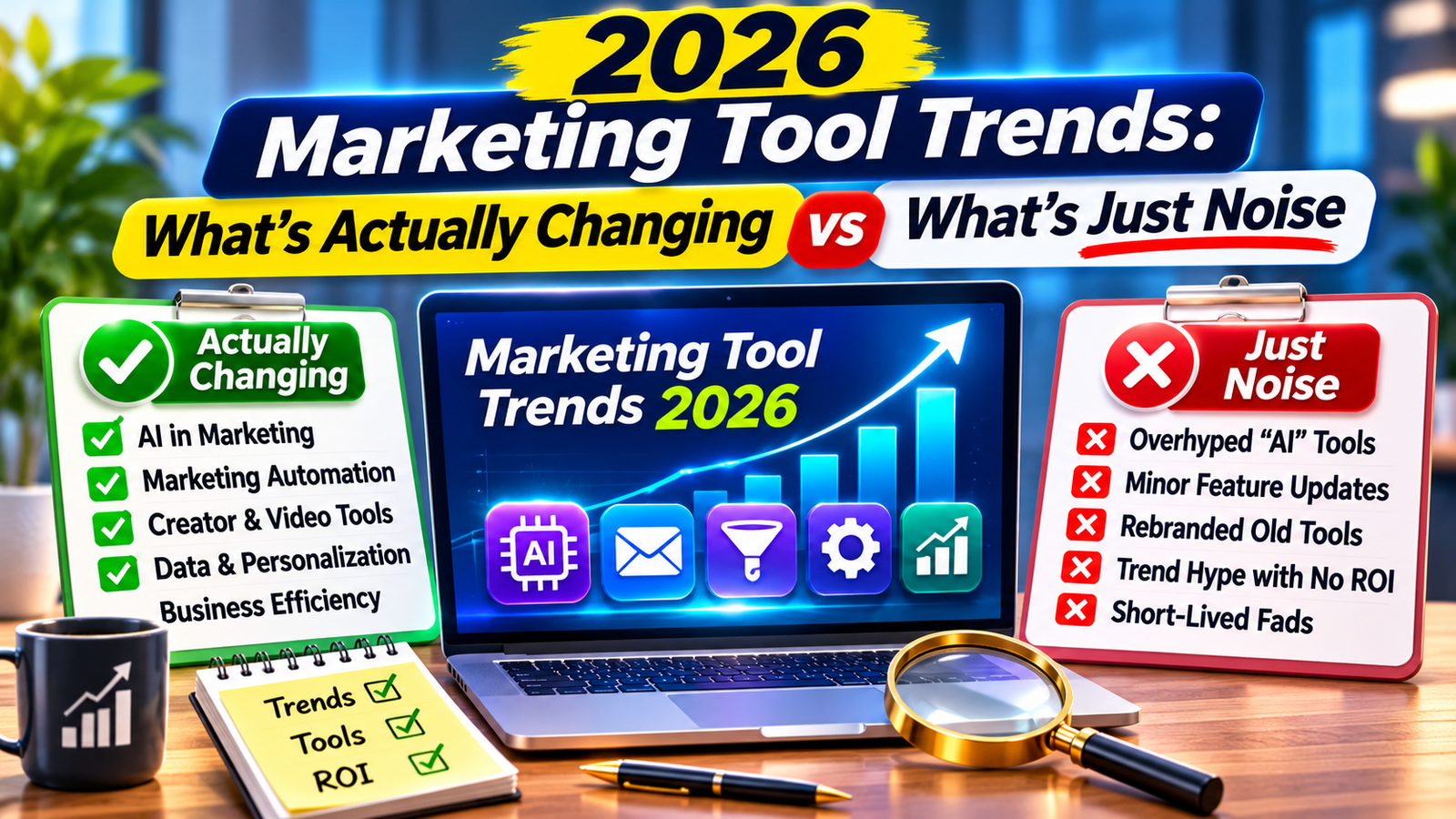
Marketing tool trends in 2026 come with a lot of noise. Every software company now calls its product “AI-powered,” and every conference promises the next big shift. If you run a small business, you cannot test all of it, and you should not try.
This guide sorts the marketing tool trends of 2026 into two lists: the shifts that are actually changing how small businesses market, and the hype you can safely skip for now. You will also get a simple test for judging any new tool, so you can decide with results instead of sales pages.
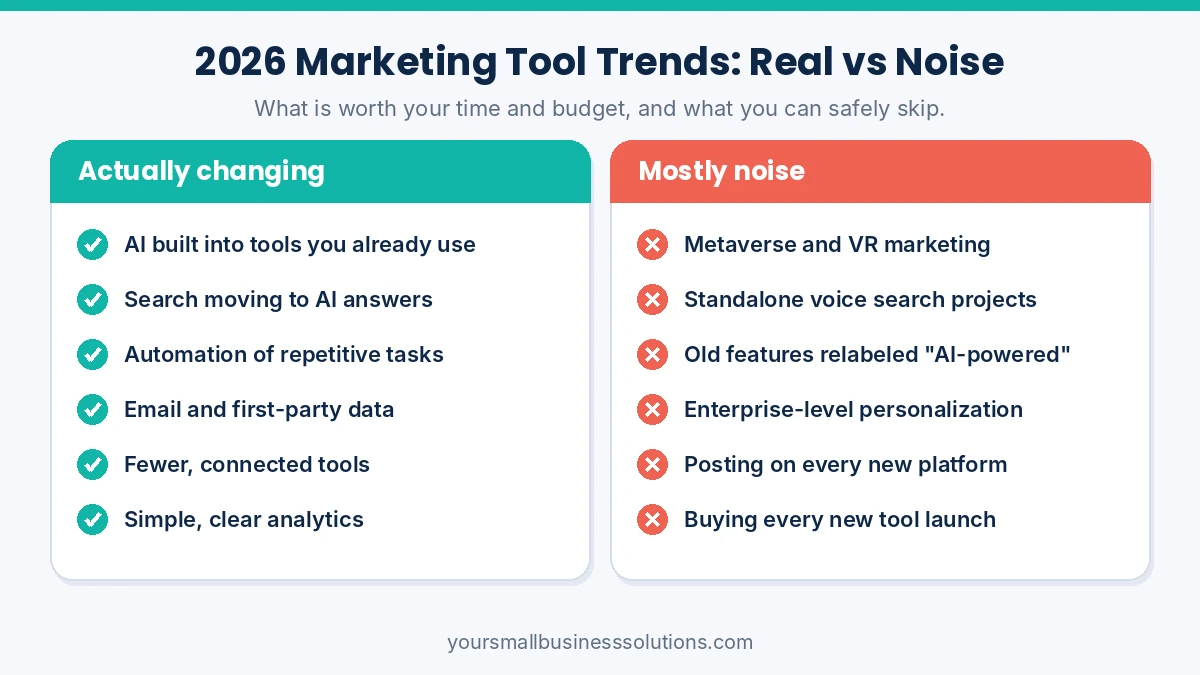
Table of Contents
How to Tell a Real Trend From Noise
Before the list, here is the filter used to sort every trend below. Ask three questions:
- Does it save time or money within a quarter? If the payoff is “someday,” it can wait.
- Is it built into tools you already pay for? The best changes cost you nothing extra.
- Can you measure the result? If you cannot tell whether it worked, you cannot justify paying for it.
If a trend fails all three, treat it as noise for now. If it passes two, it is worth a small test. This matters because most marketing tool trends are first explained by the companies selling the tools.
The Marketing Tool Trends That Are Actually Changing Things
Six shifts stand out in 2026. None of them needs a big budget.
1. AI Is Moving Inside the Tools You Already Use
AI is no longer a separate product category. Email platforms, design tools, schedulers and website builders now ship with AI features built in: subject line ideas, image generation, caption drafts and page copy. HubSpot’s 2026 State of Marketing report, based on data from 1,500+ marketers, lists using AI to personalize content (48.57%) and leveraging automation (47.38%) among the top trends. See the full HubSpot data.
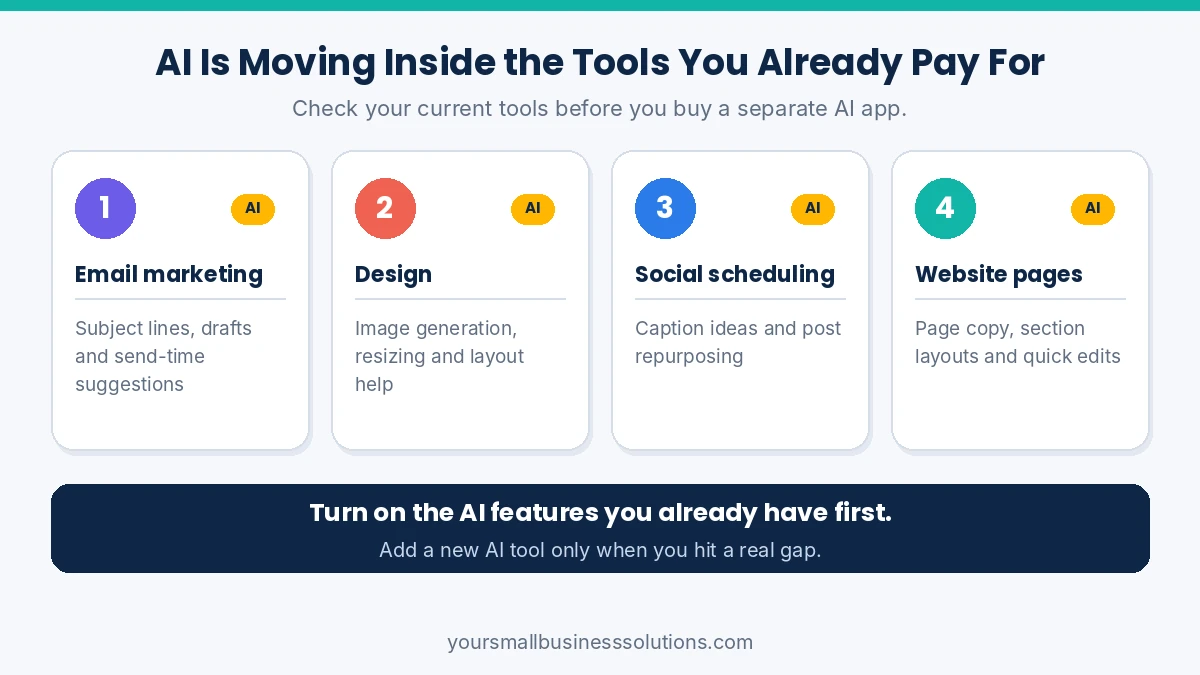
What to do: before you buy a standalone AI app, open the tools you already pay for and check which AI features are included. Many owners pay twice for the same thing. If you do need a dedicated tool, our guide to the best AI marketing tools for small business is a good place to start.
Where to look: your email tool may offer subject line and draft help, your design tool may include resizing and background tools, your scheduler may suggest captions, and your website builder may suggest page copy. Spend 20 minutes clicking through each tool’s settings and help pages. One caution: AI drafts still need your review for accuracy and brand voice before anything goes live.
2. Search Is Shifting to AI Answers
More people now ask an AI tool a question and read the answer instead of clicking through ten links. That changes what you should track. LocaliQ reports that half of small and mid-sized businesses are already tracking AI referrals and mentions in its 2026 digital marketing trends roundup.
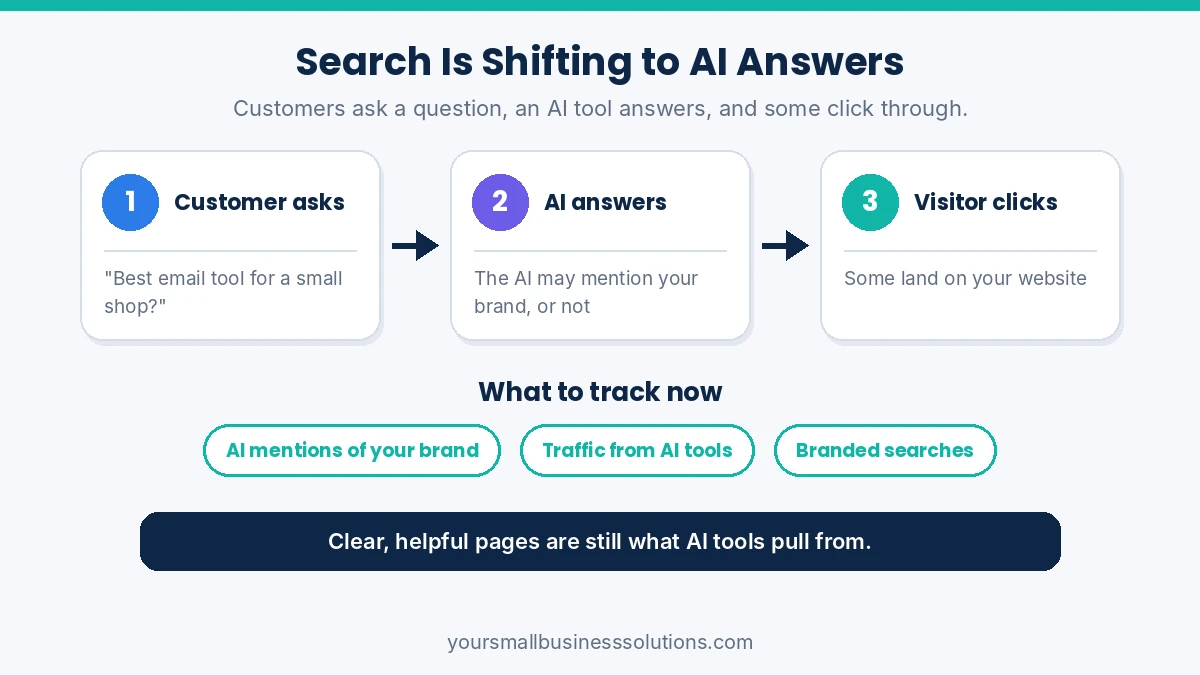
What to do: check your analytics for visits that come from AI tools, and ask a few AI assistants about your category to see whether your brand shows up. Clear, specific, well-structured pages give AI tools something useful to pull from. Our AI search optimization checklist walks through the basics.
A simple habit helps here. Once a month, ask two or three AI assistants the questions your customers would ask, such as “best [your service] in [your city]” or “how do I choose a [your product].” Write down whether your business is mentioned. Over a few months, you will see whether your visibility is moving.
3. Automation Is Replacing Repetitive Work
Welcome emails, follow-ups, lead tagging and social scheduling all follow rules, so software can handle them. The trend is not “fully autonomous marketing.” It is small automations that each save an hour here and there, and add up over a month.
What to do: pick one task you repeat every week and automate only that. Our guide to marketing automation for solopreneurs shows where to start, and marketing tools that save time covers the types that cut hours instead of adding dashboards.
Good first automations for a small business:
- A welcome email sequence for new subscribers
- An automatic reply to new enquiries, with a link to book a call
- Tags that sort subscribers by what they clicked
- A week of social posts scheduled in one sitting
4. Email and First-Party Data Are Worth More
A list you own does not depend on an algorithm or an ad platform. As privacy expectations grow and platforms change their rules, the data you collect yourself, such as email subscribers, customers and survey answers, becomes your most dependable marketing asset. That is why email tools remain one of the safest places to invest.
What to do: make sure every page of your site has a clear way to join your list, and review your email marketing tools before adding anything new.
Easy ways to build first-party data: offer a useful checklist in exchange for an email address, add an opt-in at checkout, send a short customer survey, and keep your enquiry form simple. Collect only what you will actually use.
5. Tools Are Consolidating Into Fewer Platforms
Many small businesses are cutting the number of tools they pay for. Agencies such as WebFX also point to unified tool stacks as a 2026 theme in their digital marketing trends list. One platform means fewer logins, one bill and cleaner data.
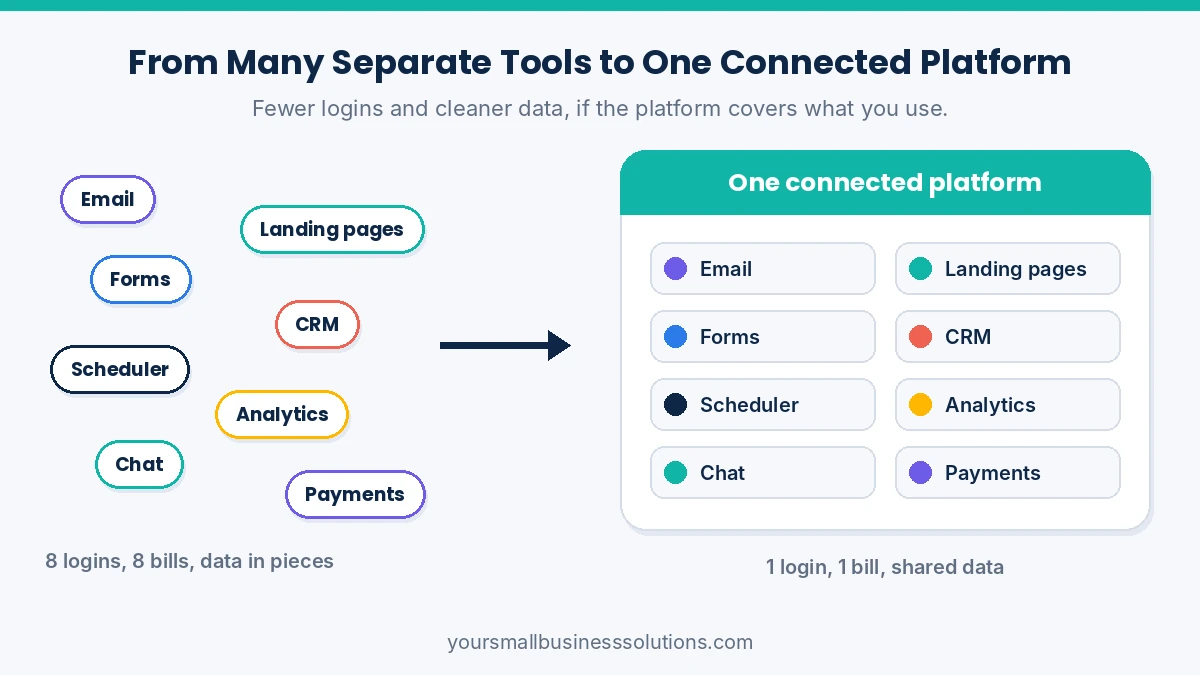
The catch: an all-in-one tool is only worth it if it covers what you actually use. Otherwise you pay for features you ignore. Our comparison of all-in-one vs best-of-breed tools helps you decide which route fits you.
6. Analytics Are Getting Simpler
Owners are tired of ten dashboards. Benchmark Email’s look at small business trends for 2026 says marketers now want clear performance trends, simple answers to “what worked?” and easy comparisons between campaigns.
What to do: track three numbers only: leads, sales, and the one channel that brings most of them. Add more only when you have a question those numbers cannot answer.

What’s Mostly Noise for Small Businesses Right Now
These marketing tool trends get plenty of attention. For most small businesses, they are not worth your budget today. “Not now” does not mean “never,” so revisit this list once or twice a year.
- Metaverse and VR marketing: it needs specialist skills and equipment, and most of your customers are not there.
- Voice search as a standalone project: good basic SEO already covers most of it.
- Old features relabeled “AI-powered”: ask what the AI actually does, and whether the price changed.
- Enterprise-level personalization: it needs large amounts of data and a team. Basic segmentation inside your email tool is enough for most small businesses.
- Posting on every new platform: pick two channels and do them well.
- Buying every new tool launch: launch hype is not results. Our guide to telling hype from a genuinely good tool shows how to check before you buy.
How do you know when a “noise” trend has become real? Watch for three signs: your customers start using it, a tool you already pay for adds it, and the cost is low. When all three happen, it is no longer noise. Until then, your time is better spent on the marketing tool trends above.
Which Marketing Tool Trends Matter Most for Your Business?
Not every trend fits every business. Use the list that matches your situation:
- Solo business owner: focus on AI inside your current tools and one simple automation. Your biggest limit is time.
- Local service business or store: focus on email, first-party data and checking whether AI answers mention your business.
- Small team with several tools: focus on consolidation and simpler analytics, since overlapping tools and scattered data cost you the most here.
Pick one or two of these marketing tool trends and ignore the rest until those are working.
What to Do About These Marketing Tool Trends This Month
You do not need a new strategy. You need a short cleanup:
- List every marketing tool you pay for, with its monthly cost.
- Turn on the AI features already included in those tools.
- Pick one repetitive task and automate it.
- Check your analytics for traffic from AI tools.
- Cancel anything you have not used in the last 60 days.
If you would like a checklist to work through while you do this, the SmallBiz AI Checklist is made for small business owners who are adding AI to their work. You can grab it here.
A Simple 30-Day Test for Any New Marketing Tool
When a new tool does pass the filter, test it before you commit. The 30-day test keeps the decision based on results:
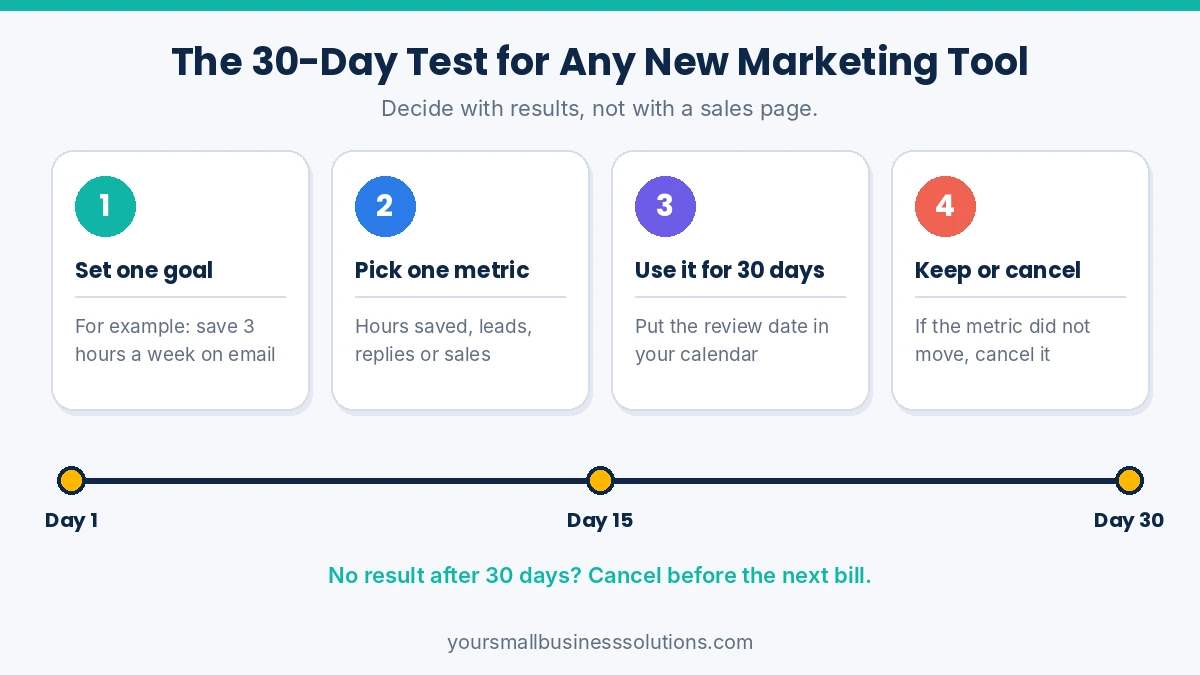
- Set one goal. For example, save three hours a week on email.
- Pick one metric. Hours saved, leads, replies or sales.
- Use it for 30 days. Put the review date in your calendar on day one.
- Keep or cancel. If the metric did not move, cancel before the next bill.
For examples of affordable setups to test against, see our guide to a small business marketing stack under $200 a month.
Where to Go From Here
Marketing tool trends will keep changing, but your process does not have to. Use the three-question filter, fix what you already pay for first, and test anything new for 30 days. That approach protects your budget and your time.
If you want a simple next step, start with the SmallBiz AI Checklist.
Marketing Tool Trends FAQ
What are the biggest marketing tool trends in 2026?
The biggest shifts are AI built into existing tools, search moving toward AI answers, automation of repetitive tasks, more value in email and first-party data, fewer connected platforms, and simpler analytics.
Do small businesses need AI marketing tools?
Not necessarily separate ones. Start with the AI features inside tools you already pay for. Add a standalone tool only when you hit a gap you can measure.
How do I know if a marketing tool is worth paying for?
Run the 30-day test: one goal, one metric, and a review date. If the metric does not move, cancel the tool.