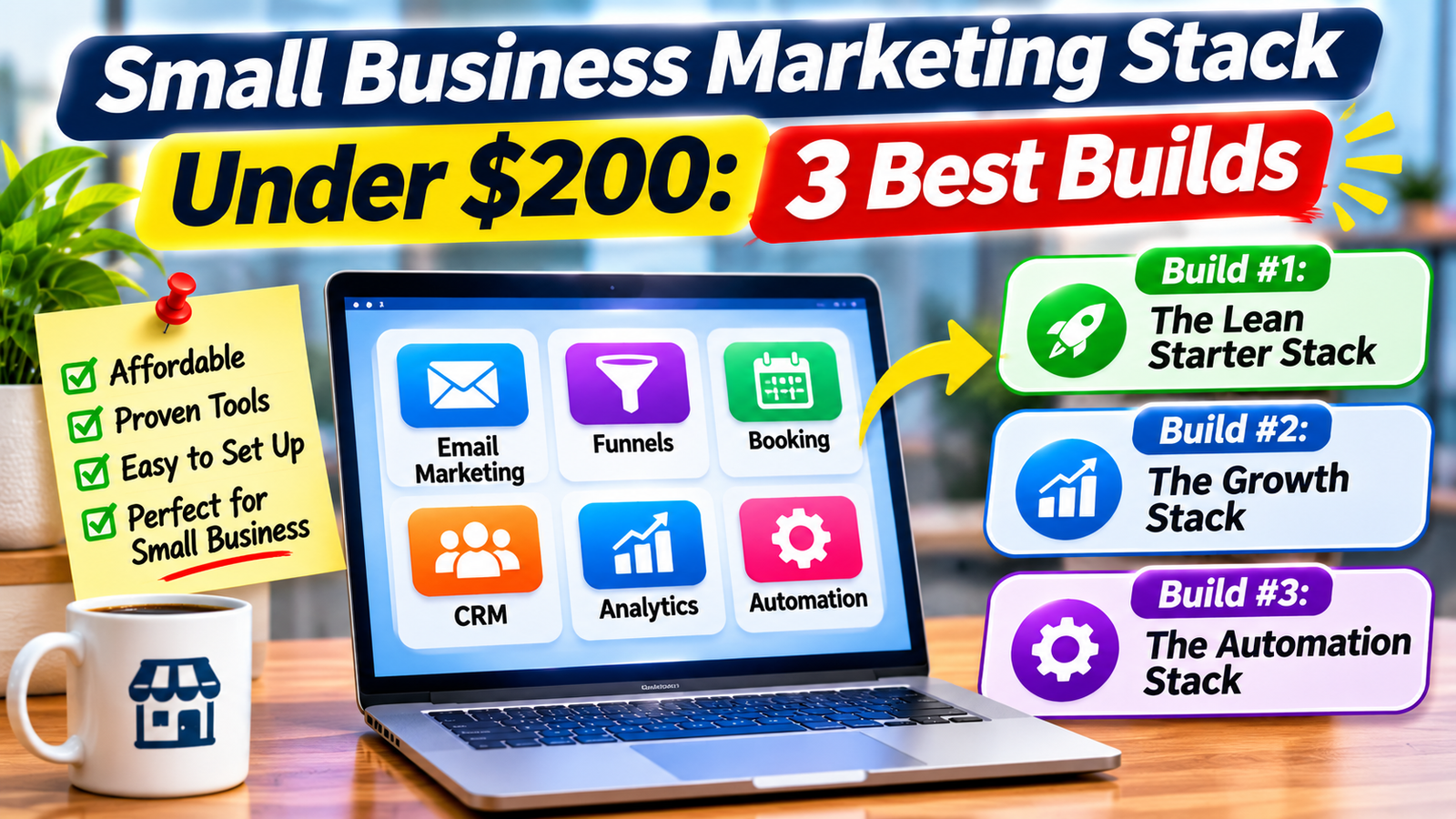
A small business marketing stack does not have to cost more than $200 a month. Most owners overspend because they buy tools one at a time, forget to cancel the ones they stopped using, and end up paying for features they never open.
This guide fixes that with three ready-made builds you can copy. Each one covers the same six jobs: your website, email, social media, design, SEO and analytics, and AI help. You pick the build that fits your budget and the stage your business is in, and you get a real monthly cost for every tool.
Prices below were checked in November 2026 and are approximate. Plans and list-size pricing change often, so confirm the current price on each tool’s site before you pay.
Table of Contents
What a Small Business Marketing Stack Actually Needs
A marketing stack is the set of tools you use to attract customers, capture their details, and follow up with them. You will also see it called a marketing tool stack or a marketing tech stack. They all mean the same thing. A good small business marketing stack covers six layers:
- Website and hosting: the home base where visitors land.
- Email marketing: how you stay in touch with leads and customers.
- Social scheduling: so you post consistently without living on your phone.
- Design: for graphics, pins and simple videos.
- SEO and analytics: to get found on Google and see what is working.
- AI assistant: for first drafts, ideas and repetitive writing.
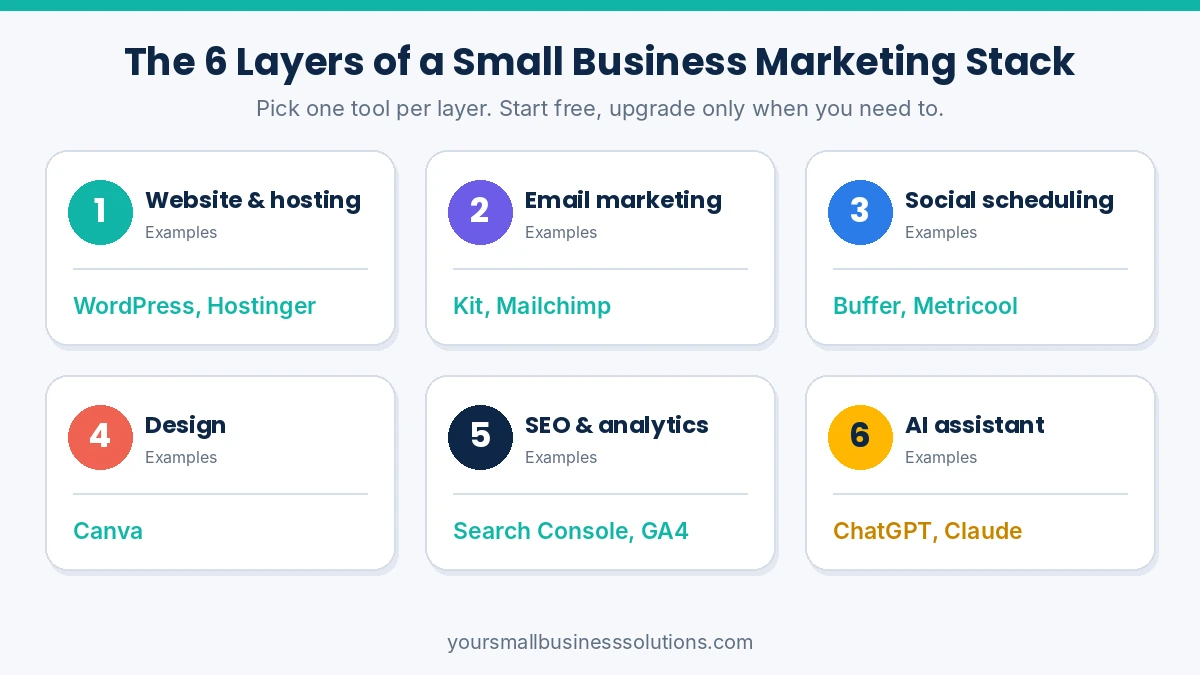
The rule for every build below is simple: one tool per layer, free tools first, and upgrade only when a free plan holds you back. A $200 stack you use every week beats a $2,000 stack that sits unopened.
If you are weighing one platform against several separate tools, read my guide to all-in-one vs best-of-breed first. It will help you decide how many tools you really need.
Build 1: The Starter Stack ($0 to $25 a Month)
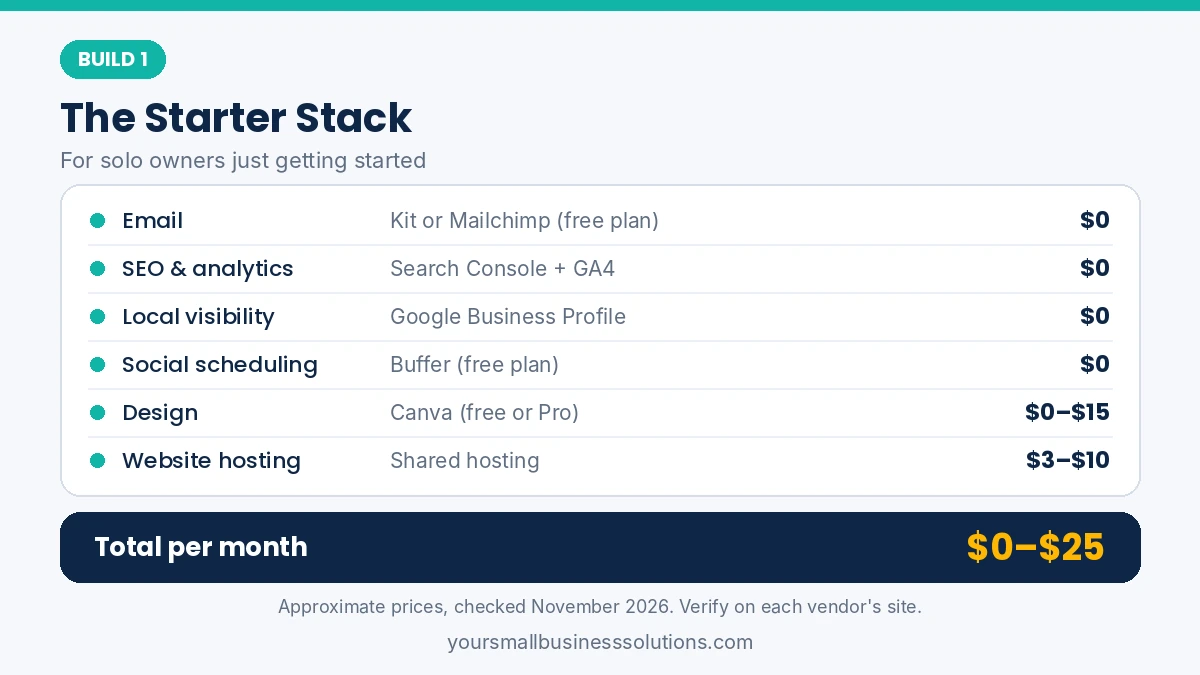
This build is for solo owners, side projects and anyone testing an idea. This starter small business marketing stack leans on free tools that are good enough to start winning customers. Here is what goes in it:
- Email: the free plan from Kit or Mailchimp. Mailchimp’s free plan covers a small list (about 250 contacts at the time of writing). Kit’s free plan is broadcast-only, so it has no automations or sequences.
- SEO and analytics: Google Search Console and Google Analytics 4. Both are free.
- Local visibility: a Google Business Profile, which is free, if customers search for you nearby.
- Social scheduling: Buffer’s free plan.
- Design: Canva’s free plan. Move to Canva Pro (about $15 a month) when you need brand kits and one-click resizing.
- Website: shared hosting at roughly $3 to $10 a month for a WordPress site.
Your total for this small business marketing stack is $0 to $25 a month. What you give up is email automation and some scheduling limits, and that is fine for your first 90 days. Spend that time publishing useful content and collecting email addresses.
Still choosing an email platform? My comparison of the best email marketing tools for small business in 2026 shows which free plans hold up.
Build 2: The Core Stack (About $102 a Month)
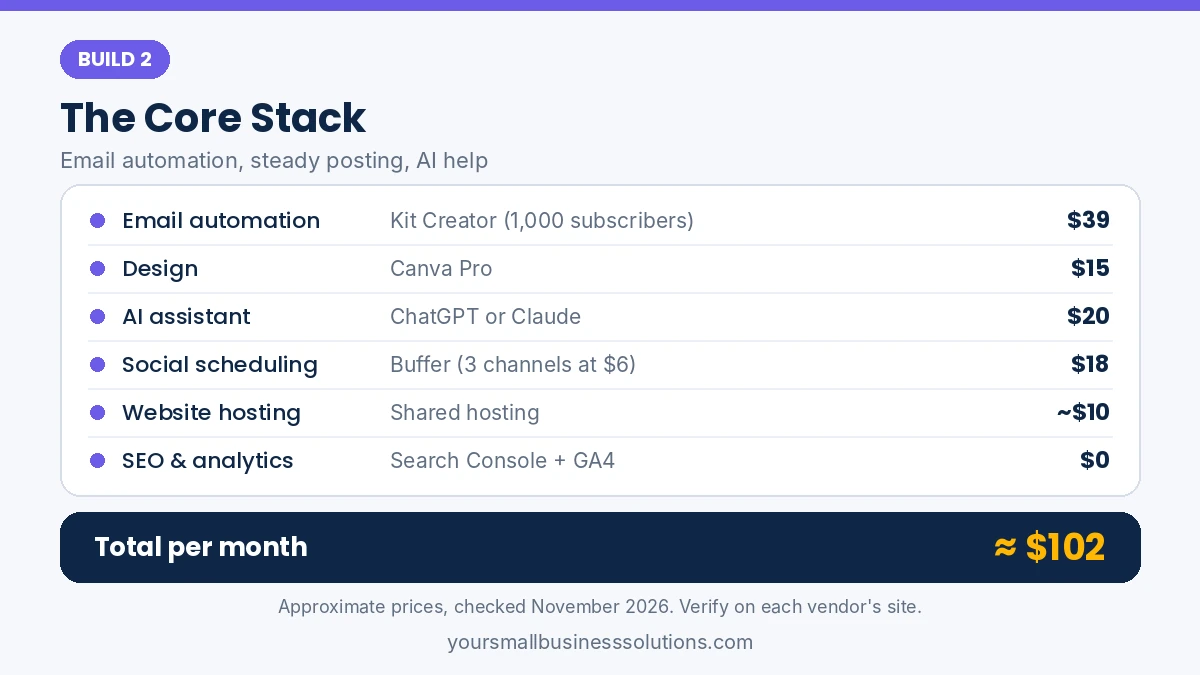
Build 2 is the sweet spot for most owners. You add email automation, steadier posting and an AI assistant, and you still land near $100. This small business marketing stack looks like this:
- Email automation: Kit Creator, which starts at about $39 a month for 1,000 subscribers. Check Kit’s pricing page because the price rises as your list grows.
- Design: Canva Pro, about $15 a month.
- AI assistant: ChatGPT or Claude, about $20 a month.
- Social scheduling: Buffer at about $6 per channel per month, so roughly $18 for three channels. See Buffer’s pricing.
- Website: hosting at about $10 a month.
- SEO and analytics: still free with Search Console and Google Analytics 4.
That adds up to about $102 a month. The biggest upgrade is email automation. A welcome sequence, for example, introduces your business to every new subscriber while you work on other things. My guide to marketing automation for solopreneurs shows where to start.
Use your AI assistant for first drafts of emails, captions and blog outlines, then edit them in your own voice. If you want to compare more options, see my list of the best AI marketing tools for small business.
Build 3: The Growth Stack (About $135 to $199 a Month)
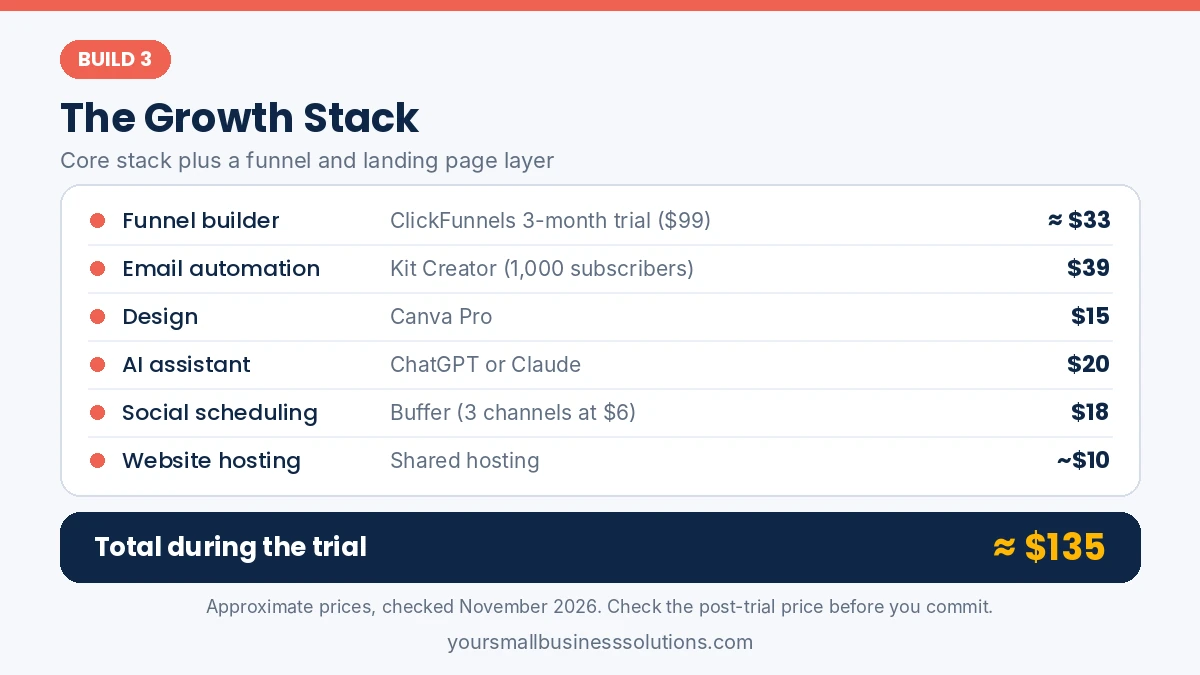
Build 3 adds a funnel and landing page tool. It suits owners who sell a product, a course or a service and want a guided path from first click to sale. It starts with everything in Build 2 and adds ClickFunnels.
ClickFunnels runs a 3-month trial for $99, which works out to about $33 a month. During the trial, this version of the small business marketing stack costs roughly $135 a month.
After the trial, the Launch plan is about $97 a month at the time of writing, which pushes the total to about $199. That is still under the $200 line, but it leaves no room to spare. Confirm today’s price on the official ClickFunnels pricing page before you commit.
New to the platform? My ClickFunnels for beginners guide walks through setup, and my landing page builders roundup shows the alternatives. Disclosure: the trial link above is an affiliate link, so I may earn a commission at no extra cost to you.
What if you would rather spend on paid SEO tools? Semrush starts at about $140 a month, which only fits under $200 if you drop the funnel builder. Most small sites get a long way with Search Console and the free Ahrefs Webmaster Tools until traffic grows.
Tools to Skip Until You Are Making Money
Every extra subscription needs to earn its place. These are the ones I would hold off on:
- Enterprise CRMs and marketing hubs. The paid tiers of big platforms can climb to hundreds of dollars a month, which is hard to justify for a small team.
- Advanced analytics dashboards. You only need four numbers each week: traffic, leads, conversion rate and revenue.
- A/B testing tools. Testing needs a lot of traffic to mean anything, so wait until you have it.
- Overlapping tools. Two schedulers or two design apps double your cost for no real gain.
My article on marketing tools that save time explains which types of tools cut hours of work and which only add more dashboards to check.
How to Choose the Right Small Business Marketing Stack for You
Ask yourself three questions before you buy anything:
- What is my main channel? If customers find you through email, social media or search, put your money there first.
- How many hours a week do I have? Fewer hours means you should lean on automation and AI.
- What already works? Keep it. Do not replace a tool just because a newer one looks better.
Next, write down every tool you pay for and the job it does. If two tools do the same job, cancel one. The SmallBiz AI Checklist gives you a simple way to put AI tools to work across your business, from marketing to daily tasks, so you can see which jobs a tool should handle before you add more software.
Once your stack is lean, run a quick site check too. My guide on how to audit your own website shows what to fix first.
Marketing Stack Mistakes to Avoid
- Paying annually before testing. Start monthly for the first 60 days, then switch to yearly billing for tools you use every week.
- Ignoring list-size pricing. Email prices climb as your list grows. Kit’s Creator plan, for example, can run from about $39 to $199 a month between 1,000 and 25,000 subscribers.
- Buying tools to fix a strategy problem. No tool can fix an offer nobody wants.
- Never reviewing the stack. Set a reminder every quarter to cancel anything you did not open.
- Copying a competitor. Their stack fits their business and budget, not yours.
Small Business Marketing Stack FAQs
What is a small business marketing stack?
It is the group of tools a small business uses to plan, create, publish and measure its marketing. Most stacks cover a website, email, social media, design, SEO and analytics, and an AI assistant.
How much should I spend on my small business marketing stack?
You can start free and stay well under $200 a month. A good rule is to begin under $100 and add a tool only when a free plan blocks something you need.
Can I build a marketing stack for free?
Almost. Build 1 uses free plans for email, social scheduling, analytics and local listings. You will still pay a few dollars for hosting if you run your own website.
Which marketing tool should I buy first?
Email marketing. It gives you a list you own, and it does not depend on any social platform’s algorithm.
Final Thoughts
The best small business marketing stack is the one you will actually use. Start with Build 1 and publish consistently. Move to Build 2 when you are ready for email automation, and add Build 3 when you have an offer that needs a funnel.
Whichever build you choose, keep the stack lean and review it every quarter. And if you want a ready-made list for putting AI tools to work in your business, grab the SmallBiz AI Checklist.