For a small online store, a Black Friday sale isn’t really finished when the package ships. It’s finished when the card network’s dispute window closes, often months later. That’s why Black Friday fraud prevention has to start before the rush, not after the first chargeback lands in your inbox.
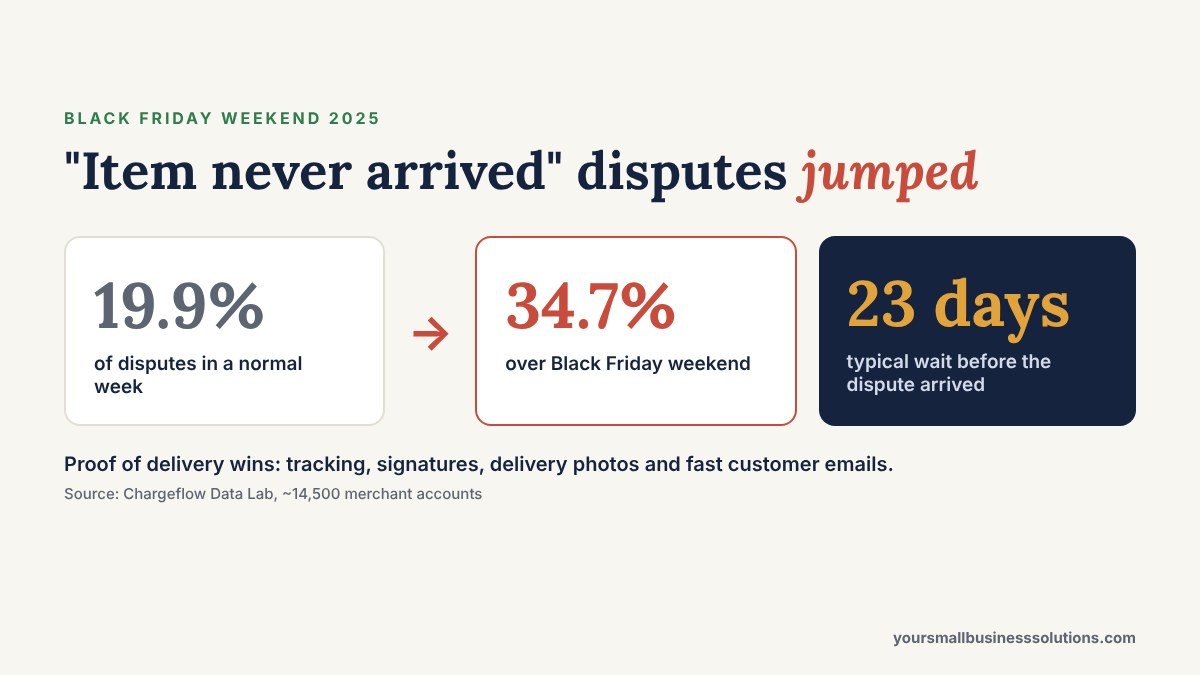
Here’s what makes this season risky. In Chargeflow’s data on Black Friday weekend 2025, the share of disputes claiming the item “never arrived” jumped from 19.9% in a normal week to 34.7%. The typical one arrived 23 days after the order, right before Christmas, when sellers were busiest.
This guide walks you through Black Friday fraud prevention in six practical steps: the settings to switch on, the policies that win disputes, how to ship with proof, the red flags to watch for, the scams aimed at sellers, and what to do when a chargeback arrives anyway.
Quick note: this is general education for US small businesses, not legal or payments advice. Card network rules and processor fees change, so always follow the deadlines in your own payment dashboard.
Table of Contents
Why Black Friday fraud prevention matters for small sellers
A chargeback costs far more than the sale. You lose the product, the shipping, the payment fee and a dispute fee, plus the time it takes to respond. On Stripe in the US, for example, a dispute costs $15, and countering it manually adds another $15 that you only get back if you win.
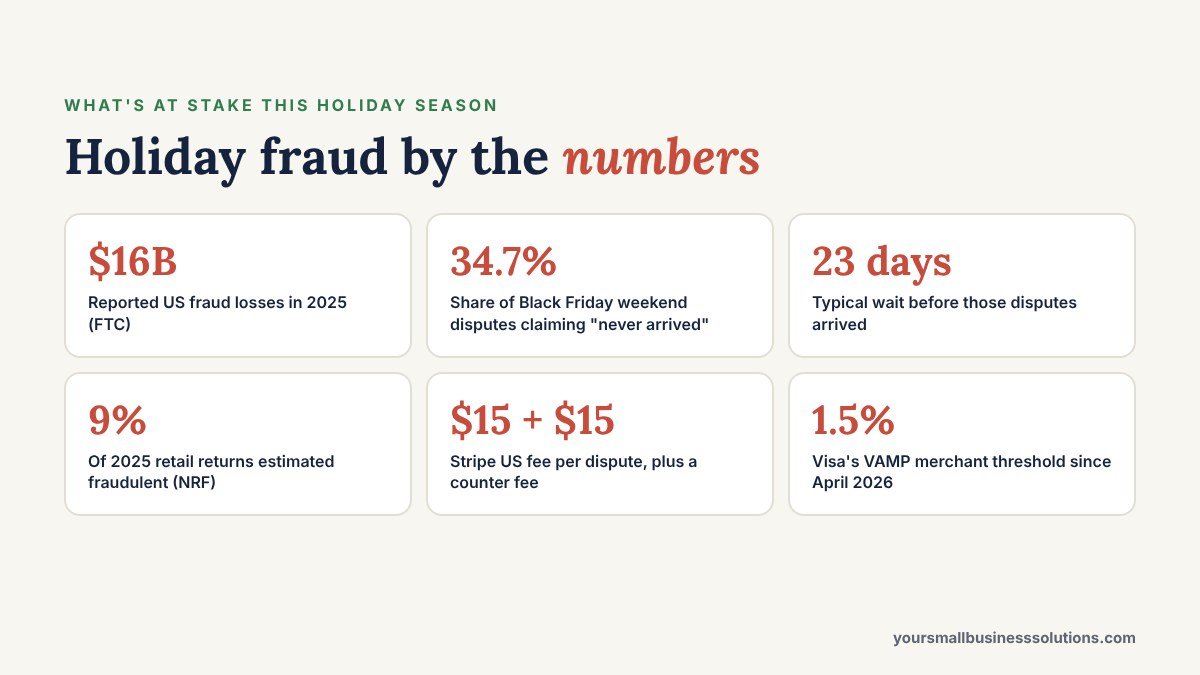
- Fraud is at record levels. People reported losing about $16 billion to fraud in 2025, roughly 25% more than in 2024, according to the FTC. Nearly $1 billion of that involved scammers impersonating a business.
- Returns get abused too. US retailers estimated that 9% of all 2025 returns were fraudulent, and holiday returns reached 17% of holiday sales (NRF).
- Your payment account is at stake. Since April 1, 2026, Visa’s monitoring program treats a merchant ratio of fraud reports plus disputes above 1.5% as excessive in the US. Payment processors watch much lower rates: Stripe describes dispute activity above 0.75% as the industry standard for excessive.
The 7 threats to watch for this holiday season
Effective Black Friday fraud prevention starts with knowing what you’re up against. Not every chargeback comes from a criminal. Many come from real customers who are confused or impatient. Knowing which threat you’re facing tells you how to stop it.
- Stolen card orders: a fraudster buys with someone else’s card, and the real cardholder disputes it weeks later.
- “Friendly” fraud: a real customer disputes a real purchase because they forgot it, didn’t recognize the charge or want the item and the money.
- “Never arrived” claims: late, stolen or misdelivered packages that go straight to the bank instead of to you.
- Card testing: bots run hundreds of small payments through your checkout to find working stolen cards.
- Return and refund fraud: empty boxes, swapped or counterfeit items and fake “damaged” claims.
- Reshipping and triangulation fraud: a fake reseller takes a real buyer’s money, then orders from you with a stolen card.
- Scams aimed at you: fake platform emails, fake payment proof, overpayments and changed supplier bank details.
The golden rule for all seven: a refund is almost always cheaper than a chargeback. If a customer has a fair complaint, refunding quickly saves the dispute fee and protects your dispute rate.

Step 1: Lock down payments and checkout before Nov 27
Black Friday fraud prevention starts in your payment dashboard. Spend one hour there before Black Friday. Most of these settings are free and already built into Stripe, Shopify Payments, Square and PayPal.
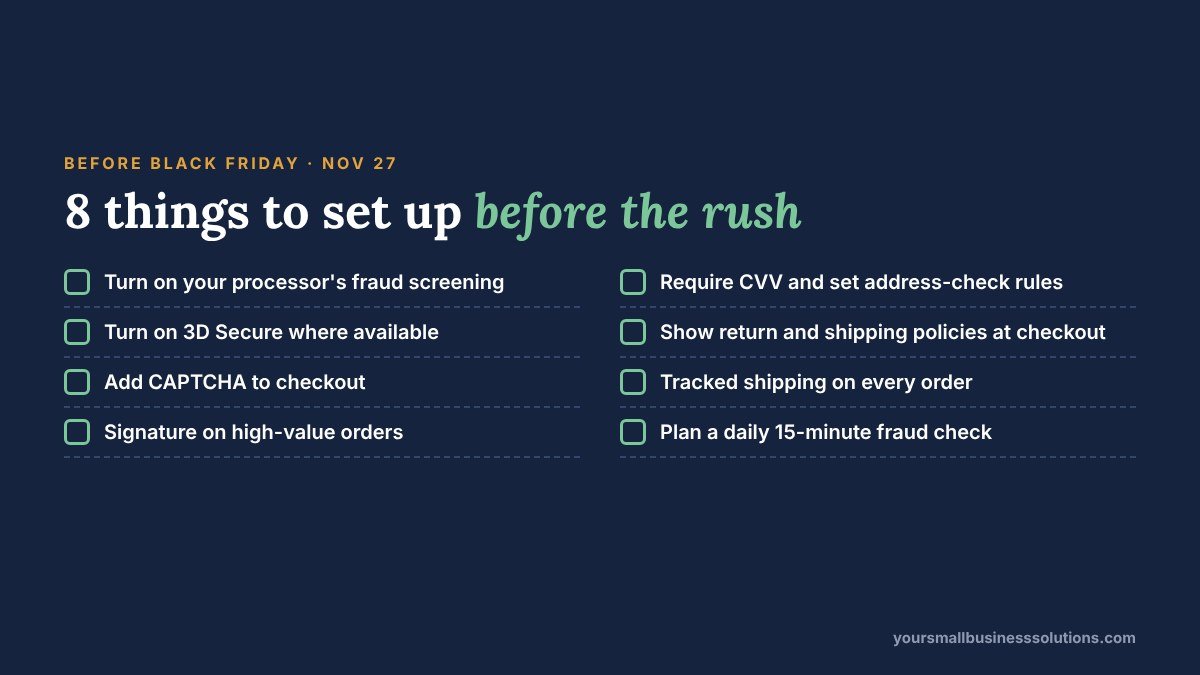
- Turn on fraud screening, such as Stripe Radar or Shopify’s fraud analysis, and review its risk settings.
- Require the CVV on every card payment, and decide what happens when the billing address doesn’t match.
- Turn on 3D Secure where your processor supports it. When a payment is authenticated, liability for a fraud chargeback generally shifts to the card issuer. It doesn’t cover “never arrived” or “not as described” disputes, though.
- Add CAPTCHA and attempt limits to checkout and any “save card” page to slow down bots.
- Check your statement descriptor. The name on the customer’s card statement should match the name on your website. Unrecognized charges are a major cause of friendly fraud.
- Set a review limit for large orders, for example three times your average order value.
Step 2: Make your policies dispute-proof
When a customer claims “not as described” or “refund not processed,” the bank checks what you promised and whether the customer could see it before paying. Clear, visible policies are one of the simplest Black Friday fraud prevention tools, and they win those disputes.
- Link your refund, return and shipping policies in the footer, on product pages and at checkout.
- Publish a holiday return window, for example: “Purchases made Nov 1 to Dec 24 can be returned until Jan 15.”
- List your holiday shipping cutoffs based on your carrier’s published deadlines, plus a safety margin.
- Make product descriptions and photos match the item exactly, including size, color and what’s in the box.
- Ask customers to tick a box agreeing to your policies at checkout, and keep a record of it.
Step 3: Ship with proof of delivery
Shipping with proof is the heart of Black Friday fraud prevention for small stores. “Never arrived” is the dispute that jumps the most over Black Friday weekend. It’s also the one where evidence helps most: in the same Chargeflow data, “never arrived” disputes with compelling evidence were won about 1.5 times as often.
- Use tracked shipping on every order, and upload tracking numbers to your store.
- Require a signature on high-value orders.
- Save delivery photos wherever your carrier offers them.
- Send a “delivered” email that says: “Didn’t get it? Reply here first.”
- If an order is delayed, email the customer before they ask, with a new estimate.
- Never change a delivery address after payment because of an email or call without verifying the buyer. It’s a classic fraud signal.
Step 4: Spot order red flags before you ship
Good Black Friday fraud prevention means reviewing risky orders before they ship. One red flag rarely means fraud. Gift buyers often ship to another address. But when several show up on the same order, slow down.
- Billing and shipping names don’t match, and the order isn’t marked as a gift
- Several failed card attempts before one works
- Multiple orders to one address with different cards
- Shipping to a freight forwarder, hotel or vacant property
- Rush shipping on a high-value first order
- An IP location far from both the billing and shipping addresses
- A random-looking email address or an invalid phone number
- Several units of one popular, easily resold item
A simple rule works well for most small stores: with zero or one flag, ship as normal. With two or three, contact the buyer and require a signature. With more, cancel and refund before you ship. Refunding a suspicious order costs far less than a fraud chargeback plus the lost product.
Step 5: Watch for card testing and seller scams
Card testing
Card testers use scripts to run stolen card numbers through small stores. Watch for a sudden spike in failed payments, lots of $1 to $5 charges and nonsense names on orders. If it happens, Stripe recommends refunding the fraudulent payments that went through, adding CAPTCHA and rate limits, and asking your developer or app vendor for help, since stopping it often needs code changes.
Scams aimed at sellers
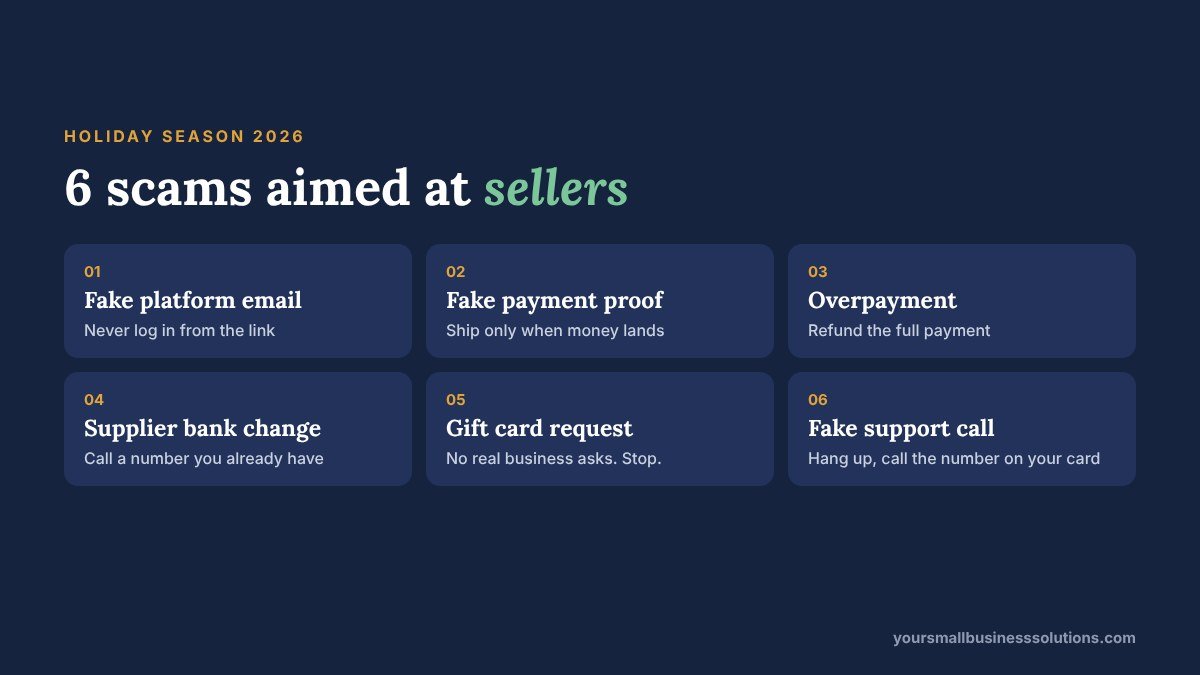
- Fake platform emails: “Your store will be suspended.” Never log in from the link; open your dashboard directly.
- Fake payment proof: ship only when the money shows in your own account, not in a screenshot.
- Overpayments: refund the whole payment to the original method and ask the buyer to pay the right amount.
- Supplier bank changes: call the supplier on a number you already have before changing any payment details.
- Gift card requests: no real business or agency asks for payment in gift cards.
- Fake support calls: hang up and call the number on your card. Never share one-time login codes.
For more on protecting your accounts, see our guides to cybersecurity basics for small business and data security and customer privacy.
Step 6: When a chargeback arrives anyway
Even with good Black Friday fraud prevention, some disputes will come. Most card disputes can be filed up to about 120 days after the sale, so a Black Friday order can still be disputed until around late March 2027.
- Note the deadline. Your processor’s respond-by date is often much shorter than the card network’s, sometimes 5 to 10 days. No response means an automatic loss.
- Read the reason code. Fraud, not received, not as described, refund not processed or canceled subscription. The reason decides the evidence.
- Decide whether to fight or refund. Fight when your evidence is strong. Accept when the customer has a fair point.
- Send matching evidence. For fraud: address and CVV results, 3D Secure, IP address and device data. For “never arrived”: tracking, delivery photo or signature.
- Write a one-page summary and submit it before the deadline.
For Visa fraud disputes on online orders, Visa Compelling Evidence 3.0 lets you use the same customer’s earlier undisputed purchases from 120 to 365 days before, matched by details such as IP address, device ID or shipping address. Ask your processor whether it supports CE3.0.

Get the Holiday Fraud & Chargeback Protection Checklist
Want every step in one place? The Holiday Fraud & Chargeback Protection Checklist 2026 is a 19-page printable Black Friday fraud prevention guide for US small businesses selling online, by phone or in store.
- A 2026 holiday fraud timeline, from setup week to late March 2027
- Payment, checkout, policy and shipping checklists, with fill-in boxes
- Order red flags and a points-based order review scorecard
- A card-testing emergency plan and 6 scams aimed at sellers
- An evidence checklist for every dispute reason, plus Visa CE3.0
- A dispute rate worksheet, a dispute tracker and a one-page master checklist
It’s $15, written in plain English, and ready to print before Black Friday. Get the Holiday Fraud & Chargeback Protection Checklist here.
Black Friday fraud prevention FAQ
How long can a customer dispute a Black Friday purchase?
Generally up to about 120 days for Visa, Mastercard and American Express, with some exceptions. That means a Black Friday 2026 sale can usually be disputed until around late March 2027.
Does 3D Secure stop chargebacks?
It helps with fraud disputes: when a payment is authenticated, liability for a fraud chargeback generally shifts to the card issuer. It doesn’t protect you from “never arrived” or “not as described” disputes.
Should I refund or fight a chargeback?
Fight when you have strong evidence that matches the dispute reason. If the customer has a fair point or your evidence is weak, a quick refund is usually cheaper and protects your dispute rate.
What is a good dispute rate for a small online store?
Lower is always better. Stripe describes dispute activity above 0.75% as the industry standard for excessive, and Visa’s merchant threshold is 1.5% since April 2026.
Start your Black Friday fraud prevention this week
Black Friday is Friday, November 27. Switch on your payment protections, tighten your policies, ship with proof and teach your team the scam rules this week, while you still have time. Then keep a simple dispute log from December to March.
Planning your holiday promotion too? Our Small Business Saturday guide and Q4 checklist for small business cover the rest of your season.