The 1099 threshold for 2026 is $2,000. Under the 1099 threshold 2026 rule, the amount that triggers most contractor forms more than tripled. For the first time since 1954, the amount that triggers a 1099 has changed, and it’s not the only new rule small businesses face this January. The W-2 has new boxes for tips and overtime, and the IRS has switched to a new e-filing system.
If you paid contractors, freelancers or employees in 2026, this guide explains the 1099 threshold 2026 change in plain English, lists every 2027 deadline and gives you a simple year-end filing checklist so you can finish on time.
Quick answer: for payments made in 2026, you generally need to file Form 1099-NEC or 1099-MISC only for payees you paid $2,000 or more (up from $600). W-2s and 1099-NECs are due Monday, February 1, 2027.
Table of Contents
What is the 1099 threshold for 2026?
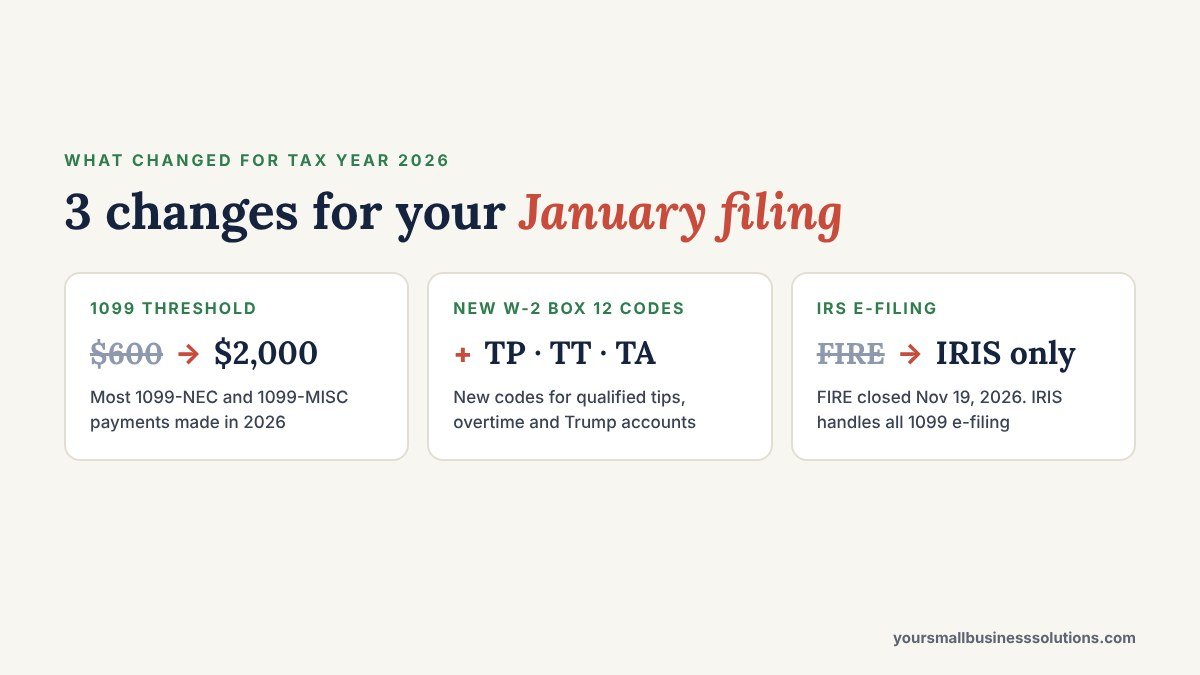
The One Big Beautiful Bill Act, signed on July 4, 2025, raised the 1099 reporting threshold from $600 to $2,000 for payments made after December 31, 2025. So the 1099 threshold 2026 rule applies to the forms you file in January 2027, not the ones you filed earlier this year.
The key word is payments. The new 1099 threshold is based on the date you actually paid someone, not the date of their invoice. A December 2025 payment still followed the old $600 rule, while a January 2026 payment falls under the new $2,000 rule.
The 1099 threshold 2026 table, form by form
| Form and payment type | 2025 payments | 2026 payments |
|---|---|---|
| 1099-NEC: contractor services | $600 | $2,000 |
| 1099-MISC: rents | $600 | $2,000 |
| 1099-MISC: prizes, awards, other income | $600 | $2,000 |
| 1099-MISC: royalties | $10 | $10 (unchanged) |
| 1099-K: payment apps and marketplaces | $20,000 and 200 payments | $20,000 and 200 payments |
| Backup withholding | $600 | $2,000 |
After the 1099 threshold 2026 year, the amount will rise each year with inflation, so check the current amount every January rather than assuming it stays at $2,000.
What the 1099 threshold 2026 rule doesn’t change
The higher 1099 threshold for 2026 means fewer forms for many small businesses, but it doesn’t remove the paperwork. A few rules stay exactly the same:
- You still need a W-9 from every contractor. You can’t know in March who will reach $2,000 by December, so collect a W-9 before the first payment.
- Card and payment app payments are still left out. If you paid by credit card or PayPal Goods and Services, the processor reports it on a 1099-K, not you.
- Most corporations are still exempt. Attorneys are the big exception: they get a 1099 even if their firm is a corporation.
- Your state may have its own rules. Some states require their own 1099 filing, so check your state’s revenue department website.
- Your contractors still owe tax. A freelancer paid $1,500 doesn’t get a 1099 from you, but they still report that income.
The other two big changes for tax year 2026
The 1099 threshold 2026 update gets the headlines, but two other changes matter just as much when you file in January.
New W-2 boxes for tips and overtime
The same law created new federal deductions for workers’ qualified tips and qualified overtime. To support them, the 2026 Form W-2 adds three Box 12 codes and splits Box 14:
- Code TP: total qualified tips
- Code TT: qualified overtime, generally the extra “half” in time-and-a-half required by federal law
- Code TA: employer contributions to a Trump account
- Box 14b: the Treasury Tipped Occupation Code for tipped employees (Box 14a holds other information)
The IRS gave employers penalty relief for these amounts on 2025 forms, but for 2026 they’re part of the W-2. If you use a payroll service, ask them now to confirm these boxes will be filled in. Our guide to payroll compliance for small business covers the basics of keeping payroll records clean.

FIRE has closed, so 1099s are e-filed through IRIS
The IRS retired its old FIRE e-filing system on November 19, 2026. The Information Returns Intake System (IRIS) is now the only IRS system for e-filing 1099s, including corrections and prior-year forms, according to the IRS FIRE retirement page. Small filers can use the free IRIS Taxpayer Portal, but you need an IRIS Transmitter Control Code and an ID.me login first, so apply in December.
Remember the 10-return rule as well: if you file 10 or more information returns in total, counting W-2s and every type of 1099, you must e-file.
1099 and W-2 deadlines for 2027
The 1099 threshold 2026 rule doesn’t move any deadlines. January 31, 2027 falls on a Sunday, so the main deadline moves to Monday, February 1. Here are the dates to put in your calendar:
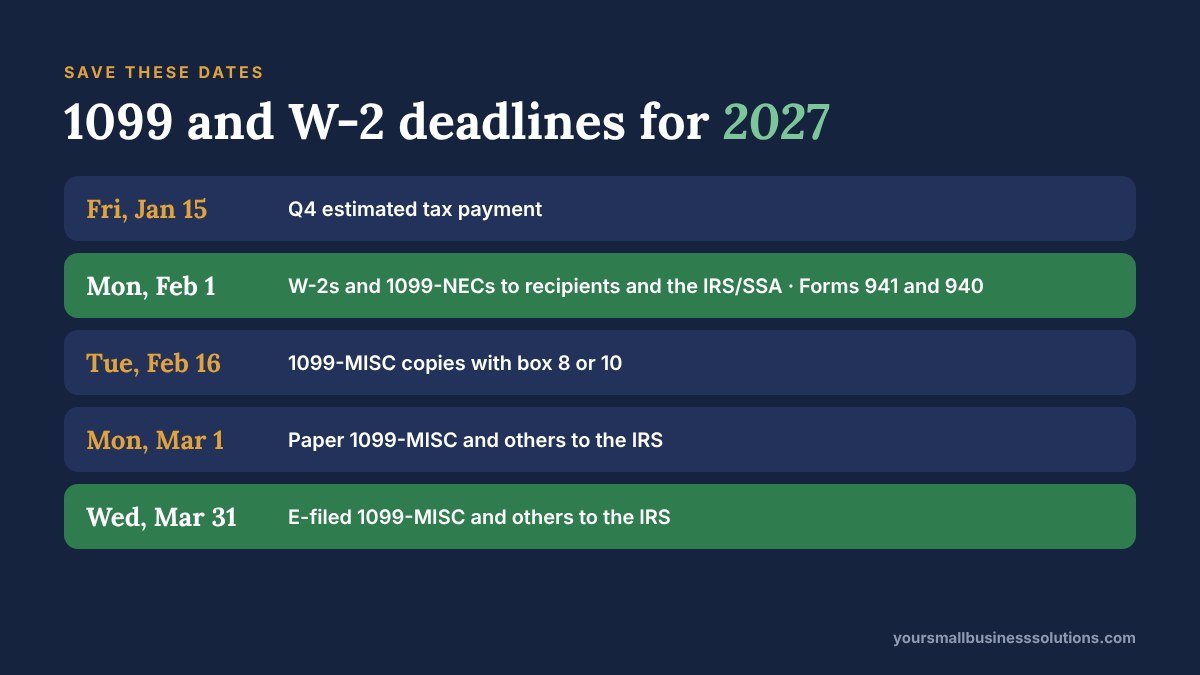
| Date | What’s due |
|---|---|
| Fri, Jan 15, 2027 | Fourth-quarter 2026 estimated tax payment |
| Mon, Feb 1, 2027 | W-2s to employees and the SSA, 1099-NECs to contractors and the IRS, most 1099 recipient copies, Form 941 (Q4) and Form 940 |
| Tue, Feb 16, 2027 | Recipient copies of 1099-MISC with amounts in box 8 or 10 |
| Mon, Mar 1, 2027 | Paper 1099-MISC and most other 1099s to the IRS |
| Wed, Mar 31, 2027 | E-filed 1099-MISC and most other 1099s to the IRS |
There’s no automatic extension for W-2s or 1099-NECs, so plan to finish them by February 1. For a full list of yearly filing dates, see our compliance deadlines for small business owners.
Your year-end 1099 and W-2 filing checklist
Use this checklist to apply the 1099 threshold 2026 rules and get your W-2s right, step by step.
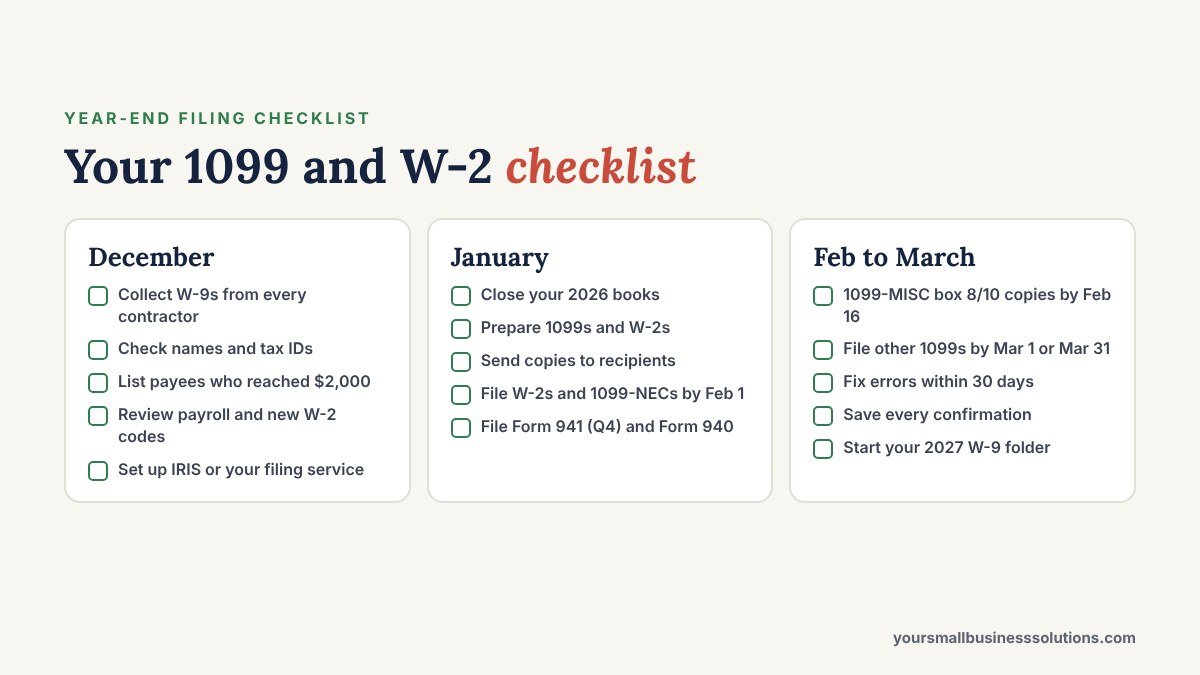
In December
- List every contractor, freelancer and landlord you paid in 2026
- Collect a signed W-9 from each one, and request any that are missing
- Check that names match tax IDs (for a sole proprietor, it’s their personal name)
- Total non-card payments per payee and flag anyone at or above the 1099 threshold 2026 amount of $2,000
- Review payroll: employee names, Social Security numbers, addresses, bonuses and benefits
- Confirm your payroll provider is ready for codes TP, TT, TA and Box 14b
- Choose how you’ll file and apply for IRIS access if you’ll file yourself
In January
- Close your 2026 books and run a payments-by-payee report
- Prepare your 1099-NECs and 1099-MISCs, and approve your W-2 data
- Send copies to recipients by February 1 (electronic copies only with their consent)
- File W-2s with the SSA and 1099-NECs with the IRS by February 1
- File Form 941 for the fourth quarter and Form 940
From February to March
- Send 1099-MISC copies with box 8 or 10 amounts by February 16
- File remaining 1099s by March 1 on paper or March 31 by e-file
- Correct any errors quickly with a corrected 1099 or a Form W-2c
- Save every confirmation and start a 2027 W-9 folder
If you’re still doing your year-end tax planning, our year-end tax checklist for small business covers the moves to make before December 31. And if you hired for the first time this year, the hiring your first employee checklist explains the payroll setup behind your first W-2.
What late or wrong 1099 and W-2 forms cost
Getting the 1099 threshold 2026 rules wrong, or filing late, can be costly. Information return penalties are charged per form. For forms due in 2027, the amounts for small businesses are:
| When you file or correct | Penalty per form |
|---|---|
| Within 30 days of the deadline | $60 |
| After 30 days, by August 1 | $130 |
| After August 1, or not at all | $340 |
| Intentional disregard | $690 or more, with no maximum |
The penalty can apply twice for one form: once for filing late with the IRS or SSA, and once for giving the recipient their copy late. The fastest way to keep the cost down is to file on time, then fix mistakes within 30 days. IRS Publication 1099 has the full rules.
Get the full 1099 and W-2 Year-End Filing Checklist
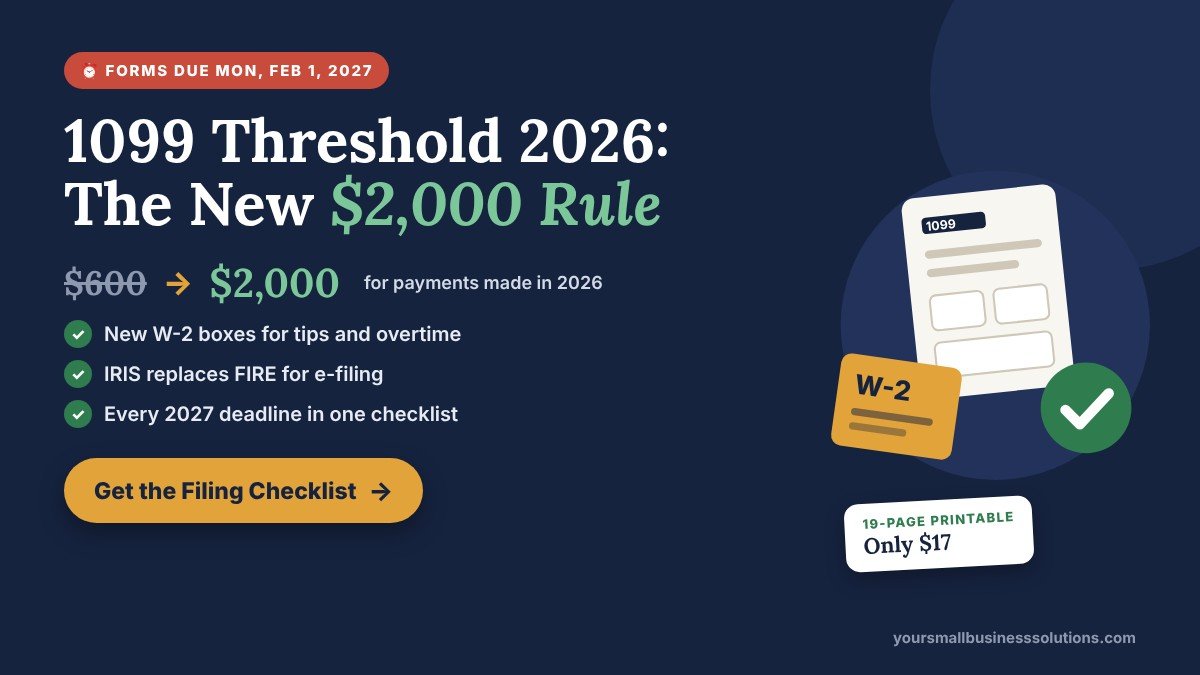
Want every step in one printable guide? The 1099 & W-2 Year-End Filing Checklist turns the 1099 threshold 2026 rules and everything else in this post into a 19-page checklist you can print, fill in and tick off.
- What’s new for tax year 2026, explained in plain English
- A December to March filing calendar with every 2027 deadline
- Who gets which form, plus a fill-in contractor and vendor list
- W-9 and tax ID checks, and what to do when a contractor won’t send a W-9
- A W-2 payroll review including the new tip and overtime codes
- How to file through IRIS, software or your payroll provider
- Corrections, penalties, 15 questions for your accountant, a master checklist and a filing tracker
1099 threshold 2026 FAQ
Do I need to send a 1099 if I paid a contractor $1,500 in 2026?
Generally, no. Under the 1099 threshold 2026 rule, Form 1099-NEC is required once you’ve paid a payee $2,000 or more for services during the year. You should still keep their W-9 and your payment records, and check whether your state has its own rules.
Do I send a 1099 to someone I paid through PayPal?
Not for payments made by credit card, debit card or PayPal Goods and Services. Those are reported by the payment company on Form 1099-K. Payments by check, bank transfer or Zelle still count toward the 1099 threshold 2026 total of $2,000.
When are 1099s due in 2027?
Form 1099-NEC is due to both the contractor and the IRS on Monday, February 1, 2027. Most other 1099s are due to recipients on February 1 and to the IRS by March 1 on paper or March 31 if e-filed.
Can I still use the IRS FIRE system?
No. FIRE closed on November 19, 2026. For 2026 forms, e-file through the IRS IRIS system, filing software or your payroll provider.
Conclusion: start your 1099 and W-2 prep this December
The 1099 threshold 2026 change is good news for many small businesses: fewer forms for small contractor payments. But the new W-2 boxes, the move to IRIS and a February 1 deadline mean January still needs a plan.
Here’s the short version:
- Know the new number: $2,000 for payments made in 2026, up from $600.
- Collect W-9s now from everyone you paid, whatever the amount.
- Check payroll for the new tip and overtime codes.
- Set up IRIS or your filing service before January.
- Finish by Monday, February 1, 2027.
Block out one hour this week to start. If you want every step laid out for you, grab the 1099 & W-2 Year-End Filing Checklist for $17 and tick it off as you go.
This article is general education for US small businesses, not tax advice. Rules and amounts can change, so confirm your situation with a tax professional or your payroll provider.