If you’re picking an all-in-one marketing platform this year, ClickFunnels 2.0 vs Kartra is probably the comparison you keep running into. Both promise to replace half a dozen tools — funnel builder, email automation, course hosting, checkout — with one dashboard. But they’re built for slightly different kinds of businesses, and picking the wrong one can cost you months of wasted setup time.
In this guide, we’ll break down how ClickFunnels 2.0 and Kartra actually compare in 2026 — pricing, features, ease of use, and who each platform is really built for — so you can make the call with confidence.
Table of Contents
ClickFunnels 2.0 vs Kartra: Quick Overview
ClickFunnels was launched in 2014 by Russell Brunson and Todd Dickerson, and it basically created the “funnel builder” category. ClickFunnels 2.0, released in 2022, expanded the platform far beyond funnels — it now includes a CRM, email and SMS automation, a course and community builder (called Communities), a blog builder, and FunnelFlix, a library of built-in marketing training.
Kartra takes a different approach. Instead of leading with “funnels,” it positions itself as a complete operating system for online businesses — funnels, email marketing, membership sites, video hosting, a help desk, and even an affiliate management system, all built by the same company.
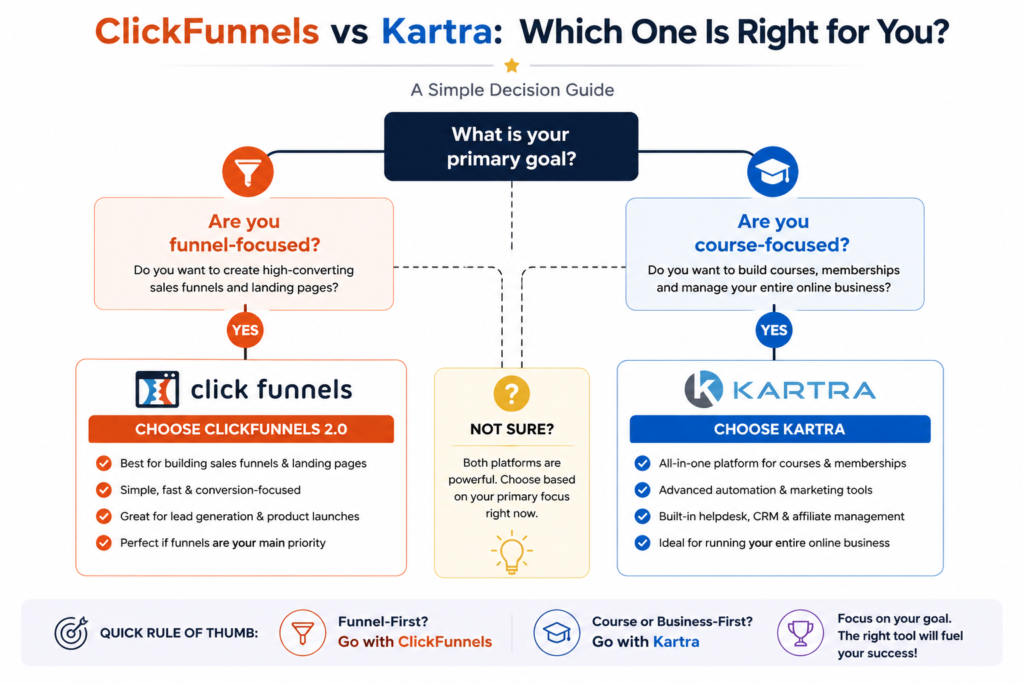
In short: ClickFunnels is funnel-first with everything else added on. Kartra is business-first with funnels as one piece of the puzzle.

Pricing: ClickFunnels 2.0 vs Kartra in 2026
Pricing is usually the first deciding factor, so let’s get it out of the way.
ClickFunnels 2.0 pricing:
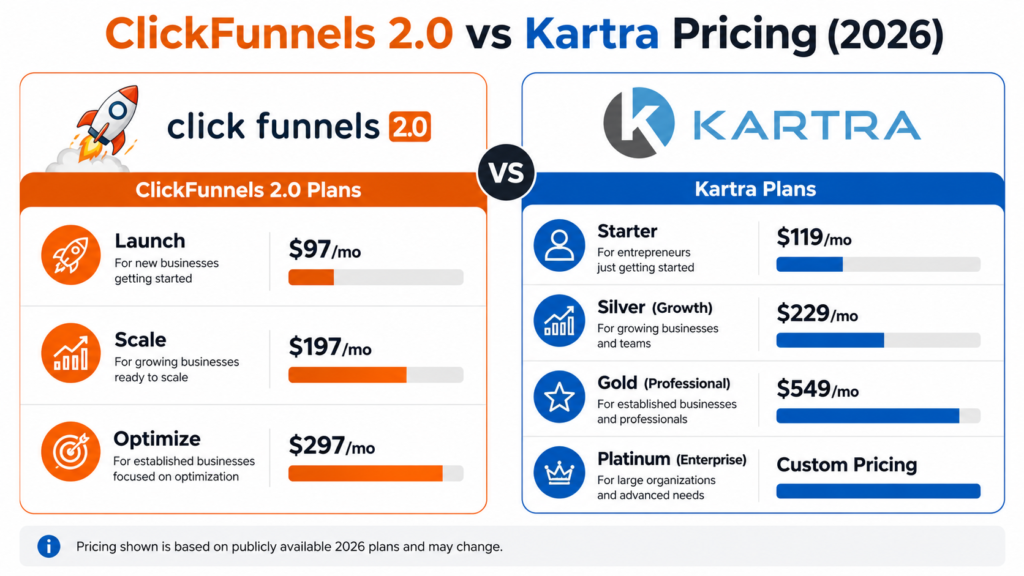
- Launch: $97/month — core funnel-building features
- Scale: $197/month — higher limits, more advanced automation
- Optimize: $297/month — top-tier plan for larger businesses
Kartra pricing:
- Starter: around $59/month, with a 5% transaction fee on the entry tier
- Silver, Gold, and Platinum plans scale up based on lead volume, with unlimited features and no transaction fees on higher tiers
On paper, Kartra’s entry price is lower and includes more built-in features (like course hosting and a help desk) right out of the gate. ClickFunnels’ entry plan is more focused on funnels and pages, with courses and CRM features becoming more useful on the higher tiers.
Funnel and Page Building
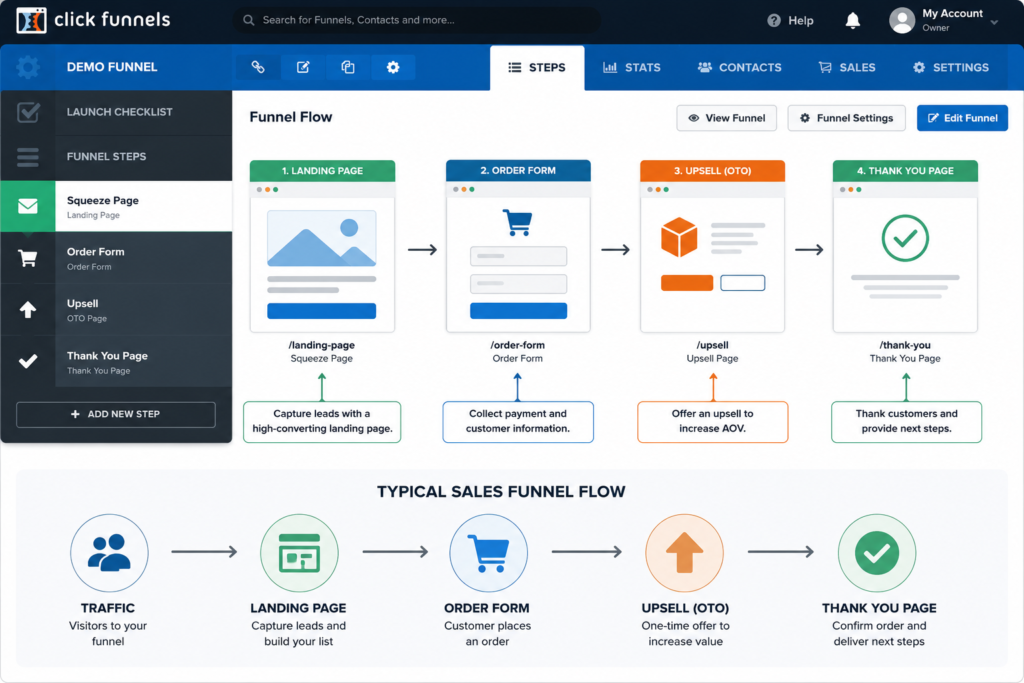
This is ClickFunnels’ home turf. The drag-and-drop editor is built specifically around conversion — pre-built funnel templates for webinars, product launches, tripwires, and membership sales are ready to customize in minutes. If your business lives and dies by sales funnels, ClickFunnels 2.0 still has the edge in template depth and funnel-specific features.
Kartra’s page builder is also drag-and-drop and genuinely easy to use, with solid templates of its own. It’s not quite as funnel-obsessed as ClickFunnels, but it’s more than capable for most landing pages, sales pages, and checkout flows — and it’s tightly integrated with Kartra’s other tools.
Email Marketing and Automation
Kartra pulls ahead here. It offers both one-off broadcasts and full automated sequences, with behavior-based triggers — for example, sending a different follow-up email to someone who watched 80% of a sales video versus someone who only watched 10%. That level of behavioral segmentation is genuinely useful for anyone selling through video sales letters or webinars.
ClickFunnels’ email features are more basic in comparison, focused on broadcasts and simpler automation rather than deep behavioral triggers. If sophisticated email automation is central to your strategy, Kartra currently has the stronger toolkit.
Courses and Membership Sites
If you’re building a course or membership business, this is worth paying close attention to.
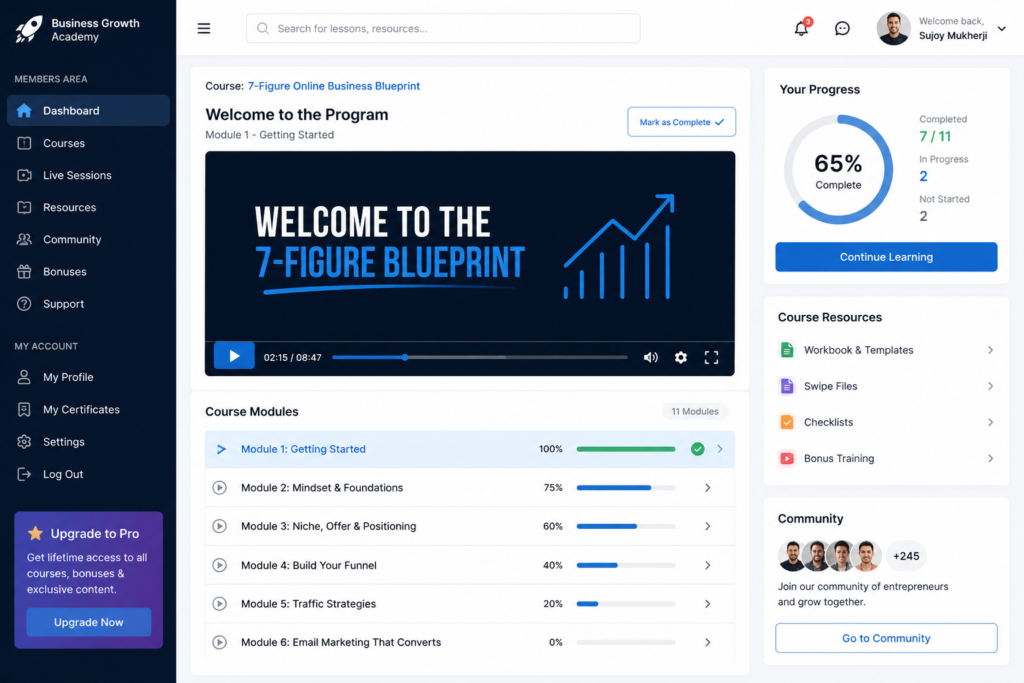
Kartra offers a fully featured membership portal, complete with content dripping, multiple membership tiers, progress tracking, and built-in video hosting — so you’re not paying separately for Vimeo or Wistia.
ClickFunnels 2.0 added its own course and community builder, and it’s improved a lot from earlier versions — you can host courses, run community discussions, and sell memberships with access control. That said, it still doesn’t match Kartra’s depth for multi-tier access and progress tracking. For creators who need serious course infrastructure, Kartra is the stronger pick.
E-commerce and Checkout
Since its 7.0 update, Kartra’s checkout system supports one-click transactions, flexible pricing models, and dynamic order bumps — giving it a more robust e-commerce toolkit. ClickFunnels’ checkout is solid and proven (it was, after all, built for selling), but its native e-commerce features are considered more basic by comparison.
Split Testing
Kartra currently offers broader A/B testing — you can test landing pages, email variations (up to four at once), and entire funnels. ClickFunnels limits split testing to individual pages, with only two variations at a time. If continuous optimization through testing matters a lot to you, Kartra has more room to experiment.
Support and Community
ClickFunnels has one of the largest and most active communities in the online marketing space — a real advantage if you like learning from other users, joining challenges, or following proven templates from well-known marketers. Kartra, on the other hand, includes a built-in help desk with ticketing, live chat, and a knowledge base — useful if you also serve clients and want support tools bundled into your own subscription.
ClickFunnels 2.0 vs Kartra: Which One Should You Choose?
Here’s the simplest way to break it down:
Choose ClickFunnels 2.0 if:
- Sales funnels are the core of your business
- You want access to proven, conversion-focused templates
- You value being part of a large, active marketer community
- You sell high-ticket offers, coaching, or run “funnel hacking” style campaigns
Choose Kartra if:
- You’re a course creator or coach who needs strong membership features
- You want built-in video hosting, a help desk, and deeper email automation
- You want more features at a lower starting price
- Advanced split testing and behavioral email triggers matter to you
Both platforms are mature, reliable, and capable of running a full online business. There’s no universally “better” option — it comes down to whether your business is funnel-first or course/membership-first.
Try ClickFunnels 2.0 Risk-Free
If sales funnels are your priority — and you want templates that are already proven to convert, plus a massive community of marketers to learn from — ClickFunnels 2.0 is hard to beat.
Right now, you don’t have to commit to a full monthly plan just to test it out. ClickFunnels is offering 3 months of access for just $99 — a fraction of the regular price — giving you a full quarter to build your funnel, launch your offer, and see real results before deciding if it’s the right long-term fit.
👉 Try ClickFunnels for 3 Months at $99 →
No guesswork, no long-term risk — just enough time to put your funnel to work and see what it can do for your business.
Affiliate Disclosure: This article may contain affiliate links. If you purchase through these links, I may earn a commission at no additional cost to you. I only recommend tools and platforms I believe can provide value to my readers.