If you’re wondering whether premium AI tools are worth it when you’re just getting started, you’re not alone — it’s one of the most common questions new solopreneurs, freelancers, and small business owners ask before they’ve made a single dollar online. The honest answer isn’t a flat yes or no. It depends on what you’re trying to do, how fast you need results, and whether the free version of a tool is actually holding you back — or just missing a few extras you don’t need yet.
This article breaks down exactly when paying for premium AI tools makes sense, when it’s a waste of money, and how to make the call for your own situation.
Table of Contents
What “Premium AI Tools” Actually Means
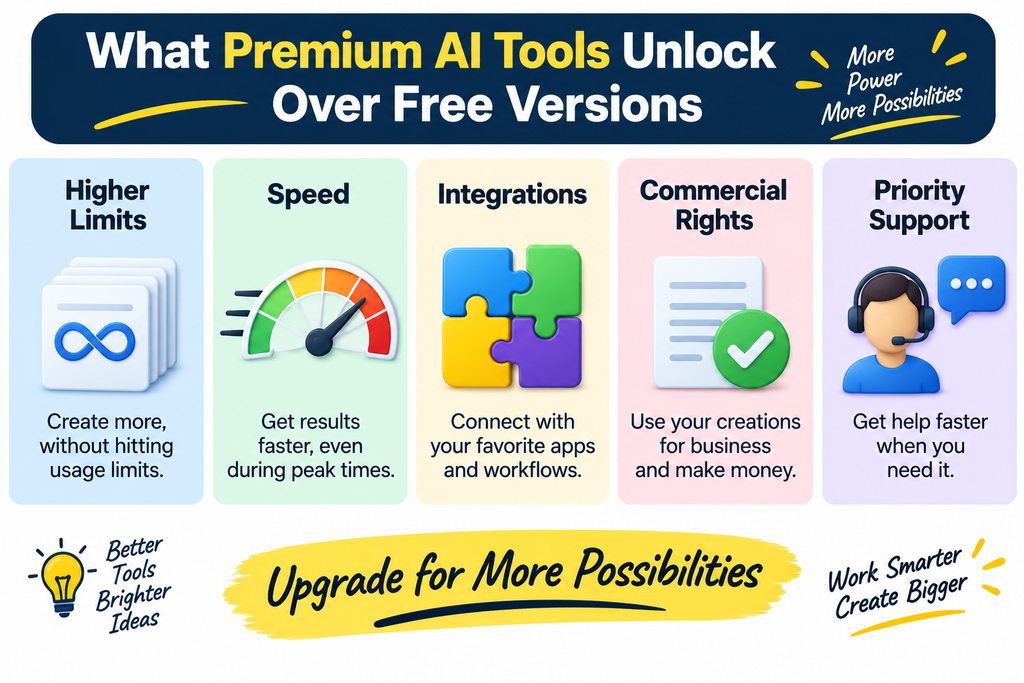
Before deciding whether premium AI tools are worth it, it helps to know what you’re actually paying for. Most AI tools — writing assistants, chatbots, image generators, automation platforms — use a freemium model. The free tier gets you in the door; the paid tier usually unlocks:
- Higher usage limits (more words, images, or requests per month)
- Faster processing and priority access during busy periods
- Advanced features like custom training, integrations, or team seats
- Commercial usage rights (a big one many beginners miss)
- Better support when something breaks
None of that is inherently “worth it” on its own. It’s only worth it if one of those limits is actually stopping you from doing something you need to do right now.
The Case for Starting Free
If you’re just starting out, there’s a strong argument for squeezing every bit of value out of free tools first:
- You don’t know your workflow yet. Paying for a premium plan before you know how you’ll actually use a tool often means paying for features you never touch.
- Free tiers have gotten genuinely good. Tools like ChatGPT’s free tier, Canva’s free plan, and Google’s AI features cover a huge range of beginner needs without costing a cent.
- Cash flow matters more early on. Every subscription is a fixed cost you’re committing to before you’ve proven the business model works.
- Free tools force discipline. Working within limits often pushes beginners to get clearer on what they actually need, instead of drowning in features.
The mistake isn’t staying free too long — it’s staying free after the limits are visibly costing you time or money.
When Paying for Premium AI Tools Actually Makes Sense
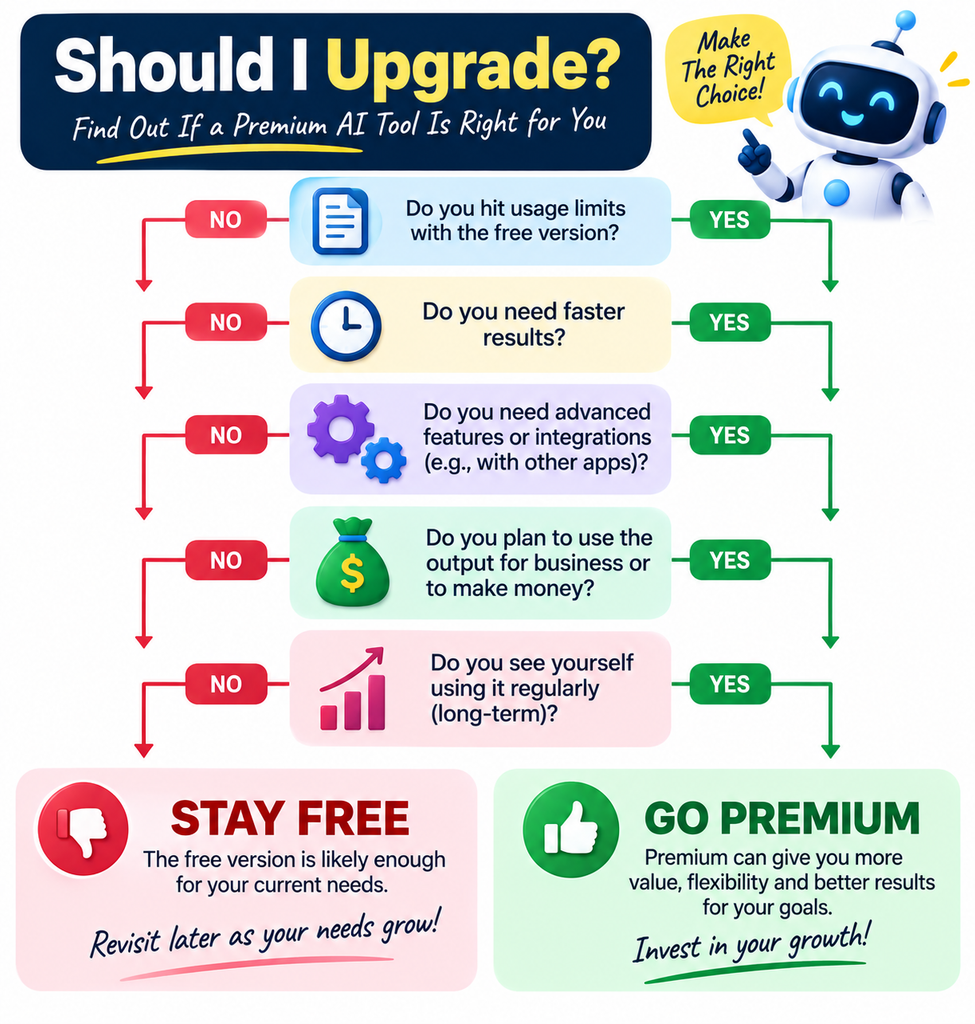
There’s a tipping point where premium AI tools stop being a luxury and start being the cheaper option. Watch for these signals:
1. You’re hitting usage caps every week. If you’re constantly running out of credits, words, or generations before the month resets, you’re losing productivity — and time is money even before you’re profitable.
2. You need commercial rights. Many free AI image and content tools restrict commercial use. If you’re publishing content, selling products, or running ads with AI-generated assets, skipping the paid tier can create real legal risk.
3. The tool directly drives revenue. If an AI tool is generating leads, writing sales copy, or automating a task that would otherwise cost you hours (or a freelancer’s invoice), the ROI math changes fast. A $30-$50/month tool that saves 10 hours a month is rarely a bad deal.
4. You’re duplicating effort across multiple free tools. Sometimes beginners stitch together three or four free tools to replace one paid tool’s functionality — and end up spending more time (and losing more quality) than if they’d just paid for the single premium option.
5. Support and reliability actually matter to your business. If downtime or a bug in a free tool means a client-facing deliverable is late, that’s a business cost, not just an inconvenience.
Free vs. Paid: What You’re Really Comparing
When people ask if premium AI tools are worth it, they’re often comparing the wrong things. It’s not “free tool vs. paid tool” — it’s “the cost of the subscription vs. the cost of your time, missed opportunities, or lower-quality output.”
A few honest comparisons worth making before you upgrade:
- What would it cost to hire someone to do this manually? Compare that to 12 months of the premium plan.
- How many hours per month does the free version’s limitations cost you? Multiply that by what your time is worth.
- Is there a mid-tier plan that solves the specific limitation, instead of jumping straight to the most expensive tier?
Most beginners overpay by jumping to the top-tier plan of a tool when a $9-$20/month starter plan would solve the actual bottleneck.
A Simple Framework for Deciding
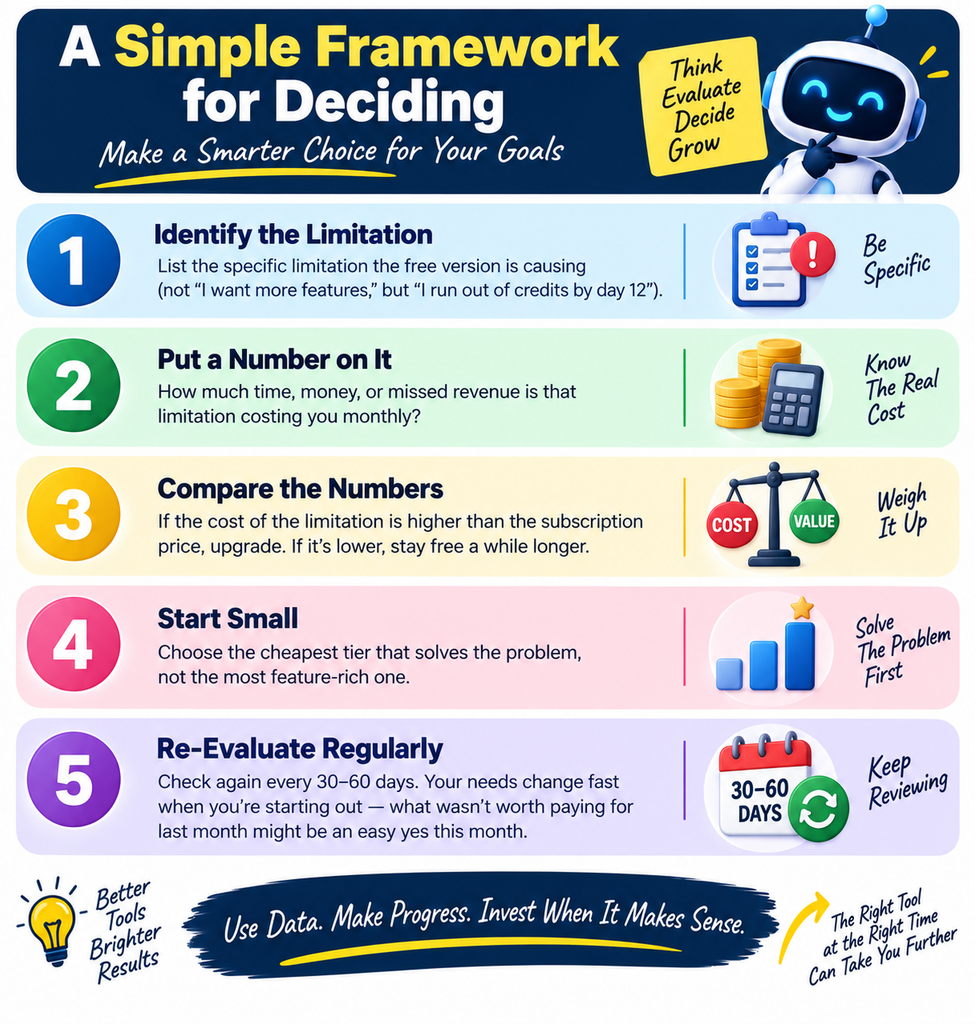
Here’s a practical way to think it through before you pull out your card:
- List the specific limitation the free version is causing (not “I want more features,” but “I run out of credits by day 12”).
- Put a number on it. How much time, money, or missed revenue is that limitation costing you monthly?
- Compare that number to the subscription price. If the cost of the limitation is higher than the plan, upgrade. If it’s lower, stay free a while longer.
- Start with the cheapest tier that solves the problem, not the most feature-rich one.
- Re-evaluate every 30-60 days. Your needs change fast when you’re starting out — what wasn’t worth paying for last month might be an easy yes this month.
Common Mistakes Beginners Make
- Upgrading out of FOMO, not because of an actual bottleneck.
- Buying annual plans immediately before confirming the tool fits the workflow.
- Stacking multiple premium subscriptions for tools that overlap in function.
- Ignoring one-time-purchase alternatives. Some AI tool bundles are sold as a single one-time payment instead of a recurring subscription — often a better fit for beginners who want premium features without an ongoing monthly bill eating into thin early margins.
That last point is worth sitting on for a second. If your hesitation about premium AI tools is really about recurring costs rather than the tools themselves, a one-time-payment bundle can solve that specific problem — you get the premium feature set without adding another monthly line item to your budget while you’re still finding your footing.
One example worth a look: the Agent Jarvis AI Bundle packages premium-level AI business agent features — automation, content, and outreach tools that would normally live behind a monthly subscription elsewhere — into a single one-time purchase. For beginners specifically trying to avoid stacking recurring costs before revenue is coming in, that pricing structure is worth comparing against the subscription tools you’re currently eyeing.
The Bottom Line
So — are premium AI tools worth it if you’re just starting out? Usually not on day one. Start with free tools, learn your actual workflow, and let real bottlenecks — not shiny features — decide when to upgrade. Once a specific limitation is costing you more in time, quality, or missed revenue than the subscription costs, paying stops being a luxury and starts being the obviously cheaper option.
If a recurring subscription feels risky this early on, keep an eye out for one-time AI tool bundles — like the Agent Jarvis AI Bundle — that give you premium-level features (automation, AI agents, content generation) without a monthly bill. They can be a lower-risk way to test whether “premium” actually moves the needle for your business before you commit to an ongoing cost.
And if you’re still mapping out which tools you actually need before spending anything, the Lean Business OS checklist is a useful free first step — it walks through exactly this kind of tool-by-tool decision so you’re not upgrading on guesswork.